Math · Grade 1–2 to Grade 7–8
How many do you think?
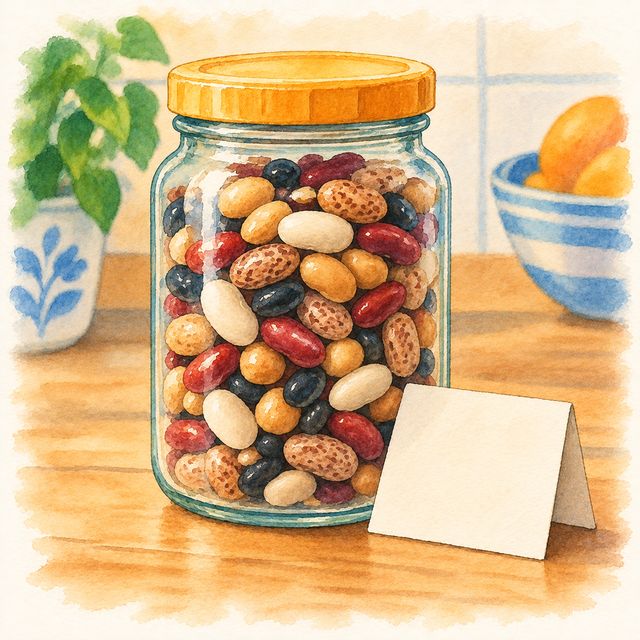
A feel for how big a number is, and that a guess can be off and still be useful.
A picture shows a lot of something. Your child says a number that is surely too few, one that is surely too many, and their best guess, then sees the real count on a number line beside the Pet's guess.
- Grade 1–2 to Grade 7–8
- 10 min
- Nothing to prepare
- On the screen
Free to sign up.
Is it a good fit?
- Ready if Your child can count to thirty and knows which of two numbers is bigger.
- Too much today? Start with How many?: seeing a number at a glance in a ten frame before guessing a jar.
- Too easy? The Grade 7–8 level: a big jar from a small one, a field from one patch, a rate over an hour, and the percent off.
What your child practises
- Estimating
- Too few, too many, just right
- Building from ten
- How far off
“Ten, twenty, thirty. About thirty, so not a hundred.”
If your child says something like this, in their own words, the idea has landed. Finishing the rounds means they took part; this is the learning.
Your part
- Nothing to prepare for the screen
- Each question has a Read it to me button
- At the youngest level a grown-up nearby helps: the numbers are tapped on a line
Take it off the screen (optional)
Count a jar at home together once, then let your child guess it next time before you say.
More like this
The full design
What it is
A picture of a lot of something, three numbers from your child, and the real count shown last. Your child says a number that is surely too few, a number that is surely too many, and then the guess they believe. Being off is normal here: the Pet guesses too, and is often further off. What grows is a feel for how big numbers are.
How it goes
The picture comes up. Your child gives a too-few number, a too-many number, and their real guess between them. The Pet gives its own. Then the real one is shown: the jar counted a ten at a time, the rulers or cups laid out one by one. Every number lands on one number line, with a "close enough" band round the real one, wide for the youngest and narrower as the child grows. Three pictures, then a card that says what was guessed.
The Pet
It says each number back as your child sets it. It notices a near miss: "You said 25. It was 28. 3 away: close enough!" When your child is stuck it asks one question ("how many tens like the ringed one would fill it?"), then points at where to tap, and at the youngest level it says the step with them but never picks a number for them. Its own bad guesses ("I said 100. Way off!") are the point: a guess can be off and still be useful. When a guess comes closer than the one before, it says so.
By band
1–2: a jar of up to about 30 things, and each number is tapped on a number line, never typed. 3–4: up to about 200, with ten of them ringed so the guess can be built from tens; numbers are typed. 5–6: how long a table is, how much a jug holds and how heavy a melon is, with one ruler, one cup or one bag of sugar drawn beside it to go by, in your family's units; then how far off the guess was. 7–8: a big jar from a small one someone counted, a field of daisies from one counted patch, and how many drips a tap makes in an hour; then how many percent off the guess was.
What it grows
Estimation routines that ask for a too-low, a too-high and a just-right number, with the answer shown last, are a daily habit in many maths classrooms, and the number sense built this way carries into every later topic. The reveal after the guess is what makes the number stick.
Done, and what counts as evidence
Done means three estimates made. No score is kept and no accuracy is tracked anywhere. If you want a note in the records, write what you saw in your own words: "guesses within about a tenth now", or "started using the ten to build the guess".
What's personal
The jars on the screen are drawn for each age. The best version is your own: count your pasta jar or brick box once, and let your child guess it before you tell them. Lengths, jugs and weights are in your family's units.