Five steps
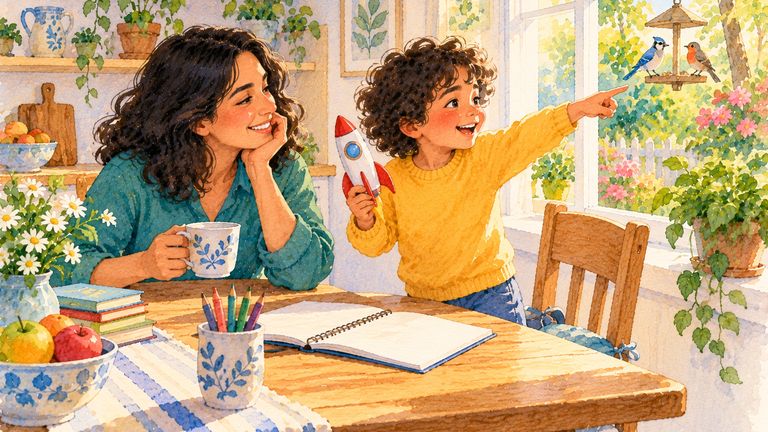
1Set up in three questions
Tell Edora your child's first name, their grade and two things they love. Edora puts five activities on the next five weekdays, each with the reason it was picked. Swap any of them, then save.

2The week on your child's plan
Each activity sits on your child's plan, on a day or anywhere in the week. Move one, drop one, or add your own, like a trip to the library on Friday or baking twice a week, and start the next week from this one. The family calendar shows every child's week and their classes, and can go on your phone's calendar.
3Your child plays and reads, with their Pet
Your child opens their day in kid mode on the family's device, or on their own device with a pass you give them. Their Pet sits beside each game and storybook: it notices what they did, asks a question when they are stuck, and cheers the finish. Many activities happen away from the screen, at the table or in the garden.
4The people around you help
Invite a grandparent, a neighbour or a tutor as a helper, for one child or several in one invitation, and they see only what you allow. Grandma can read a storybook with your child from her own phone, far away, and point at the picture. A small class gives your child time with other children.
5What happened is kept
Finished activities, a tap on how each one went and the notes you add are kept as you go, and your child tells their Pet how it was with three pictures. At the end of the week Edora looks back in two sentences and offers one idea for the next, which you can take or set aside.


The research behind it
MyEdora is built so that technology brings the family in instead of replacing it. Each finding below is stated as its study measured it, with its limit. No study of MyEdora itself exists yet.
The family takes part
A review of 51 studies found that children whose families are involved in their learning earn higher grades and test scores, across every income and background.
What the study does not show
The studies show a link, not proof of cause, and were of school-age children.
Every storybook page asks a question
When the grown-up reading asks the child questions about the story, children learn more words than when the story is only read to them: a moderate gain in the words they use themselves (d = 0.59). A 2026 review of 64 studies with 10,463 children found a large effect on early reading (g = 0.76).
What the study does not show
The gain was smaller for four- and five-year-olds and for children at risk of language delays.
Sources: Mol and others, Added Value of Dialogic Parent-Child Book Readings (2008) · Effects and moderators of dialogic reading (2026)
Play with a grown-up's part
Across 39 studies of children aged 1 to 8, play with some adult guidance helped children learn early maths and words for shapes and space better than free play or direct teaching.
What the study does not show
How guided play was run differed from study to study.
The Pet asks before it tells
Recalling something before being told it again helps it stick. In a review of 50 classroom experiments with 5,374 students, from primary school up, 57% of the effects were medium or large.
What the study does not show
These were classroom studies, not studies at home.
Sources: Agarwal, Nunes and Blunt, Educational Psychology Review (2021)
Grandma reads along, live
Toddlers learned new words from a person on a live video call but not from a recorded video. Grandparents who read with grandchildren on video calls felt closer to them, and children paid more attention when they had their own copy of the book.
What the study does not show
These were small studies of young children.
Sources: Myers and others, Baby FaceTime (2017) · Roseberry and others, Skype Me! (2014) · Strouse and others, Zooming through development (2021)
Time with other children
Homeschooling families name too little time with other children as their biggest ongoing challenge: 44% said it affected them moderately or a great deal.
What the study does not show
This is what families report, not a measured outcome.
The Pet is a guide, not a tutor
AI tutors raised learning in trials with university students at Harvard and with secondary school students in Nigeria.
What the study does not show
Both were older learners. Evidence for AI tutoring of children aged 4 to 14 is thin, so the Pet does not teach: it notices, asks and cheers, and you decide.
Sources: Kestin and others, Scientific Reports (2025) · The World Bank in Nigeria, via VoxDev
What MyEdora does not do
- No ads, anywhere.
- No rankings, leaderboards or public profiles for children.
- No adult can open a chat with your child.