Math · Kindergarten to Grade 5–6
Cover without gaps
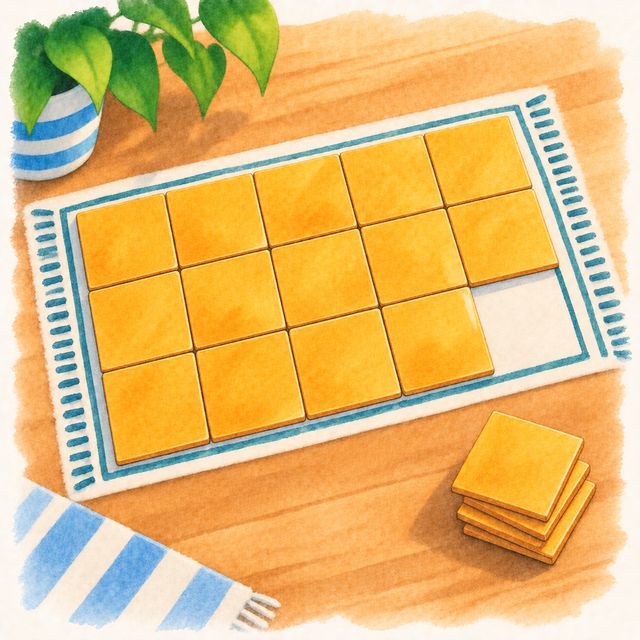
Same tiles, new shape: your child sees what area means.
Your child covers a card with blocks on the table, with no holes and no piles, then shows the Pet on the screen. They move the same tiles into a new shape and say what stayed the same and what changed.
- Kindergarten to Grade 5–6
- 15 min
- A printout
- On the screen
Free to sign up.
Is it a good fit?
- Ready if Your child can count six blocks and lay them side by side.
- Too much today? The Kindergarten level: six tiles on the Pet's bed, then the same six as a new shape.
- Too easy? The Grade 5–6 level: a card half hidden under a book, half tiles, and an L-shape cut into two rectangles.
What your child practises
- Covering with no gaps
- Counting in rows
- Same area, different shape
- The edge round a shape
“Same tiles, new shape, still twelve.”
If your child says something like this, in their own words, the idea has landed. Finishing the rounds means they took part; this is the learning.
Your part
- A piece of card, like a cereal-box side, and a dozen or more blocks or squares all of one size
- Each question has a Read it to me button
- Plays alone; at Kindergarten a grown-up holds the card still
Take it off the screen (optional)
Cover a book or the placemat with blocks, then move the same blocks into a new shape.
More like this
The full design
What it is
Cover a card with tiles so there are no holes and no piles. Then move the same tiles into a different shape. The number of tiles never changes, however the shape does, and that is what area is: how much a thing covers, not what shape it makes. At the older rungs the edge round the shape becomes the second thing to look at, because it does change.
How it goes
First the real thing: your child covers the card with blocks on the table, every bit covered, nothing on top of anything, and taps "covered it". Then the screen: tap every square of the card that was covered, and Check; a missed square glows and the Pet says "one hole". Then "make a different shape with the same twelve tiles", tapping squares anywhere on the board. Then "what stayed the same?" and "what changed?" with two or three answers each. At 3–4 a guess about the edges, and the Pet walks round both shapes counting tile-edges. Two arrangements of the same tiles is a round.
The Pet
Notices: "you moved the tiles without adding any, same tiles, new shape." Asks on a miss: "one hole, is every part covered exactly once? Look at that join." Remembers (3–4): "your long shape, can the same tiles make a shorter edge?" Dares: a card with a corner missing, played now at 3–4.
By band
K: cover the Pet's bed (a small card) with six tiles, then the same six as a new shape. 1–2: a bigger card in rows, count by rows ("three rows of four"), then the same twelve as a new shape and "what stayed the same?" 3–4: two shapes from the same tiles, guess which has the longer edge round it, then the Pet walks both edges and counts. 5–6: a card you cannot see all of (40 tiles in 5 rows, how long is a row?), half tiles, and an L-shape cut into two rectangles.
What it grows
Area is learned by covering before it is a number to multiply, and the idea children find hardest, that a longer shape is not "more", is only seen when the same tiles are moved by hand. Guided play with shapes, a grown-up naming what stayed the same, beats being told.
Done, and what counts as evidence
Done = two arrangements of the same tiles. Photos of both are the work sample; at 3–4 the guess about the edges, and whether the count agreed, is an observation a parent may note. This game is not Build my room: that one measures a room; this one keeps an area the same while the shape changes.
What's personal
The card can be a real thing in the house, a book cover, the placemat, the Pet's bed; the tiles are the family's blocks. Photos of the two arrangements are the record.