Math · Kindergarten to Grade 5–6
Bundle builders
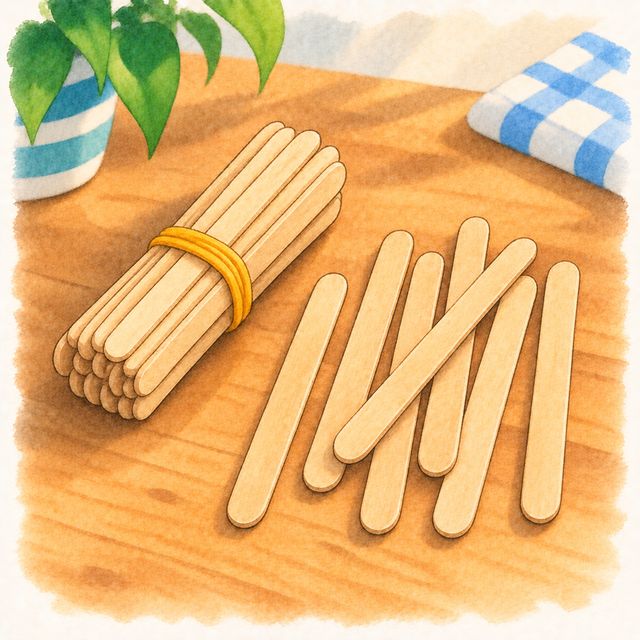
Ten loose sticks and one bundle of ten are the same ten.
Your child makes an amount with real sticks at the table, bundled in tens, then shows the Pet on the screen. They make the same amount a second way and see that no sticks came or went.
- Kindergarten to Grade 5–6
- 15 min
- A printout
- On the screen
Free to sign up.
Is it a good fit?
- Ready if Your child can count ten sticks, touching each one once.
- Too much today? Start with How many?: seeing ten as two rows of five before bundling it.
- Too easy? The Grade 5–6 level: a bundle is one and a stick is a tenth, so 1.7 and 1.5 are added by banding ten tenths.
What your child practises
- Tens and ones
- Same amount, bundled differently
- Trading inside a sum
- Tenths
“It's still ten, just with a band on.”
If your child says something like this, in their own words, the idea has landed. Finishing the rounds means they took part; this is the learning.
Your part
- About forty craft sticks, straws or pencils, and elastic bands or paper sleeves that a grown-up puts on and keeps from younger siblings
- Each question has a Read it to me button
- With you at Kindergarten; from Grade 1–2 your child builds alone and you do the banding
More like this
The full design
What it is
Ten loose sticks and one bundle of ten are the same ten sticks. Your child makes an amount with real sticks, changes how it is bundled, and sees that nothing came and nothing went. That is what tens and ones mean, and later what tenths mean: the same amount written in bigger or smaller pieces. The screen only asks your child to show the Pet what the table did.
How it goes
A card shows the exchange a grown-up does first, on a different amount, so your child sees one before doing their own. Your child builds theirs at the table, then taps "we did ours" and shows the Pet: tap sticks and bundles onto a board until the total matches, then on a second board the same amount another way, with a Band ten or an Open one tap. Then "did any sticks come or go?" with three answers. The Pet opens one bundle on the screen so the ten inside show, and folds it back. One exchange shown two ways is a round.
The Pet
Notices: "one bundle open, ten loose, still 34." Asks: "a band needs ten loose, you have four." Admits when tapped: "I lost count, let us count the loose ones together." Dares at 1–2: ten bundles into a box, played now.
By band
K: ten loose sticks, a grown-up bands them, "is it still ten?" 1–2: show 34 as bundles and sticks, then the same 34 a different way; then ten bundles into a box of a hundred. 3–4: the exchange inside a sum, 34 and 18 (band ten when you can), and 52 take away 7 (open a bundle when you must). 5–6: the same sticks with a new rule, a bundle is one and a stick is a tenth, so 1.7 and 1.5 are added by banding ten tenths.
What it grows
Place value is learned as exchange with things in the hand before it is read off digits, and a worked example on a different amount, seen first, helps more than being left to discover the trick. The grown-up does the banding: elastic bands and small fasteners are kept from younger siblings.
Done, and what counts as evidence
Done = one exchange shown two ways. A photo of the two arrangements on the table is the work sample; at 3–4 the sum is an observation a parent may note. Nothing counts errors, and nothing says "weak at place value".
What's personal
The sticks are whatever the house has: straws, pencils, spoons. The amount can be your child's age or the house number once the family's memories reach the games.