Math · Kindergarten to Grade 1–2
How many?
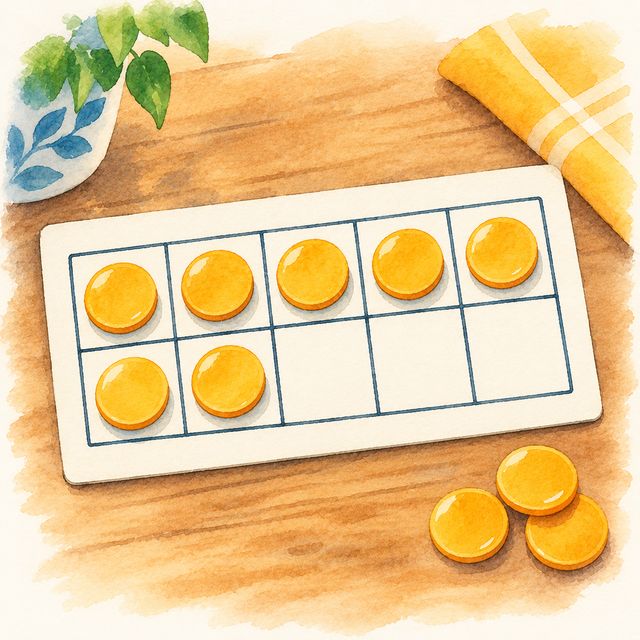
Seeing seven at a glance, without counting one by one.
Snacks sit in a ten frame, two rows of five, and your child says how many without counting one by one. Then they fill the frame to make a number and find how many more make ten.
- Kindergarten to Grade 1–2
- 5 min
- Nothing to prepare
- On the screen
Free to sign up.
Is it a good fit?
- Ready if Your child can count ten things, touching each one once.
- Too much today? Start with Snack count: counting real snacks out before seeing them in a frame.
- Too easy? The Grade 1–2 level: a second frame for the teens, and how many more make twenty.
What your child practises
- Seeing a number at a glance
- Building a number
- Making ten
“Five and two, that's seven.”
If your child says something like this, in their own words, the idea has landed. Finishing the rounds means they took part; this is the learning.
Your part
- Nothing to prepare or print
- Each question has a Read it to me button
- Plays alone or with you nearby: a wrong number is greyed, never marked, and the Pet says where to look
Take it off the screen (optional)
Lay the same number out on the table with ten real things: buttons, grapes or coins.
More like this
The full design
What it is
A ten frame is two rows of five boxes. Snacks sit in it, and your child says how many without counting one by one: a full row is five, so five and two is seven at a glance. The same frame is then used to build a number and to see how many more make ten. Seeing numbers as "five and some" and "ten and some" is the foundation that adding and subtracting later rest on.
How it goes
Five rounds. The Pet asks "how many snacks?" and a frame shows some; your child taps the number on a keypad. Then "make 6 snacks for Ziggy": your child taps empty boxes to fill them and presses Check. Then "8 and how many more make 10?": the answer pops into the empty boxes one by one, in a second colour, and the sum fills in above the keypad. A tap on the wrong number greys it and the Pet says where to look next, never "wrong". Left alone, the Pet asks a question, then glows the answer, then taps it with the child. At the end a card says what was played. On odd days the snacks sit in columns and on even days in rows, so a return looks new.
The Pet
Asks: "just look, do not count yet", and on a teen: "the top frame is full, that is ten, ten and how many more?" Notices how the child saw it: "five and two, that is how I see seven too." When it tapped the answer with the child it says so: "4. We found it together." Dares (K): "bet you can do it with two frames next time."
By band
K: one frame, numbers to ten; see it, build it, make ten. 1–2: a second frame for the teens ("ten and three"), building sixteen across the two frames, and how many more make twenty.
What it grows
Subitizing (seeing a small number without counting) and the "five and some" structure of the ten frame are how number sense is taught before digits; number bonds to ten and then twenty come from the same picture. The game follows that order: see it, build it, make ten.
Done, and what counts as evidence
Done = five rounds. The card at the end says what your child looked at, built and made this time; the line for you under the lock says which skill it was. What is worth noticing at the table: whether the top row is counted one by one or seen as five.
What's personal
The snacks are the Pet's, in the Pet's own colour, and the build round asks for them by the Pet's name. Nothing is typed and nothing is kept beyond the round.