History · Pre-K to Grade 5–6
The one-shelf museum
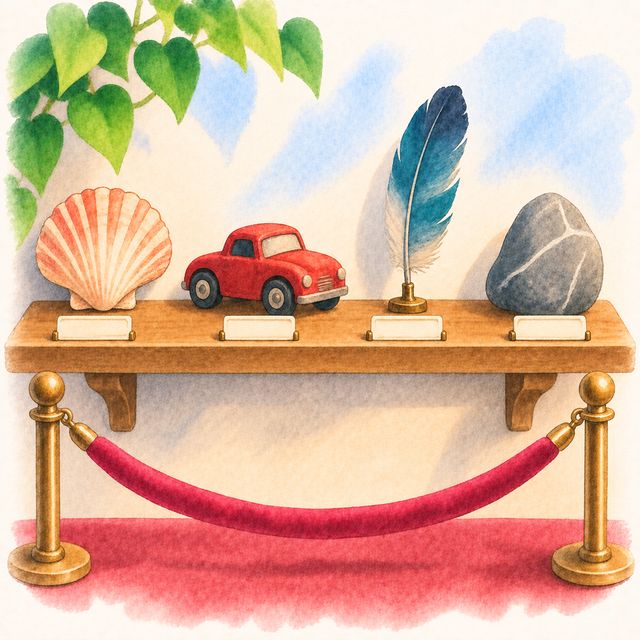
A museum on one real shelf, and a visitor who learns from it.
Your child makes a tiny museum on one shelf about a single question, with labels, and someone in the family visits it. Then they change one label so the story lands, and lay the shelf out on the screen for the Pet.
- Pre-K to Grade 5–6
- 20 min
- A printout
- On the screen
Free to sign up.
Is it a good fit?
- Ready if Your child can pick one thing and listen to its story.
- Too much today? Start with My day in order: putting the day's pictures in order, before choosing what to show.
- Too easy? The Grade 5–6 level: a date and a place on every label, the right way to date a copy of something very old, and whose side of the story is missing.
What your child practises
- Choosing what matters enough to show
- Writing a label for a reader
- Where a thing came from and when
“Grandma was there, so she doesn't need that label. My friend does.”
If your child says something like this, in their own words, the idea has landed. Finishing the rounds means they took part; this is the learning.
Your part
- One to five safe things from around the house, paper and a pencil for the labels; keep sacred, fragile and valuable things in the drawer
- Be the visitor, or bring one, and say what story you got
- At four, tell the story of the thing together
- Each question has a Read it to me button
- The screen draws the shelf as plain shapes and never learns what your things are
Take it off the screen (optional)
At a real museum, find one label that told you what you needed, and one that did not.
More like this
The full design
What it is
Make a museum on one shelf about one question, then let someone visit it. What your child chooses to put out, and what they leave in the drawer, decides what the visitor can learn; the labels decide whether they learn it. Museums are made this way, by someone choosing, and a child who has done it once reads every museum differently.
How it goes
The Pet asks for a tiny museum about one question. Your child chooses the things, sets them out and labels them. The visitor walks the shelf and says what story they got. Your child adds or changes one label so the story lands. Then they lay the shelf out on the screen, as simple drawn shapes, not photos, and the Pet visits it in the order the child chose. One shelf is a round.
The Pet
It notices: "you chose that because it helps tell this story." It asks: "what would a visitor learn from this one?" It remembers: "last time the key had no label. What will today's visitor need?" Its dare: "bet you can add the thing that is missing from the story."
By band
Pre-K: one thing on the shelf and the story you tell about it. K: two things, and the child picks the one that tells the story better. 1–2: three things that answer one question, "what did we do last summer?", each with a label the child says, draws or writes. 3–4: two different visitors, Grandma and a friend from school: what would each one need explained? 5–6: where each thing came from and when, a date on every label, and whose side of the story is missing from the shelf; if a copy of something ancient is out, the right way to write its date.
What it grows
Deciding what matters enough to show is one of the ideas that make history a way of thinking, and a child can practise it at four with one shell and a story. A real visitor who says what they understood is the honest test of a label, better than any mark.
Done, and what counts as evidence
Done means one shelf visited. The plan of the shelf and the label your child changed make a work sample. This sits beside Detective of the past: that one asks what a single thing can tell you; this one asks what to show, and what to leave out.
What's personal
All of it: the things are your family's and the question is your child's. Keep sacred, fragile and valuable things off the shelf. The app keeps the drawn shelf, as plain shapes in your child's order, and which label changed, never a list of what your family owns, and nothing is shared.