History · Pre-K to Grade 5–6
Time capsule
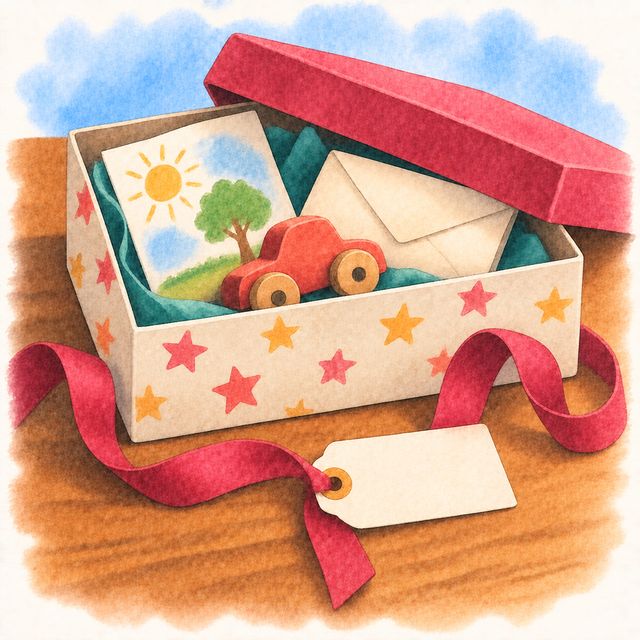
A box for next year, and proof of what changed.
Your child fills a real box for next year with a favourite thing, a hand outline and their height, while the screen fills a matching box. They seal it, and a year later the Pet asks them to guess what's inside before opening it.
- Pre-K to Grade 5–6
- 20 min
- A printout
- On the screen
Free to sign up.
Is it a good fit?
- Ready if Your child can choose a favourite thing and hold still while you trace their hand.
- Too much today? Start with Every year: the year as a wheel of your family's own days, with no guessing ahead.
- Too easy? A letter to next-year self, one sealed guess with the thing that will check it, and a stranger reading the box to find what it does not say.
What your child practises
- Guessing the future
- Change over time
- Checking a guess against evidence
“I said I'd be taller than the door handle, and I am!”
If your child says something like this, in their own words, the idea has landed. Finishing the rounds means they took part; this is the learning.
Your part
- A box or a jar, paper and pens; a tape measure from about six; a shop receipt and a newspaper from about ten
- Trace the hand or mark the height, and at ten be the reader who was not there
- The closed box stays in your house; the list and the month are on your child's Pet memory page, where you can erase them
- A few minutes again, one year later
- The screen reads every question aloud
Take it off the screen (optional)
Open the box together a year later, and see which guesses came true.
More like this
The full design
What it is
Make a box for the you of next year, seal it, and open it in a year to see what changed. It is the self in time: a guess about the future, sealed, and then the evidence. And it is the Pet keeping a promise across a whole year, which is the longest memory in any of these games.
How it goes
The screen asks for one thing at a time and waits while it goes in the real box: the favourite, the hand, the guesses from a short list, the height on a card. The box on the screen fills as the real one does, with its lid open so your child sees everything go in. Then the seal: the screen names the month one year from now, your child writes it on the real box, and the lid closes. Open the game before that month and it only asks whether the box is still safe. From that month on, the Pet says "one year ago you put a box away", asks your child what they think is inside before it opens, and only then reveals it; each guess is tapped as true or not, and the ones that did not come true are the best part.
The Pet
It notices what went in ("your teddy, in it goes, for next-year you"). At the opening it asks: you said you would be taller than the door handle; are you? It remembers, a year on, because your child told it what went in: the list and the month sit on your child's Pet memory page, where you can read or erase them. Erasing only stops the Pet asking; the box itself never leaves your house. Its dare at the opening: bet one of your guesses surprised you; which?
By band
Pre-K: tap your favourite thing and trace your hand for the box. K: add "when I'm bigger I will…". 1–2: three things you think will be true next year, and your height today on a card. 3–4: spot the guess nobody could ever check, then one guess about the world and one about home, and this year's history in five events, written on paper. 5–6: a letter to next-year you on paper, one sealed guess and the thing in the box that will check it, and a small pack for a stranger in the future: a shop receipt, today's headline, a drawing of your room; then someone who was not there looks in the box and says what they cannot tell from it, and your child adds only that label.
What it grows
Change over time in a child's own life is the first history a child can check for themselves: the hand outline that no longer fits, the prediction that came true or did not. Guessing before the box opens, then seeing, is how memory is strengthened and how a child learns that the past is checked against evidence, not just remembered.
Done, and what counts as evidence
Done twice: the box sealed, and a year later the box opened. The sealed list with its "open on" date is a work sample; the opening's "were you right?" is an observation in your child's words.
What's personal
All of it, and it is your child's. The closed box stays in your house; the month and the list of what went in are kept as something your child told the Pet, which you can read and delete. Nothing is photographed or recorded: the hand is traced on paper and the height is marked on a card, and its number never goes into the app. A photo of the closed box is a later option, once the family's photo controls arrive.