Science · Grade 1–2 to Grade 7–8
A marble run
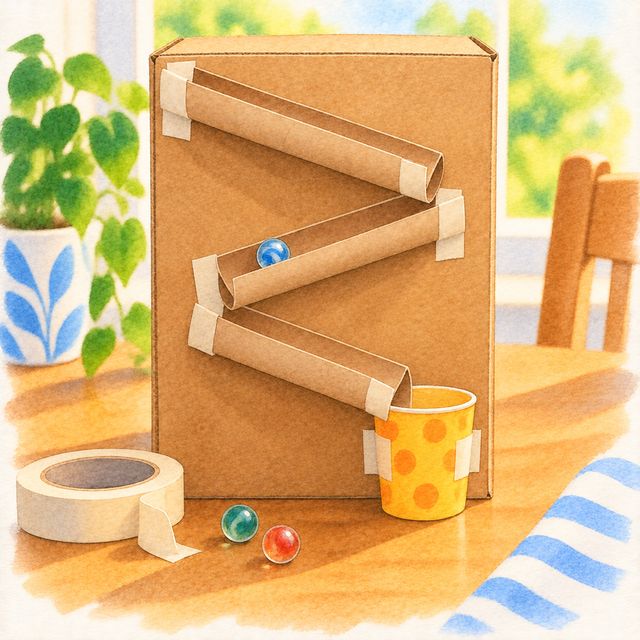
A marble run your child built and fixed until the marble lands in the cup.
Your child tapes cardboard chutes in a zigzag down a tall box and tests it with a marble, changing one thing at a time until it works. At 5–6 they time it; at 7–8 they slow it to ten seconds.
- Grade 1–2 to Grade 7–8
- 50 min
- A printout
- On the screen
Free to sign up.
Is it a good fit?
- Ready if Your child can tear and stick masking tape and drop a marble into a chute.
- Too much today? The 1–2 level: build it and fix it until the marble reaches the cup.
- Too easy? The 7–8 level: at least ten seconds, and still in the cup.
What your child practises
- Testing and fixing
- Changing one thing at a time
- Measuring a result
“It flew off at the corner, so I added a tape wall.”
If your child says something like this, in their own words, the idea has landed. Finishing the rounds means they took part; this is the learning.
Your part
- Save a tall box and four or five cardboard tubes, and buy a few marbles
- Cut the tubes and the card walls at 1–2
- Keep the marbles away from a toddler
What you need
From home
- A tall cardboard box, and some thin card like a cereal box
- Four or five cardboard tubes from kitchen roll or wrapping paper
- Masking tape and scissors
- A paper cup
- Paper, a pencil and a stopwatch or a phone timer, for the plan and the timing from 5–6
From a local store
- Three marbles (small parts)
The steps
Grade 1–2
 Squeeze one end of each tube flat. Snip into both folds, then cut straight along to the far end. Tape a square of card across one end of each chute. (A grown-up does this step)
 Squeeze one end of each tube flat. Snip into both folds, then cut straight along to the far end. Tape a square of card across one end of each chute. (A grown-up does this step)
The other 4 steps, each with its painting, are in the Family portal.
It must pass: The marble reaches the cup.
Grade 3–4
- Squeeze one end of each tube flat. Snip into both folds, then cut straight along to the far end. Tape a square of card across one end of each chute.
The other 4 steps, each with its painting, are in the Family portal.
It must pass: The marble reaches the cup three times in a row, and if it failed, you changed one thing at a time.
Grade 5–6
- Draw your run on paper first: where each chute goes, how steep it is, and where each one overlaps the next. Mark where the marble might fly off.
 Draw your run on paper first: where each chute goes, how steep it is, and where each one overlaps the next. Mark where the marble might fly off.
The other 5 steps, each with its painting, are in the Family portal.
It must pass: The marble reaches the cup, and you timed it before and after one change.
Grade 7–8
- Draw your run on paper first: where each chute goes, how steep it is, and where each one overlaps the next. Mark where the marble might fly off.
The other 5 steps, each with its painting, are in the Family portal.
It must pass: The marble reaches the cup and takes at least ten seconds.
Safety
Marbles are small enough for a toddler to swallow: keep them in the cup and the cup out of a small child's reach. At 1–2 you cut the tubes and the card walls; from 3–4 your child uses scissors beside you. Stand the box against a wall so it cannot tip.
Where the facts come from
More like this
The full design
What it is
Cardboard tubes cut in half the long way, each with a card wall at one end, taped in a zigzag down the front of a tall box standing against a wall, each chute reaching past the end of the one above it, with a paper cup at the bottom. A marble set at the top must reach the cup, and when it flies off, one thing is changed and it is tested again. The screen gathers the things, shows one step at a time as a painting of that step, and asks at the end.
How it goes
One step fills the screen: the painted plate of that step, the words under it, and two buttons. Done this step moves on. Too hard, skip it also moves on, and the finish says how many were skipped without dressing it up. At the end, Show asks what is true (it flew off, then I fixed it), and What I learned asks the band's question.
The Pet
Asks at each step: "One change. Then test again." Notices: "Changed and tested. That is how runs get better." Remembers across the two sittings. Dares at 5 to 6 and up: time it, or slow it to ten seconds. A marble under the sofa is not a failure: it is information.
By band
1 to 2: you cut the tubes and tape on the card walls; your child tapes the zigzag and fixes it until the marble reaches the cup. 3 to 4: your child cuts the tubes, and it must work three times in a row, one change at a time. 5 to 6: planned on paper first, then timed three times before and after one change to the top chute's slope. 7 to 8: planned, then slowed down until a run takes at least ten seconds and still ends in the cup.
What it grows
The engineering standards ask for fair tests and improving a design from Grade 3, and for evaluating designs against a measure in middle school. A marble run makes every change visible within seconds, so a child runs many small tests in one sitting.
Done, and what counts as evidence
Done = the steps done or honestly skipped, and one line chosen at the end. The evidence is the run working, and the change that made it work: from 3 to 4 one change at a time, from 5 to 6 a time before and after, at 7 to 8 a design that meets a stated requirement.
What's personal
The changes, the times and your child's answers are stored as their answer, not as a mark. Nothing about your home is stored. A material you do not have is named once, a substitute is offered, and the project carries on.