Science · Kindergarten to Grade 5–6
Boats that hold the most
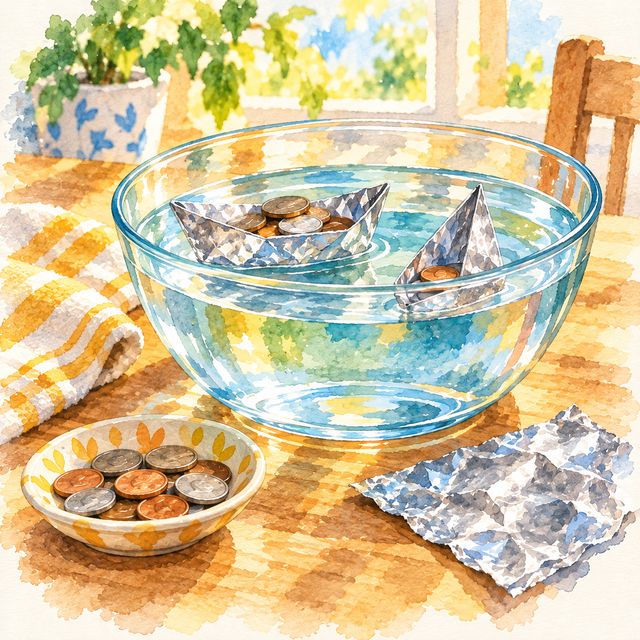
A foil boat your child improved by testing, and the numbers to show it.
Your child folds a boat from kitchen foil, loads it with coins until it sinks, then folds a better one. From 3–4 only the shape changes, so the test is fair.
- Kindergarten to Grade 5–6
- 30 min
- A printout
- On the screen
Free to sign up.
Is it a good fit?
- Ready if Your child can count to ten and fold a piece of paper in half.
- Too much today? The K level: two boats and two piles of coins.
- Too easy? The 5–6 level: three shapes planned on paper, each guessed before it is tested.
What your child practises
- Counting and recording
- Comparing two designs
- Changing one thing at a time
“The wide one held more. Its bottom pushed more water out of the way.”
If your child says something like this, in their own words, the idea has landed. Finishing the rounds means they took part; this is the learning.
Your part
- Fill a big bowl half way and put a towel under it
- Lend about 100 coins of one kind, and count them back
- Two sittings
What you need
From home
- Kitchen foil
- A big bowl or the sink, half full of water
- About 100 coins, all the same kind (small parts)
- A tea towel for the drips
- A ruler
- A pencil and paper
The steps
Kindergarten
 Tear off a square of foil as wide as your spread hand. Fold up all four edges, three finger-widths high, to make a boat with tall sides.
 Tear off a square of foil as wide as your spread hand. Fold up all four edges, three finger-widths high, to make a boat with tall sides.
The other 4 steps, each with its painting, are in the Family portal.
It must pass: The second boat must hold more coins than your first boat.
Grade 1–2
- Tear off a square of foil as wide as your spread hand. Fold up all four edges, three finger-widths high, to make a boat with tall sides.
The other 5 steps, each with its painting, are in the Family portal.
It must pass: The second boat must hold more coins than the first, and you write both numbers down.
Grade 3–4
- Measure and tear two foil squares, 10 centimetres each side. Fold one with edges 1 centimetre high, wide and flat, and one with edges 3 centimetres high, narrow and tall.
 Measure and tear two foil squares, 10 centimetres each side. Fold one with edges 1 centimetre high, wide and flat, and one with edges 3 centimetres high, narrow and tall.
The other 3 steps, each with its painting, are in the Family portal.
It must pass: From the same size of foil, one shape must hold more than the other, and you say which shape and why.
Grade 5–6
- Draw three boat shapes on paper, each from a 10 centimetre square of foil. Which will hold the most? Say why.
 Draw three boat shapes on paper, each from a 10 centimetre square of foil. Which will hold the most? Say why.
The other 5 steps, each with its painting, are in the Family portal.
It must pass: Three shapes from the same size of foil, each guessed and then tested, and you say which held the most and why.
Safety
Coins are small enough for a toddler to swallow: count them back into a cup at the end and keep them out of a small child's reach. Put a towel under the bowl and mop up spills, because a wet kitchen floor is slippery. At K stay beside the water. Wash hands after the coins.
Where the facts come from
More like this
The full design
What it is
A square of kitchen foil folded into a little boat, floated in a bowl of water and loaded with coins one at a time until the water comes in. Then a second boat of a different shape, and the question: which held more? The screen gathers the things, shows one step at a time as a painting of that step, and asks at the end. The boats and the coins on the table are the make.
How it goes
One step fills the screen: the painted plate of that step, the words under it, and two buttons. Done this step moves on. Too hard, skip it also moves on, and the finish says how many were skipped without dressing it up. At the end, Show asks what is true (the wide one held the most, it sank and then I made a better one), and What I learned asks the band's question.
The Pet
Asks at each step: "One coin at a time. Count them." Notices the result: "The water came in. Now you know its number." Remembers across the two sittings. Dares at 3 to 4 and up: change only the shape. It never calls a sunk boat a failure: it is the number to beat.
By band
K: two boats, the second wider and flatter, and the coins piled up to see which pile is taller. 1 to 2: the coins are counted and written down, and the second boat must beat the first. 3 to 4: a fair test, the same size of foil folded two ways so only the shape changes, with each boat's bottom measured. 5 to 6: three shapes planned on paper, each one's number guessed before it is tested.
What it grows
The engineering standards for each grade band ask the same thing at rising depth: compare two designs by a test (K to 2), plan a fair test and improve the design (3 to 5), evaluate competing designs against a measure (middle school). One bowl of water and some foil does all three.
Done, and what counts as evidence
Done = the steps done or honestly skipped, and one line chosen at the end. The evidence is the two numbers and the shape that won, and from 3 to 4 the change that was the only change. A fair test with a result is worth more to a record than the count of steps.
What's personal
The numbers, the shapes and your child's answer are stored as their answer, not as a mark. Nothing about your home is stored. A material you do not have is named once, a substitute is offered, and the project carries on.