Science · Grade 1–2 to Grade 7–8
Ramp race
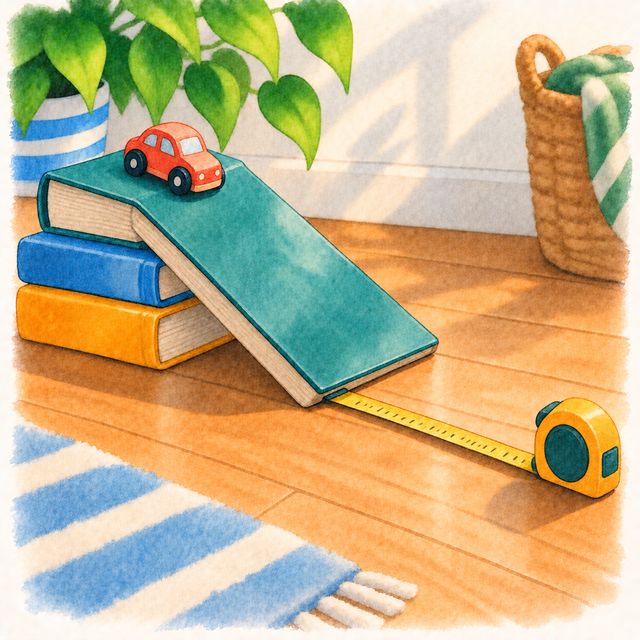
A fair test with a toy car and a pile of books.
Your child rolls a toy car down a ramp made of a board and some books, raising it one book at a time. They measure how far it goes each time, and the screen draws a bar for every try.
- Grade 1–2 to Grade 7–8
- 15 min
- Kitchen things
- On the screen
Free to sign up.
Is it a good fit?
- Ready if Your child can let a car go from a line and count hand spans along the floor.
- Too much today? Start with Sink or float?: one guess, one try, one result, with a bowl of water.
- Too easy? The Grade 3–4 level: a tape measure, and a list to tick of what stays the same.
What your child practises
- Change one thing
- Measuring how far
- Reading a bar chart
- A claim with numbers
“We only changed the books, so the height made the difference.”
If your child says something like this, in their own words, the idea has landed. Finishing the rounds means they took part; this is the learning.
Your part
- A toy car, a board, three books and a strip of tape
- Each question has a Read it to me button
- With your child at Grade 1–2, alone from Grade 3–4
Take it off the screen (optional)
Try the Pet's dare: the same ramp on a rug or carpet, and see how far the car goes.
More like this
The full design
What it is
A toy car rolls down a ramp made of a board on books, and the only rule is the Pet's: change one thing at a time. Your child lifts the ramp one book at a time, lets the car go at the same line, and measures how far it went; the screen draws a bar for each try from the numbers your child enters, nothing else. This is the shape of every fair test: one change, one result, written down.
How it goes
The Pet says the set-up ("2 books. Same car, same line.") over a painting of the ramp, and your child taps Ready. From the second height a guess first: further, or not. Then the real run: let go at the line, count or measure, and press the plus button until the number on the screen matches. The bar grows, the Pet says what the numbers say ("You said further, the car went not as far: 2 against 3. The run decides."), and after the third height: what did we change on purpose, and why. If the higher ramp went less far in your hallway, the screen says so; it never tells your child the answer it expected.
The Pet
Asks: "what will you keep the same?" Notices what the numbers did, warmly, and loves a guess that missed: "the run decides." At 5–6 it asks for the average before it says or draws it. Dares, once, at the end: a tape instead of hands (1–2), the carpet (3–4), coins on the car (5–6).
By band
1–2: three heights, the distance counted in hand spans on the floor, a guess of "further or not" before the second and third run, then what changed and why. 3–4: a tape measure in your family's unit, and before each run a list to tick: same car, same start line, same floor. Untick one and that bar comes out striped: the screen reads it as "we cannot tell which change did it", never as a mistake. 5–6: three runs at each height and the average picked from the three numbers, then the same ramp on the carpet, then a claim with the numbers in it. 7–8: coins taped on the car for mass, then the Pet's own ramp on the screen (a model, said so, never your hallway) where books, coins and the floor can change one at a time, then the claim.
What it grows
A fair test, one variable at a time, is the practice science lessons rest on through the middle years, and a chart a child drew from their own measurements is the work sample teachers ask for. A simulation teaches only after the real thing, with a question in hand, which is why the screen ramp comes last and only at 7–8.
Done, and what counts as evidence
Done = three heights on the chart and the what-changed question. What counts as evidence is the chart itself, drawn from their numbers, and from 5–6 the claim sentence with the numbers in it. A striped bar is worth keeping too: it is the moment the rule made sense.
What's personal
Their car, their books, their hallway. The unit is your family's (hand spans, then centimetres or inches). "Furthest today in our hallway" is this house's number and nobody else's. The chart comes back if you leave the game half way. The Pet never counts a run for your child: when it helps, it says it cannot see your hallway and waits.