Science · Kindergarten to Grade 3–4
Who is faster?
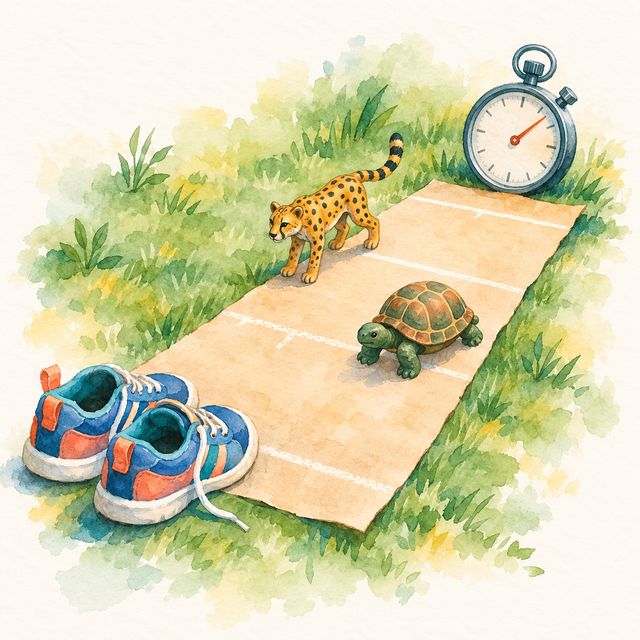
Your child races the animals, with their own real speed.
Your child taps which of two animals they think is faster, and both real speeds appear. Then they run across the room while you count, and the Pet places their own speed between two animals.
- Kindergarten to Grade 3–4
- 10 min
- Nothing to prepare
- On the screen
Free to sign up.
Is it a good fit?
- Ready if Your child can run across a room and guess which of two animals is faster.
- Too much today? The Kindergarten level: four easy pairs, like a cheetah and a sloth, and one run.
- Too easy? The Grade 3–4 level: close pairs, and three animals put in order, slowest first.
What your child practises
- Faster or slower
- Putting in order
- Speed as a number
“I am faster than a hedgehog but slower than a koala.”
If your child says something like this, in their own words, the idea has landed. Finishing the rounds means they took part; this is the learning.
Your part
- A clear stretch of floor about ten metres long
- Each question has a Read it to me button
- You count the seconds while your child runs; the Pet never counts for you
More like this
The full design
What it is
Fast is a number. Two animals stand side by side and your child taps the one they think is faster; then both numbers appear, and nobody is ever "wrong", because the numbers are the answer. Then the best part: your child runs across the room while you count the seconds, and the Pet turns that into a speed and places it between two animals ("faster than a hedgehog, slower than a koala"). The speed is theirs, measured, not looked up.
How it goes
The Pet asks "which one is faster?" and the two animals are the buttons. A tap on the faster one shows both speeds under the pictures and the Pet says them. A tap on the slower one shows the same two numbers and asks again, so the second tap is an easy one. After the pick, a tap on either picture opens it big. The run is a card: run, then tap "We ran", then tap the number of seconds the grown-up counted; the screen stays quiet while your child is off running. The finish says how many races were called and your child's own speed.
The Pet
Asks: "long legs, or short?" Notices: the two speeds, and where your child's run lands among the animals. Dares (1–2 up): find one animal that beats a car in town. The Pet never counts the seconds for you: it says it did not see the run and waits for the grown-up's number. Never a leaderboard: the speed is compared to animals, never to another child.
By band
K: four pairs that are easy to call (a cheetah and a sloth) and the run. 1–2: five closer pairs, the run, and three animals to pick the fastest from. 3–4: four close pairs, the run, and three animals to put in order, slowest first; the dare asks which of three could beat a car in town.
Done, and what counts as evidence
Done = the pairs called and one run. The run is an observation only when a grown-up timed it; nothing is written for K.
What's personal
The run is your child's own; the number is kept only until the game is finished and never stored. Speeds are in the unit your family's roads use: km/h, or mph where the family measures in miles (the United States, and the UK's "miles on the road").