Science · Grade 1–2 to Grade 5–6
What a magnet can pull
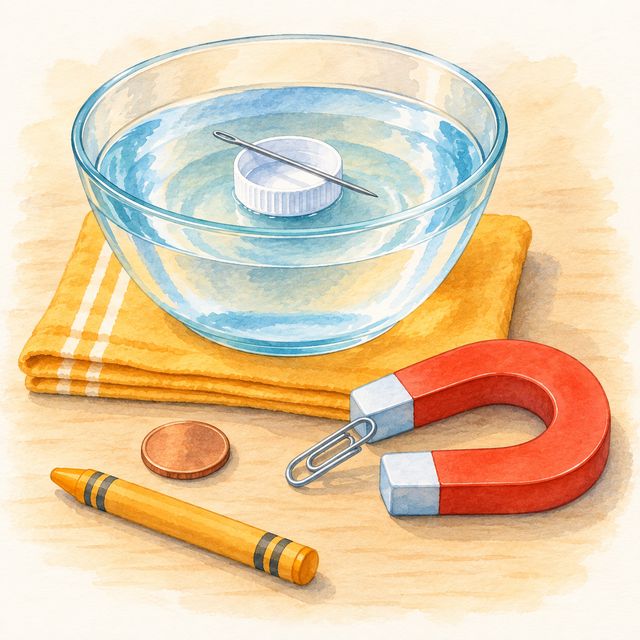
Your child finds out for themselves what a magnet pulls, how far its pull reaches, and how it makes a needle point roughly north and south.
Your child guesses which things a magnet will pull and tests each. From 3–4 they measure how far away it pulls a paper clip, three times. At 5–6 a needle floats on a bottle cap, plain and then stroked with the magnet, and settles roughly north and south.
- Grade 1–2 to Grade 5–6
- 25 min
- A printout
- On the screen
Free to sign up.
Is it a good fit?
- Ready if Your child can sort things into two groups and say why.
- Too much today? The 1–2 level: guess, test and sort.
- Too easy? The 5–6 level: a needle compass, tested four times.
What your child practises
- Guessing then testing
- Measuring in centimetres
- Repeating a test and recording it
“The foil is metal, but the magnet did not pull it.”
If your child says something like this, in their own words, the idea has landed. Finishing the rounds means they took part; this is the learning.
Your part
- One large magnet in one piece, kept away from phones and cards
- At 5–6, float the needle on a bottle cap, stroke it, and keep phones an arm from the bowl
- Count the small things back into a cup
What you need
From home
- Eight things from home: a metal paper clip, a coin, a spoon, a key, a square of kitchen foil, a cork, a plastic lid and a crayon (small parts)
- A plastic or wooden ruler, 30 centimetres long, not a metal one
- A pencil and two sheets of paper
- For 5–6 only: a sewing needle, and a plastic bottle cap to float it on (a grown-up's) (small parts)
- For 5–6 only: a wide bowl of plastic, glass or china, not metal, half full of water, on a tea towel
From a local store
- One large magnet in one piece: a horseshoe or bar magnet, or a magnet wand, from a toy, craft or hardware shop
The steps
Grade 1–2
 Lay two sheets of paper on the table, a hand apart. Draw a magnet on the left sheet and a cross on the right sheet.
 Lay two sheets of paper on the table, a hand apart. Draw a magnet on the left sheet and a cross on the right sheet.
The other 4 steps, each with its painting, are in the Family portal.
It must pass: Every thing guessed, then tested and moved to the sheet the magnet chose, and you say why one thing (a moved one, or the foil) went where it did.
Grade 3–4
- Lay the ruler flat, numbers up. Lay the paper clip flat against its long edge: the clip's end on the 0 line, the rest past the ruler's end.
 Lay the ruler flat, numbers up. Lay the paper clip flat against its long edge: the clip's end on the 0 line, the rest past the ruler's end.
The other 5 steps, each with its painting, are in the Family portal.
It must pass: The same clip and magnet from the same start, three tries each written to the half centimetre, and you say how far your magnet pulls and how much the three tries differ.
Grade 5–6
- Before stroking: a grown-up floats a bottle cap open side up mid-bowl, needle across it. Phone, screen and magnet an arm away. Turn it twice; draw each stop. (A grown-up does this step)
 Before stroking: a grown-up floats a bottle cap open side up mid-bowl, needle across it. Phone, screen and magnet an arm away. Turn it twice; draw each stop. (A grown-up does this step)
The other 5 steps, each with its painting, are in the Family portal.
It must pass: Two lines drawn before stroking and four after; the four lie along about the same line and roughly across your arm pointed at the sunrise side, or you say what may have pulled it off, fix it and test again.
Safety
Use one large magnet in one piece. Never use small loose magnets: two swallowed magnets can pull together through the gut, and a child who may have swallowed one needs a doctor straight away. Keep the magnet away from phones, bank cards and anyone with a pacemaker. The needle is the grown-up's: the grown-up strokes it, lays it on the bottle cap and puts it away at the end. The paper clip, the coin, the key and the cap are small enough for a toddler to swallow: count them back into a cup. Put the bowl on a towel and mop up spills. The water is not for drinking.
Where the facts come from
More like this
The full design
What it is
One large magnet and the things on your kitchen table. At 1 to 2 your child guesses which things it will pull, tests each, and finds that not all metal is pulled. At 3 to 4 they measure how far away it still pulls a paper clip. At 5 to 6 a needle floats on a bottle cap, first plain and then stroked with the magnet, when it turns to lie roughly north and south (magnetic north, not the North Pole). The screen shows one step at a time as a painting of that step and asks at the end. The game twin is Magnet hunt: the game is the practice on the screen, the project is the real thing.
How it goes
One step fills the screen: the painted plate of that step, the words under it, and two buttons. Done this step moves on. Too hard, skip it also moves on, and the finish says how many were skipped without dressing it up. At the end, Show asks what is true (I guessed first, then tested; I did it more than once), and What I learned asks the band's question.
The Pet
Asks at each step: "One end of the magnet. One thing at a time." Notices the result: "It moved. That line is your first number." Dares at 5 to 6: turn it again and see if it comes back. It never calls a guess wrong: a surprise is the part worth talking about.
By band
1 to 2: eight things guessed onto two sheets, tested, and re-sorted, with one surprise explained. 3 to 4: a measurement along a ruler: the same clip and magnet from the same start, three tries to the half centimetre, and how much they differ. 5 to 6: a needle compass, floated plain first as the control, then stroked, turned three times and drawn each time, checked against the side where the sun comes up, never against a phone, which is kept an arm from the bowl because its own magnets would turn the needle.
What it grows
Third-grade science asks children to find the cause and effect in magnetic forces between things that do not touch, including how distance changes the pull, and to define a simple design problem that magnets can solve. Barrow's "Magnet concepts and elementary students' misconceptions" (1987, in the proceedings of the Cornell seminar on misconceptions in science and mathematics) reports that many children believe a magnet pulls every metal; testing kitchen foil and a coin answers that from their own table.
Done, and what counts as evidence
Done = the steps done or honestly skipped, and one line chosen at the end. The evidence is the surprise and its reason at 1 to 2, the three numbers in centimetres at 3 to 4, and the four drawn lines after stroking, against the two before, with the sunrise check at 5 to 6. Coins, spoons and keys differ from country to country and kitchen to kitchen, so only your child's test says which of yours are pulled. The sunrise check is rough: in midsummer and midwinter the sun comes up well north or south of east, so the needle may sit at a slant to the arm rather than straight across it. A needle points to magnetic north, which in some places is 10 to 20 degrees from true north.
What's personal
The guesses, the numbers, the drawings and your child's answer are stored as their answer, not as a mark. Nothing about your home is stored. A material you do not have is named once, a substitute is offered, and the project carries on.