Science · Grades 1–2 and 3–4
Magnet hunt
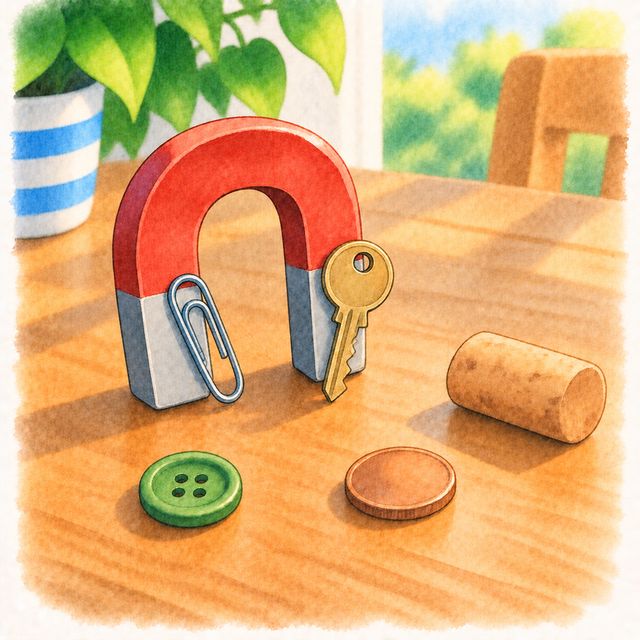
A real magnet, a hunt round the house, and a rule.
Your child guesses what a magnet will stick to, then goes round the house testing with a real one. Back at the screen they tap what really happened and look for what the sticky things have in common.
- Grades 1–2 and 3–4
- 15 min
- A printout
- On the screen
Free to sign up.
Is it a good fit?
- Ready if Your child can carry a magnet round the house and tell you whether it stuck.
- Too much today? Start with Sink or float?: the same guess and test, with a bowl of water.
- Too easy? The Grade 3–4 level: does the magnet work through paper, a plate or a hand, and how many sheets before the clip lets go.
What your child practises
- Guessing first
- Testing for real
- Sorting results
- Finding the rule
“The shiny foil did not stick, so it is not about shiny.”
If your child says something like this, in their own words, the idea has landed. Finishing the rounds means they took part; this is the learning.
Your part
- A flat fridge magnet, a steel paper clip, a few sheets of paper and a plastic plate
- Each question has a Read it to me button
- Nearby at Grade 1–2, alone at Grade 3–4; small magnets stay up high, away from little brothers and sisters
Take it off the screen (optional)
Take the Pet's dare: find one more thing that sticks, outside the kitchen.
More like this
The full design
What it is
Your child guesses what a magnet will stick to, goes round the house with a real one, and comes back to say what happened. The screen never knows the answer: it writes down what your child saw, and counts the surprises, because a guess the magnet disagreed with is where the thinking starts. Then the question a scientist asks: what do the sticky ones have in common?
How it goes
At 1–2 the notebook is ten rows with Sticks and Doesn't beside each. Your child taps a guess for every row, then "Now test them" turns the screen into a card that says to take the magnet round the house, and waits. Back at the table, "Did it" opens the same ten rows again, the guess written under each name, and your child taps what really happened. A row the magnet disagreed with turns gold: a surprise, counted at the top of the sorted chart. Then four ideas for the rule: shiny, metal, some metals (the ones with iron in), not sure yet. The Pet refuses an idea only with your child's own results ("the foil is shiny, did it stick?"); "not sure yet" is always a fair answer. At 3–4 the paper clip is the tester: guessed, tried, reported the same way, then a counter for the sheets of paper (starting at two when the clip moved through one), and two magnets end to end, where whatever your child felt is written down, never marked.
The Pet
Asks: "sticks, or does not? A guess is not a promise." Notices a surprise and celebrates it: "the shiny foil did not stick! A surprise, the best part." Notices a retest: "you tested it twice to be sure. Scientists do that." Refuses only with your child's own foil or coin. Dares (1–2): "bet you can find one more thing that sticks, outside the kitchen." (3–4): "bet a bigger clip lets go at a different number of sheets." Neither runs on the screen; they are things to try next time.
By band
1–2: ten things from the kitchen (the fridge door, a spoon, a coin, a cork, a key, a paper clip, a plastic cup, the scissors, a book, kitchen foil), a guess for each, the hunt, the results, a sorted chart, and the rule. 3–4: does the magnet work through a sheet of paper, a plastic plate, a hand; how many sheets before a paper clip lets go; and two magnets end to end.
What it grows
Predict, test, explain is the pattern science learning rests on from the first years of school, and magnets are the classic first case because the result is instant and often surprising. At 3–4 the same habit meets a force that works at a distance and through things, which is the seed of the forces work in later grades.
Done, and what counts as evidence
Done = ten things tested (1–2), or the three through-tests, the sheets and the two magnets (3–4). The evidence is the sorted chart and the rule your child picked, which is an observation, not a mark. One line worth keeping: which thing surprised them, and what they think the rule is now. Small magnets stay up high, away from little brothers and sisters; the card says so.
What's personal
The ten things are your kitchen's, and what your magnet did is what counts. A stainless spoon that does not stick, a brass key, a coin that sticks in one country and not in another: all of it is right because your child saw it. Two flat fridge magnets that pull every way round are a true result too, and the Pet says why. Nothing about your things is stored beyond the notebook of this game.