Science · Grade 3–4 to Grade 7–8
A sundial
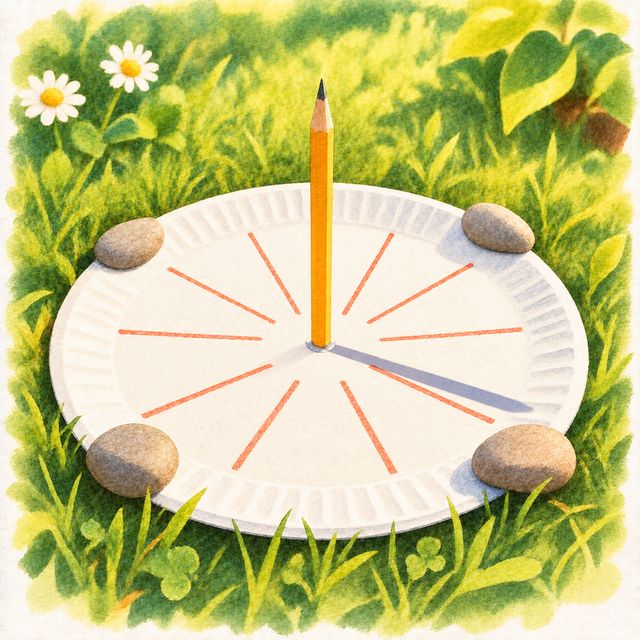
A sundial your child made that tells the time the next day.
Your child pins a paper plate with a pencil through it to sunny ground, marks the pencil's shadow every hour by the clock, and checks the next day whether the shadow lands on its lines.
- Grade 3–4 to Grade 7–8
- 30 min
- A printout
- On the screen
Free to sign up.
Is it a good fit?
- Ready if Your child can read the hour on a clock.
- Too much today? The 3–4 level: a day of marks and one check.
- Too easy? The 7–8 level: the shortest shadow, measured.
What your child practises
- Watching a pattern through the day
- Testing a claim
- Measuring shadows
“At three o'clock the shadow landed right on my line.”
If your child says something like this, in their own words, the idea has landed. Finishing the rounds means they took part; this is the learning.
Your part
- Pick a sunny day and a flat spot that gets sun all day
- Remind them on the hour
- Keep a clock where they can see it
- Check it within a few days, and not across a clock change
What you need
From home
- A paper plate
- A straight pencil
- Five pebbles
- A felt pen
- A clock, or a phone: its compass shows which way is north
- A ruler, 30 centimetres long
The steps
Grade 3–4
 Push the pencil, point down, through the plate's middle into soft sunny ground, straight up. Pin it with four pebbles. Draw a rim arrow; a fifth pebble at its point.
 Push the pencil, point down, through the plate's middle into soft sunny ground, straight up. Pin it with four pebbles. Draw a rim arrow; a fifth pebble at its point.
The other 3 steps, each with its painting, are in the Family portal.
It must pass: The next day, at an hour you marked, the shadow lands on its line.
Grade 5–6
- Push the pencil, point down, through the plate's middle into soft sunny ground, straight up. Pin it with four pebbles. Draw a rim arrow; a fifth pebble at its point.
The other 3 steps, each with its painting, are in the Family portal.
It must pass: The next day, at three hours you check, each shadow lands on or right beside its line.
Grade 7–8
- Push the pencil, point down, through the plate's middle into soft sunny ground, straight up. Pin it with four pebbles. Draw a rim arrow; a fifth pebble at its point.
The other 5 steps, each with its painting, are in the Family portal.
It must pass: It tells the time the next day, and you found when the shadow is shortest and which way it points then.
Safety
Nobody looks at the sun: the dial is read by its shadow. On a hot day, a hat and some shade between visits. Put the dial where nobody will step on it.
Where the facts come from
More like this
The full design
What it is
A pencil pushed up through the middle of a paper plate, pinned to sunny ground with pebbles, and the pencil's shadow marked with a line every hour by the clock. The next sunny day, put back the same way round, the dial is tested: does the shadow land on its line at that hour? The screen shows one step at a time as a painting of that step, comes back each hour, and asks at the end.
How it goes
One step fills the screen: the painted plate of that step, the words under it, and two buttons. The steps fall into short visits through one day and a check the next. Done this step moves on; skip it also moves on, and the finish says how many were skipped. At the end, Show asks what is true (the shadow moved all day, it told the time the next day), and What I learned asks the band's question.
The Pet
Asks at each step: "On the hour. Draw along the shadow." Notices: "A fan of lines. That is your dial." Remembers across the visits and the night. A cloudy hour is a missed mark, not a failure, and it says so.
By band
3 to 4: mark a day of hours and check one the next day. 5 to 6: look at how the lines are spaced and check three hours. 7 to 8: measure the shadow's length each hour to find when it is shortest and which way it points then, before testing the dial.
What it grows
Fifth-grade science asks children to show the daily pattern in the length and direction of shadows. A dial marked by the clock shows both, and it works without any calculation: the lines spread out around midday, when the sun is highest, which your child sees rather than is told.
Done, and what counts as evidence
Done = the steps done or honestly skipped, and one line chosen at the end. The evidence is the dial and the next day's check: a claim, "it tells the time", tested against a clock. At 7 to 8, the measured shortest shadow and its direction.
What's personal
The marks and your child's answers are stored as their answer, not as a mark. Nothing about where you live is stored. A material you do not have is named once, a substitute is offered, and the project carries on.