Science · Grade 1–2 to Grade 7–8
Keep the ice
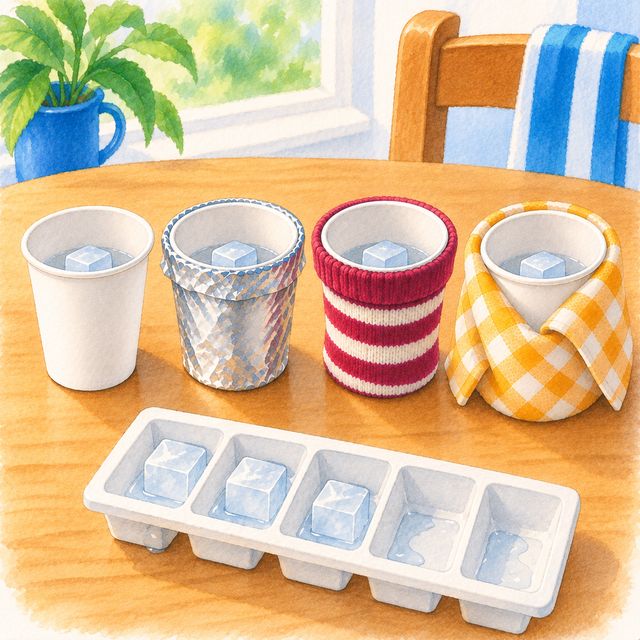
A test your child ran on real ice, and a record of which wrap kept it longest.
Your child wraps identical cups in different ways, drops an ice cube from the same tray into each, and looks every 15 minutes to see which lasts. From 3–4 only the wrap changes, so the test is fair; at 7–8 they measure cold water with a thermometer and draw a graph.
- Grade 1–2 to Grade 7–8
- 20 min
- A printout
- On the screen
Free to sign up.
Is it a good fit?
- Ready if Your child can use a timer and look at the same things each time it rings.
- Too much today? The 1–2 level: two cups, one in a folded tea towel.
- Too easy? The 7–8 level: a control, a thermometer and a line graph.
What your child practises
- Comparing over time
- Changing one thing at a time
- Recording a table and a graph
“The towel didn't make it cold. It stopped the warm getting in.”
If your child says something like this, in their own words, the idea has landed. Finishing the rounds means they took part; this is the learning.
Your part
- Fill an ice cube tray the night before
- Be at home for an afternoon: the wrapped cubes can last a few hours
- Lend clean socks and tea towels
- At 7–8, a digital kitchen thermometer, never a glass one
What you need
From home
- Five cups, all the same size and kind, paper or plastic
- An ice cube tray, filled from a jug by a grown-up, every hole to the same height, and frozen the night before; at 7–8, a bottle of water left in the fridge overnight and a measuring jug
- Kitchen foil, a pair of clean dry socks big enough to pull over a cup, and two tea towels
- A kitchen timer or a phone timer, and a clock to read the time
- A pencil and paper; squared paper at 7–8
From a local store
- A digital kitchen thermometer with a probe, for 7–8
The steps
Grade 1–2
 Take two cups the same. Fold a tea towel in four, stand one cup in its middle and gather the towel up round its side. Leave the other bare.
 Take two cups the same. Fold a tea towel in four, stand one cup in its middle and gather the towel up round its side. Leave the other bare.
The other 3 steps, each with its painting, are in the Family portal.
It must pass: Two cups the same, one bare and one in a tea towel folded in four: you draw both every 15 minutes until the bare cube is gone, then say what is left in the towel cup and why.
Grade 3–4
- Take four cups the same; one stays bare. Stand one on 30 centimetres of foil; press the foil up round its side, turning any above the rim down outside.
 Take four cups the same; one stays bare. Stand one on 30 centimetres of foil; press the foil up round its side, turning any above the rim down outside.
The other 5 steps, each with its painting, are in the Family portal.
It must pass: Four cups the same, only the wrap changed: you mark each every 15 minutes, write when each cube went, and say which wrap kept ice longest and why it might.
Grade 5–6
- Take four cups the same; one stays bare. Stand one on 30 centimetres of foil; press the foil up round its side, turning any above the rim down outside.
The other 5 steps, each with its painting, are in the Family portal.
It must pass: Three tries in one table, then a two-layer keeper tested beside the best single wrap: you say which kept its ice longer, and by how many minutes, to the nearest look.
Grade 7–8
- Take four cups the same; one stays bare. Stand one on 30 centimetres of foil; press the foil up round its side, turning any above the rim down outside.
The other 5 steps, each with its painting, are in the Family portal.
It must pass: Four cups of the same fridge water, the bare one the control, read every 10 minutes for an hour and drawn as a line graph: you say how far apart the cups were at minute 0, and one thing the test cannot show.
Safety
The ice and the water are for the test: nobody eats the ice or drinks the water. Use a digital thermometer, never a glass one, which can break in a hand; its probe has a point, so it goes into the water and nowhere else. Cups sweat and tip: wipe drips off the table and the floor straight away, because a wet floor is slippery. Keep the cups away from the oven, the hob and any heater.
Where the facts come from
More like this
The full design
What it is
Cups the same size and kind, an ice cube in each from the same tray, put in at the same moment and stood on one table out of the sun. Each cup has a different wrap, and the child looks every 15 minutes to see which cube lasts longest. At 7–8 the ice gives way to cold water and a thermometer. The screen shows one step at a time as a painting of that step, comes back at each look, and asks at the end. The game Where the ice goes (science-where-the-ice-goes) is the practice on the screen; this is the real thing on the table.
How it goes
One step fills the screen: the painted plate of that step, the words under it, and two buttons. The steps fall into setting up and then short looks while the ice melts. Done this step moves on; skip it also moves on, and the finish says how many were skipped. At the end, Show asks what is true (one cup stayed cold much longer, a wrap slows the warmth getting in), and What I learned asks the band's question.
The Pet
Asks at each look: "Big, small or gone?" Notices: "Four cubes, each timed to the nearest look." Remembers across the looks and, at 5 to 6, across three days. It corrects the common idea gently: a towel does not make the ice cold, it slows the warmth of the room getting in.
By band
1 to 2: two cups, one bare and one in a tea towel folded in four, drawn at every look until the bare cube is gone, and the child says what is left in the towel cup; a thick wrap leaves plenty, so the result is clear and the sitting ends with the bare cube. Every cube comes from one tray filled to one height, because a bigger cube lasts longer whatever its wrap. 3 to 4: a fair test of four cups, bare, foil, a sock and a tea towel, everything else the same, each marked whole, half or gone, and the minutes each cube lasted worked out to the nearest look; a cube still there when the afternoon ends is written down as still there, the longest. 5 to 6: the same three times, in one table, then a keeper of two layers built from the winner and tested beside it. 7 to 8: 100 millilitres of fridge water in each cup, the bare cup as the control, the temperature read every 10 minutes for an hour, a line graph by hand, how far apart the cups were at the start, and what the test cannot show.
What it grows
Studies of how children and adults think about heat found two lasting ideas: that cold is a kind of heat of its own (Erickson, 1979), and that some materials hold cold in: many students chose foil over wool to keep a cold thing cold (Lewis and Linn, 1994). Here every wrap is tested against a bare cup, and the result is put in words the standards use: heat moves from the warmer room into the colder ice (grade 4), and a device can be designed and tested to slow it (middle school). The same wrap would slow a hot drink cooling, which is the question that tests the idea.
Done, and what counts as evidence
Done = the steps done or honestly skipped, and one line chosen at the end. The evidence is the record: the drawings at 1 to 2, the minutes with only the wrap changed at 3 to 4, three tries and the keeper at 5 to 6, and at 7 to 8 the graph beside the spread at minute 0 and the limit named. One room on one day says which wrap won there, not everywhere.
What's personal
The drawings, times, readings and your child's answers are stored as their answer, not as a mark. Nothing about your home is stored. A material you do not have is named once, a substitute is offered, and the project carries on.