Science · Grade 1–2 to Grade 7–8
Kitchen changes
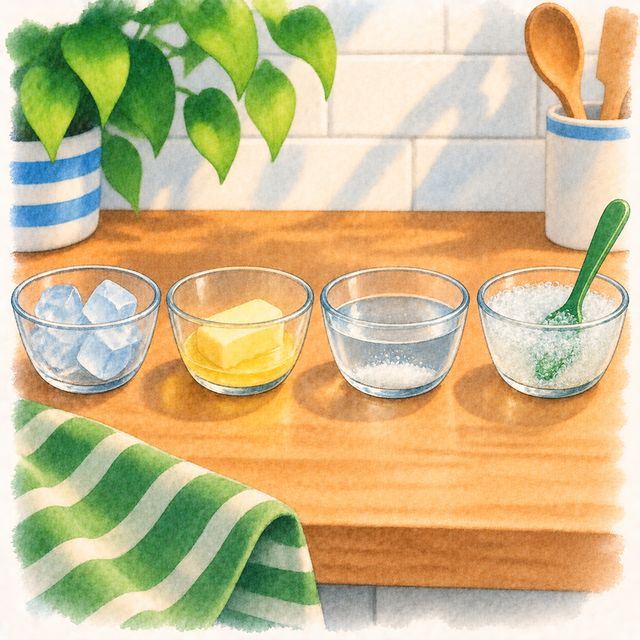
Real changes on your worktop, and whether they go back.
Your child guesses what ice, butter, sugar or baking soda will do, then tries it for real on the worktop with you. They tap what they saw, then decide whether the change can go back.
- Grade 1–2 to Grade 7–8
- 15 min
- A kit
- On the screen
Free to sign up.
Is it a good fit?
- Ready if Your child can watch something closely and tell you what it did in a word or two.
- Too much today? Start with Sink or float?: the same guess, try and tell with one bowl of water.
- Too easy? The Grade 3–4 level: sugar in a hot cup and a cold one, and where the sugar went.
What your child practises
- Guessing first
- Saying what you saw
- Can it go back?
“The sugar is still in there, it is just too small to see.”
If your child says something like this, in their own words, the idea has landed. Finishing the rounds means they took part; this is the learning.
Your part
- An ice cube, butter, sugar, baking soda, vinegar, a plate and cups of water
- Each question has a Read it to me button
- Anything warm is yours: a warm plate at Grade 1–2, the kettle from Grade 3–4, and a balloon over the fizz, never a lid
Take it off the screen (optional)
Put the soft butter back in the fridge and see whether it goes hard again.
More like this
The full design
What it is
Things in the kitchen change: ice melts, butter goes soft, sugar disappears into water, baking soda fizzes when vinegar hits it. Your child guesses what each one will do, does it for real on the worktop, and tells the screen what actually happened. Nothing they report is ever marked wrong: it is their kitchen and their eyes, and the screen writes down their word. Then the question that carries this game all the way to Grade 8: can it go back?
How it goes
The Pet names a dish and rings it on the painted worktop, so a child who cannot read yet knows which one. Your child taps a guess (there is no losing a guess), then a card sends you both to the real worktop with a line for the grown-up (a warm plate only at 1–2; the kettle is yours from 3–4). Back at the screen, "what happened? Tap what you saw": the dish in the picture changes to match what they said, a puddle, a slump, a heap gone, bubbles, and the notebook writes the line. Then the rung's own questions, one or two chips each. Three or four things, then a finish that says what was written and where to take it next.
The Pet
Asks: "a guess first. There is no losing a guess." Notices a surprise and loves it: "You said go soft. It melted. A surprise is the best bit." At 1–2 it catches the one that matters: "You said melt. It went soft. Is that the same?" Remembers at 3–4: "last time the sugar disappeared. Did it go anywhere?" Dares, once, at the end: what the fridge does to the butter (1–2), whether the baking soda comes back out of the water (3–4), what melted butter is now (5–6), the mass with a balloon over the bottle (7–8).
By band
1–2: the ice, the butter and the sugar on a warm plate; melt, go soft or stay the same; then whether melted and soft are the same thing (they are not), which of them can go back, and what did it: heat. 3–4: sugar, baking soda and butter in cold water: dissolve or stay; then the same sugar in a hot cup against a cold one with only the water changed, and where the sugar went (it is still there, too small to see). 5–6: four changes sorted into ones that go back and the fizz that cannot, ice and water as a picture of tiny bits, and why the fizz has no way back. 7–8: after each change, is it a mixture (sugar water), new stuff (the fizz) or the same stuff (melted butter); and the fizz on a scale: an open cup weighs less after, because the gas that left has mass too.
What it grows
Predict, try and record is the shape science takes from the first year of school, and the surprise is where the learning is. "Can it go back?" is the question that, asked often enough at the stove, becomes the difference between a physical and a chemical change by Grade 8, without anyone saying those words before they are needed.
Done, and what counts as evidence
Done = the rung's changes written down. What counts as evidence is the notebook: the guess, what they saw, and from 5–6 the sort into back and no way back. One line worth keeping: which thing surprised them, and what they say about it now.
What's personal
The changes are the ones that happened on your worktop. A butter that melted on a warm enough plate is written as melted, and the questions after follow that; an ice cube that stayed an ice cube is not asked whether it can go back. The notebook is your child's words, and it comes back if you leave the game mid-way. The grown-up's line on the real card is the safety line: nothing on a stove at 1–2, the kettle for you only, a balloon over the fizz rather than a lid.