Science · Kindergarten to Grade 3–4
Where the ice goes
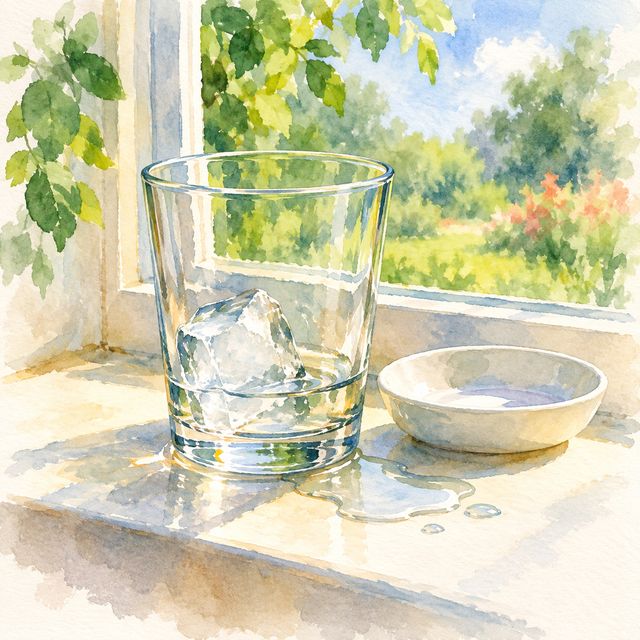
Follow one real ice cube and find where the water goes.
The family follows one real ice cube around the kitchen: out of the freezer, into a glass, onto the sunny sill, and on. At each stop your child taps what they notice, and at the end says where the water went.
- Kindergarten to Grade 3–4
- 30 min
- Kitchen things
- On the screen
Free to sign up.
Is it a good fit?
- Ready if Your child can look at an ice cube and tell you if it is hard, wet or getting smaller.
- Too much today? The Kindergarten level: four stops in about fifteen minutes, and a tap for what the ice looked like.
- Too easy? The Grade 3–4 level: six stops, a guess decided together before each test, and where the ice went, written with because.
What your child practises
- Melting and freezing
- Saying what you noticed
- Guessing, then checking
“The drops on the plate are the same water that was ice this morning.”
If your child says something like this, in their own words, the idea has landed. Finishing the rounds means they took part; this is the learning.
Your part
- One ice cube, a glass, a dish and a cup of water
- Each question has a Read it to me button
- The whole family plays; the kettle and the cold plate are a grown-up's alone
Take it off the screen (optional)
At Grade 1–2 and up, look again later at the cup of water left on the path, and talk about where it went.
More like this
The full design
What it is
A journey through your own kitchen with the Pet driving the bus. At every stop the family does one real thing to one real ice cube: out of the freezer, into a glass, onto the sunny sill, then either up to the kettle (a grown-up's job) or down the sink, and outside to a puddle for the older ones. One question the whole way: where does the ice go? The bus is the only pretend part, and the Pet says so at the end; the ice, the water, the steam and the drops on the cold plate are all real, and all the same water.
How it goes
Who is here today, by the names your family uses, then "All aboard". At each stop the screen shows the place, the one thing to do and three things your child might notice; any of the three is fine. "Drive on" moves the bus along the strip at the bottom. After the sill the road forks and the family decides together, each saying which road and why. The kettle road carries a hand sign: a grown-up boils the kettle and holds the cold plate, and nobody else touches. Every stop has "It didn't work": try again, skip it, or take the other road, with no mark against anyone. Home asks where the ice went, and then the Pet tells the truth about the bus.
The Pet
Asks at each stop what the family noticed. Notices in plain science: "hard as a stone, ice is water frozen"; "drops, the steam turned back into water"; "smaller, it is going into the air". Admits "the bus is stuck, that happens" when something did not work, and at home "the bus was pretend, the ice really melted". It never picks who is here, which road or a guess for the family, and never scores a stop.
By band
K: four stops in about fifteen minutes (freezer, glass, sill, then one road), and a tap at each for what the ice looked like. 1–2: five stops, with a cup of water on the path outside at the end and a look at it later. 3–4: six stops, a guess decided together before the glass, the cold plate and the puddle, checked against what happened, and "where did the ice go?" written at home with because.
What it grows
The Magic School Bus method: the fantasy stays in the bus and every fact is real and touchable. Following one thing through its changes is how the water cycle is first understood, and a family doing it together, with waits and a cup of tea from the same kettle, remembers it.
Done, and what counts as evidence
Done = the bus reached home and the family said where the ice went. The notebook keeps one line per stop in the child's chosen words; at 3–4 each guess beside what happened, and the because line at home. The best sign: a child who says the drops on the plate are the same water that was ice this morning.
What's personal
The crew is your family, by your words for them. The kitchen, the sill and the path are yours, and the ice does what your kitchen makes it do: the game records what your child saw, not what a textbook says should have happened.