Science · Grade 1–2 to Grade 5–6
A cup telephone
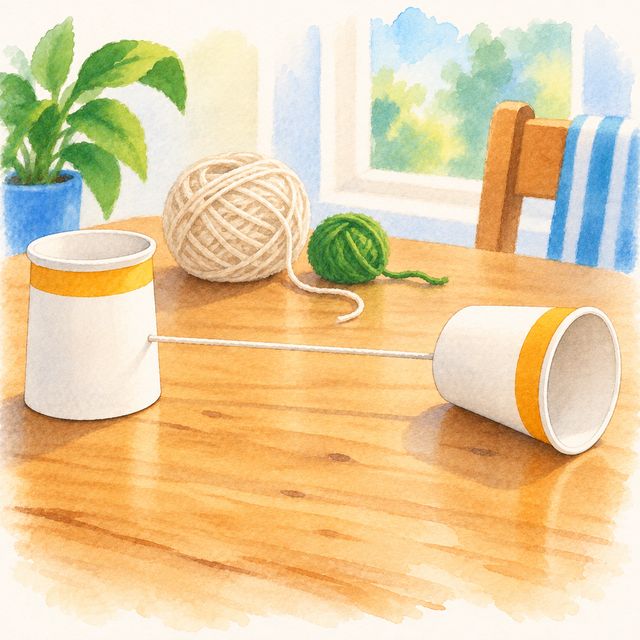
A cup telephone your child made and tested, and the counts that show which string carries a whisper best.
Your child ties string between two paper cups, then whispers five picture words along it, tight and droopy. From 3–4 only the string changes, three tries each, so the test is fair.
- Grade 1–2 to Grade 5–6
- 50 min
- A printout
- On the screen
Free to sign up.
Is it a good fit?
- Ready if Your child can tie a knot with a little help and count to five.
- Too much today? The 1–2 level: one phone, tight against droopy.
- Too easy? The 5–6 level: three strings in a table, then the winner against the same string in bigger cups.
What your child practises
- Sound as a shake
- Counting and recording
- Changing one thing at a time
“When the string was tight I got all five. When it drooped I only got one.”
If your child says something like this, in their own words, the idea has landed. Finishing the rounds means they took part; this is the learning.
Your part
- Poke the holes with a sharp pencil and cut the strings
- Be the other end of the phone, or find someone who will
- Clear about 4.5 metres of floor
- Two sittings
What you need
From home
- A sharp pencil, and sheets of paper
- Thin kitchen string, a ball of it
- Thin wool (double knitting or thinner), at least 8 metres, for 3–4 and 5–6
- Dental floss, at least 8 metres, for 5–6
- Paper clips, one for each cup (small parts)
From a local store
- Paper cups from one pack, all the same size: 2 at 1–2, 4 at 3–4, 6 at 5–6; and at 5–6 two bigger paper cups, kept aside for the last step
The steps
Grade 1–2
 A grown-up pushes the pencil point into the middle of each cup's bottom from outside, till the wood just goes in, then cuts all strings one length: about 3.5 metres. (A grown-up does this step)
 A grown-up pushes the pencil point into the middle of each cup's bottom from outside, till the wood just goes in, then cuts all strings one length: about 3.5 metres. (A grown-up does this step)
The other 5 steps, each with its painting, are in the Family portal.
It must pass: You tried five words with the string tight and with it droopy, counted the words heard each way, and say which way heard more.
Grade 3–4
- A grown-up pushes the pencil point into the middle of each cup's bottom from outside, till the wood just goes in, then cuts all strings one length: about 3.5 metres. (A grown-up does this step)
The other 5 steps, each with its painting, are in the Family portal.
It must pass: String against wool, three tries each, with everything else kept the same: the words heard counted each time, and you say which carried more.
Grade 5–6
- A grown-up pushes the pencil point into the middle of each cup's bottom from outside, till the wood just goes in, then cuts all strings one length: about 3.5 metres. (A grown-up does this step)
The other 5 steps, each with its painting, are in the Family portal.
It must pass: Three strings, three tries each, in a table; then the winner and the same string in bigger cups, three tries each in turns; and you say from your numbers whether the bigger cups helped.
Safety
A grown-up pokes the holes with the sharp pencil. Stand the cup upside down on the table, hold it by its side near the table, and push the pencil's point straight down through the middle of the bottom; a yoghurt pot needs a slow twist. Paper clips are small enough for a toddler to swallow: keep the spares out of a small child's reach. Never put the string round anyone's neck. Walk, never run or back away, while holding a phone, and never yank the string: the other cup is at an ear. Keep the string away from doorways and stairs, and wind it up after. Speak or whisper into a cup, never shout. If you use fishing line, use new fishing line, never one with a hook.
Where the facts come from
- NGSS 1-PS4-1: vibrating materials can make sound, and sound can make materials vibrate
- NGSS 1-PS4-4: build a device that uses light or sound to communicate over a distance
- NGSS 3-5-ETS1: plan fair tests and improve a design
- NGSS MS-ETS1: evaluate competing designs and improve the best one
- CPSC: small parts for toys and children's products
More like this
The full design
What it is
Two paper cups, a small hole in the middle of each one's bottom, and a string about 3.5 metres long threaded through and tied round a paper clip inside each cup. Two people walk apart until the string is tight; one whispers into a cup, the other holds the other cup over one ear and says each word back, using the picture card to choose, or shakes their head if nothing came through, so a guess does not count as hearing. It takes two people: your child and you, a brother or sister, or a friend. The screen gathers the things, shows one step at a time as a painting of that step, and asks at the end. Its game twin is science-sound-safari, where sound is found by ear on the screen; this is the real thing, and the 5–6 cup-and-string rung that game leaves for it.
How it goes
One step fills the screen: the painted plate of that step, the words under it, and two buttons. Done this step moves on. Too hard, skip it also moves on, and the finish says how many were skipped without dressing it up. At the end, Show asks what is true (I heard words through the string, one try carried more words than another), and What I learned asks the band's question.
The Pet
Asks at each step: "String tight. Whisper five words. Point to each picture." Notices: "You counted the words heard with the string tight." Remembers across the two sittings. Dares at 3 to 4 and up: change only the string. When an answer is not what most phones do, it asks for one more try rather than correcting.
By band
1 to 2: one phone, five words whispered with the string tight and then droopy, and the words heard counted each way. 3 to 4: a fair test, a string phone against a wool phone, three tries each in turns, every count written down; then a hum felt on the string, then stopped by the speaker's pinch. 5 to 6: three phones (string, wool, floss), three tries each in a table with totals, then the winner made again with bigger paper cups and tested in turns against the old winner. From 3 to 4 the whisper is first made softer until about two of five words are missed, so the phones do not all score five and tie.
What it grows
First-grade science asks children to show that vibrating materials make sound and that sound makes materials vibrate (NGSS 1-PS4-1), and to build a device that uses sound to communicate over a distance (1-PS4-4), whose examples name paper cup and string telephones. The engineering standards then ask for fair tests that improve a design by Grade 5 and for comparing competing designs against a measure in middle school: the words heard out of five is that measure.
Done, and what counts as evidence
Done = the steps done or honestly skipped, and one line chosen at the end. The evidence is the counts: tight against droopy at 1 to 2, one change with three tries each at 3 to 4, and at 5 to 6 a table with totals and a change made because of it. Before the first count the speaker whispers one word with the listener's cup off the ear, softer until it is not heard, so the count measures the string, not the air. At 1 to 2 the droopy try also stands closer, so if it still scores lower the string did the carrying.
What's personal
The counts and your child's answers are stored as their answer, not as a mark. No sound is recorded and nothing about your home is stored. A material you do not have is named once, a substitute is offered, and the project carries on. A deaf or hard-of-hearing child can be the speaker at every band: they whisper, watch the listener point and keep the count, while a hearing partner says if the whisper is soft enough. At 3 to 4 they can be the listener whose fingertip feels the hum's faint buzz on the string, and feels it stop when the speaker pinches the string by their own cup, upstream of the fingertip.