Music & arts · Pre-K to Grade 3–4
A shaker and a rubber-band guitar
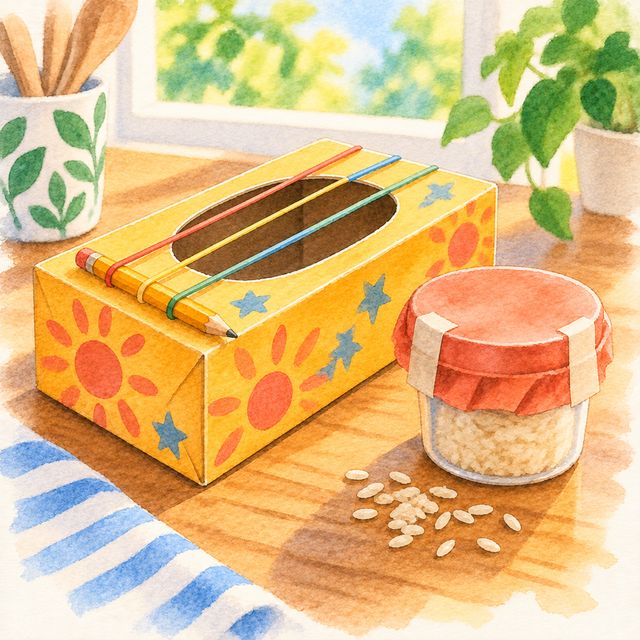
Two instruments your child made, and a high note and a low one they found by ear.
Your child makes a rice shaker from a yoghurt pot and a rubber-band guitar from a tissue box, plays them loud and quiet, and finds which band sounds high and which low.
- Pre-K to Grade 3–4
- 15 min
- Kitchen things
- On the screen
Free to sign up.
Is it a good fit?
- Ready if Your child can spoon rice into a pot and pluck a band.
- Too much today? The Pre-K level: fill and shake, then pluck what you stretched.
- Too easy? The 3–4 level: one band stretched tighter, to make it higher.
What your child practises
- Loud and quiet
- High and low
- What makes a sound
“The loose band sounds low.”
If your child says something like this, in their own words, the idea has landed. Finishing the rounds means they took part; this is the learning.
Your part
- Save a yoghurt pot and a tissue box, and find four rubber bands of different sizes and a glue stick
- Tape the shaker and stretch the bands at Pre-K and K
- Keep the rice and the bands from a toddler
What you need
From home
- A small plastic pot with a lid, like a yoghurt pot
- Dry rice and a spoon (small parts)
- Strong tape
- An empty tissue box, the plastic strip pulled out of its hole
- Four rubber bands of different sizes: small ones stretch tight round the box, big ones stay loose (small parts)
- A pencil, and a glue stick
The steps
Pre-K
 Spoon rice into the pot until it is a quarter full.
 Spoon rice into the pot until it is a quarter full.
The other 4 steps, each with its painting, are in the Family portal.
Kindergarten
- Spoon rice into the pot until it is a quarter full.
The other 4 steps, each with its painting, are in the Family portal.
It must pass: The guitar makes one sound high and one sound low.
Grade 1–2
- Spoon rice into the pot until it is a quarter full.
The other 5 steps, each with its painting, are in the Family portal.
It must pass: The guitar makes one sound high and one low, and you can feel the band that makes it buzz.
Grade 3–4
- Spoon rice into the pot until it is a quarter full.
The other 5 steps, each with its painting, are in the Family portal.
It must pass: You can make one band sound higher by changing only that band, and say what you changed.
Safety
Rice and rubber bands are small enough for a toddler to swallow: tape the shaker's lid down at every grade and keep the spare bands out of reach. Stretch the bands away from faces, because a band that slips can snap into an eye; at Pre-K and K you stretch them. If the shaker's tape lifts, tape it again before it is played.
Where the facts come from
More like this
The full design
What it is
Two instruments from the recycling: a yoghurt pot with a spoonful of rice, taped shut, and a tissue box with rubber bands stretched across its hole. Your child plays them loud and quiet, finds a high band and a low one, and from 1 to 2 feels that the sound is the band buzzing. The screen gathers the things, shows one step at a time as a painting of that step, and asks at the end.
How it goes
One step fills the screen: the painted plate of that step, the words under it, and two buttons. Done this step moves on. Too hard, skip it also moves on, and the finish says how many were skipped without dressing it up. At the end, Show asks what is true (the shaker is loud, one band sounds high), and What I learned asks the band's question.
The Pet
Asks at each step: "Pluck them one by one. High or low?" Notices: "You found high and low." Remembers across a pause. Dares at 3 to 4: change one band at a time. When an answer is not what the band does, it asks for one more listen rather than correcting.
By band
Pre-K: your child fills the shaker and plays it; you tape it and stretch the bands; they pluck and listen. K: the same with your child taping, and the question is which band sounds low. 1 to 2: a pencil bridge, and a gentle touch on a plucked band to feel it buzz. 3 to 4: the pencil bridge, then one band stretched tighter over a glue stick at the side, to find what makes a sound higher.
What it grows
First-grade science asks children to show that vibrating materials make sound; a plucked band that stops sounding when it is touched shows it in one go. Early learning frameworks name making and exploring sound as part of creative expression from age 3, which is where the shaker starts.
Done, and what counts as evidence
Done = the steps done or honestly skipped, and one line chosen at the end. The evidence is the two instruments, a high band and a low one found by ear, and from 1 to 2 what your child says makes the sound: the buzz is the answer the first-grade science standard asks for.
What's personal
What your child heard and answered is stored as their answer, not as a mark. No sound is recorded and nothing about your home is stored. A material you do not have is named once, a substitute is offered, and the make carries on.