Science · Kindergarten to Grade 3–4
Sound safari
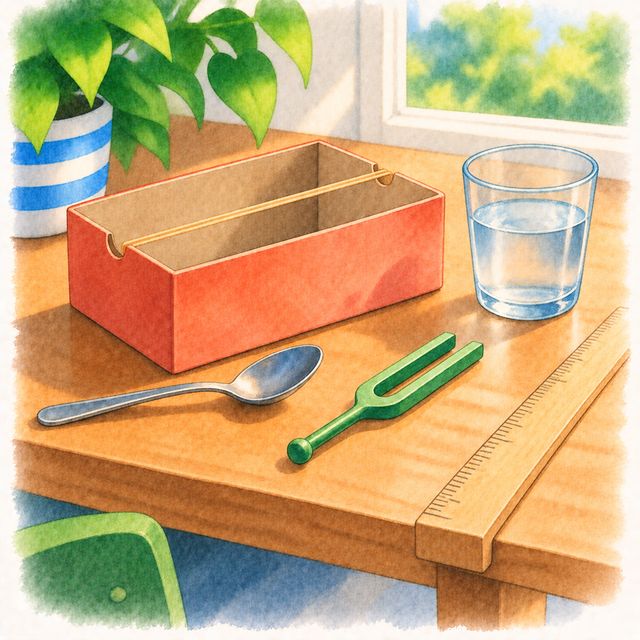
Your child finds out that every sound is something moving.
Your child stands still, listens, and finds five sounds around the house. Older children build a rubber-band guitar or tap three glasses of water to hear what makes a sound high or low.
- Kindergarten to Grade 3–4
- 15 min
- Kitchen things
- On the screen
Free to sign up.
Is it a good fit?
- Ready if Your child can stand still, listen, and tell you what a sound in the house might be.
- Too much today? The Kindergarten level: find five sounds around the house and say which was loudest.
- Too easy? The Grade 1–2 level: build a rubber-band guitar and find which part moves.
What your child practises
- Loud and soft
- High and low
- What made the sound
- A first fair test
“My finger stopped the wobble, so the band was moving.”
If your child says something like this, in their own words, the idea has landed. Finishing the rounds means they took part; this is the learning.
Your part
- Nothing at Kindergarten; a shoebox and two rubber bands at Grade 1–2; three glasses, a spoon and water at Grade 3–4
- Each question has a Read it to me button
- Alone for the sound hunt, with you for the rubber bands and the glasses
Take it off the screen (optional)
Take the Pet's dare: lie still in the dark tonight and find a sound.
More like this
The full design
What it is
Every sound is something moving, and your child can find that out with their own ears and one finger. First the house is the game: stand still, listen, and find five sounds. Then a rubber-band guitar shows the secret (a finger on the buzzing band stops the sound, so the band was the thing moving). Then three glasses of water and a spoon: which one makes the lowest note, and why. Loud and soft, high and low, and a first fair test, all on things you already own.
How it goes
At K the Pet whispers "shh, I hear something, find me five sounds" and the screen shows eight chips with a sound's name on each; your child taps a chip for each sound they hear and the count goes up to five. While they are listening the Pet stays quiet: no hints, no nudging. Then four questions ("which was the loudest?") over the five chips they found. At 1–2 the screen shows the guitar to build and waits for "I built it", then asks what happened when a finger touched the buzzing band. On the screen a tap on "the thick band" plays a low buzz and "the thin band" a higher one, so the chips sound like the thing they name. At 3–4 the screen waits for "they are ready", then asks which glass is lowest; a tap on a glass chip plays that glass's note. The chart fills one glass at a time, low to high.
The Pet
Asks: "thick band, thin band, which one is lower?" Notices: "your finger stopped the wobble, that is the secret." Bets wrong on purpose at 3–4: "more water, higher note", then owns it: "I was wrong! More water, slower wobble, lower note." Dares (K): find a sound in the dark tonight. (1–2): play three notes low to high on the guitar, thick, thin, then the thin one pulled tighter, each note sounding on the screen as it is played. (3–4): make a glass sing with a wet finger round its rim; what happened is your child's report, never marked.
By band
K: hunt five sounds from a list of eight (the fridge's hum, a dripping tap, a door, the clock, a bird, a car, the kettle, a voice), then say which was loudest, softest, high like a bird and low like a truck. Those are your child's ears talking and the game never marks them. Last, "what made it?", and the Pet's one fact. 1–2: build the guitar, pluck, touch, find which band is lower and which part moves, then draw it on paper with the moving part written on. 3–4: three glasses, a little water, half and nearly full; the Pet bets that more water means a higher note, your child taps the real glasses and finds out, then puts each glass's note on a chart and says what would make the note higher still.
What it grows
Sound and vibration is the first physical science strand in the early years, and the shoebox guitar is its classic experiment: the child feels the vibration stop. The glasses are the first fair test: change one thing (the water), keep the rest the same, predict, then look. One thing worth knowing at the table: the game's glasses are tapped with a spoon, and more water makes the note lower. Blowing across the top of a bottle goes the other way (more water, higher), because then it is the air inside that wobbles, not the glass.
Done, and what counts as evidence
Done = the five sounds found (K), the guitar built and the secret found (1–2), the three glasses tested and charted (3–4). The evidence is the drawing at 1–2 with the moving part labelled, and the chart at 3–4. One line worth keeping: what your child thinks would make the note even higher, and why.
What's personal
The sounds are your house's own. Which sound was loudest is your child's opinion and stays that way. The game keeps what was found and picked only to finish the game; no microphone, no recording, nothing about your home is stored.