Science · Pre-K to Grade 3–4
Same spot, four seasons
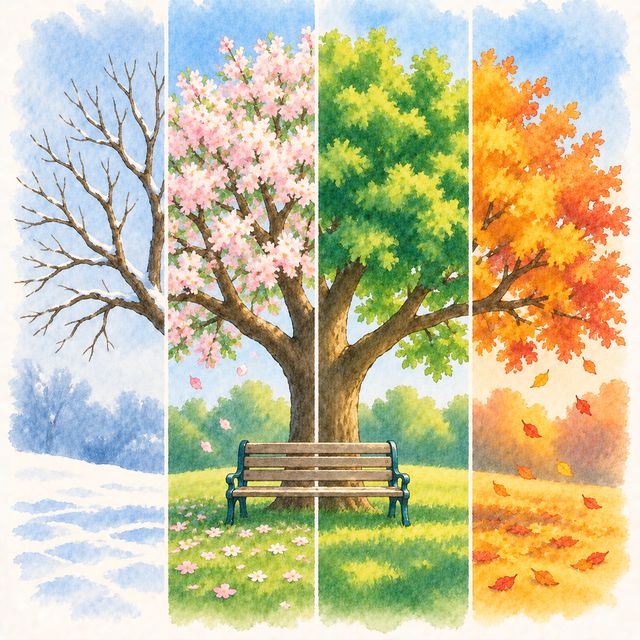
One favourite place, visited each season, and what changed.
Your family picks one place nearby and visits it once a season. Each time, your child compares today with last time and taps what changed, and older children take measurements too.
- Pre-K to Grade 3–4
- 20 min
- Nothing to prepare
- On the screen
Free to sign up.
Is it a good fit?
- Ready if Your child can tap things in a picture and notice leaves, puddles and coats.
- Too much today? Start with What do you notice?: one look out of the window and one thing noticed.
- Too easy? The Grade 3–4 level: compare the bench's shadow with last time, and say whether the sun is higher or lower.
What your child practises
- Spotting what changed
- Seasons in order
- A guess for next time
- Shadows and the sun
“The shadow is longer today, so the sun is lower.”
If your child says something like this, in their own words, the idea has landed. Finishing the rounds means they took part; this is the learning.
Your part
- Nothing to bring; a tape measure and a thermometer at Grade 3–4
- Each question has a Read it to me button
- Walk to the spot with your child once a season, the screen in your pocket
More like this
The full design
What it is
One place your family chooses and names ("the dragon tree"), visited once a season for a year. Each time, the screen shows last visit's picture beside today's and your child finds what changed and what stayed. Over the year the four pictures sit side by side, and the changes turn from noticing into measuring and, at the top, into an explanation: the sun is lower in winter, so the shadows are long and the air is cold.
How it goes
The Pet reminds you when a season has passed. Walk to the spot, stand where you always stand, and tap "we're at the spot". The screen shows last time beside today; your child taps what changed in today's picture and the Pet names it ("the sun, higher in the sky"). At 1–2, "in spring you said it would be fluffy by summer, was it?", then a new guess. At 3–4 the three measurements on a plus-and-minus, the chart, and the question about the sun. The Pet writes the date it will ask again. One visit is a round.
The Pet
Notices: "you spotted the puddle is gone before I did." Asks: "the shadow is longer, is the sun higher or lower today?" Remembers, which is its whole point here: "in spring you said the tree would be fluffy by summer, was it?" Dares (3–4): "bet you can predict the winter shadow in hand spans", and takes the guess now.
By band
Pre-K: tap three things that changed (the leaves, the sun, a puddle, a coat); a tap on the bench that stayed is a find too, never a miss. K: the four pictures of the spot in order, spring first. 1–2: the three changes, then a guess about next visit that the Pet keeps and asks about next season. 3–4: three measurements the same way each visit, the bench's shadow in hand spans at the same hour, the trunk round with a tape, the air with a thermometer, and a chart across the year; then "the shadow is longer, is the sun higher or lower?" 5–6: why, with Shadow tracker: day length and the sun's height, and a model with a torch and a ball.
What it grows
A special place returned to across a year is an old and good idea in home education: change is only seen against something that stayed the same. The daily and seasonal patterns of the sun's height, shadows and daylight are the sky science of the early and middle years, and a chart a child made is how they meet it.
Done, and what counts as evidence
Done = one visit. The year's four pictures side by side are the work sample a child is proud of; the 1–2 guess and whether it came true, and the 3–4 chart, are observations a parent may keep.
What's personal
The spot is the family's choice and named in the family's words. Photos, if you take them beside the drawn pictures, are family data, and where the spot is on a map is never stored.