Science · Pre-K to Grade 3–4
Weather window
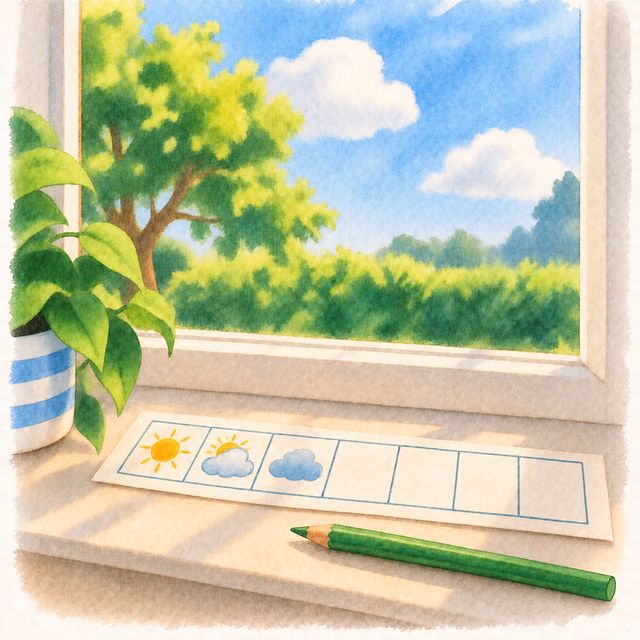
A daily look at the sky becomes a pattern.
Your child looks out of a window each day, taps what the sky is doing, and the mark goes onto a week strip. A painted practice week comes first, and after a week the marks show a pattern.
- Pre-K to Grade 3–4
- 3 min
- Nothing to prepare
- On the screen
Free to sign up.
Is it a good fit?
- Ready if Your child can look at a window and tell you whether it is sunny, cloudy or raining.
- Too much today? The Pre-K level: four skies, one tap each, over four days.
- Too easy? The Grade 1–2 level: count the rainy days, say whether there were more sunny or rainy, and make a forecast that tomorrow checks.
What your child practises
- Naming the weather
- Counting days
- Reading a thermometer
- A forecast, then a check
“There were more sunny days than rainy days this week.”
If your child says something like this, in their own words, the idea has landed. Finishing the rounds means they took part; this is the learning.
Your part
- Nothing to prepare; a thermometer outside the window at Grade 3–4 if you have one
- Each question has a Read it to me button
- With your child at Pre-K, alone from Kindergarten
Take it off the screen (optional)
Look out of the same real window at the same time each day, and at the end of the week read the marks together.
More like this
The full design
What it is
Look out of the same window every day and say what the sky is doing. After a week the marks make a pattern; after a month your child can make a claim about the weather and back it up. This is the first shape of science a four-year-old can do: look, say it, write it down, and later read what you wrote. The screen gives a practice week first, a painted window with the weather drawn over it, so the habit is learned before the real window starts.
How it goes
The Pet perches on the window frame: "Monday. What is the sky like in the window?" The child looks at the painted window (the rain patters, the leaves blow past, the sun shines) and taps the matching picture; a wrong tap gets a clue ("drops are falling"), never a cross. The day's mark lands on the week strip under the window. At K the Pet then asks warm or cold; at 3–4 it asks for the number on the thermometer. After the seven days the strip is read: count the suns, count the rain, read the line. Every day's box on the strip can be tapped and says its weather, so counting is touching.
The Pet
Asks: "Look at the window. Then tap." Notices the pattern in the child's own marks: "Marked. A third rainy day." At 3–4 it says the reading back: "21 degrees. You read it." Dares (1–2): "Bet you can say tomorrow's sky before it comes", and a forecast is never wrong: "You said Sunny; it was Rainy. A guess with a reason is a forecast."
By band
Pre-K: four skies (sun, cloud, rain, wind), one tap each; four days. K: the sky and then warm or cold, seven days, then "how many sunny days?" counted off the strip. 1–2: seven days, then "how many rainy days?" and "more sunny or more rainy?"; the dare is one forecast, checked when tomorrow comes. 3–4: the sky and a thermometer reading each day, drawn big enough to read against its numbers; the seven readings make a line; "is it getting colder?" read off the line; a forecast for tomorrow, and tomorrow comes and checks it.
What it grows
Weather is the first pattern science asks children to notice, in kindergarten and again with data in third grade: the same place, the same time, over days. The habit this grows is the one every science notebook rests on: what did you see, what did you write, and what does the week say that one day cannot.
Done, and what counts as evidence
Done = the practice week read to the end. What counts as evidence is the strip or the chart at the end of a real week or month, once, and at 3–4 one forecast and what happened the next day. A daily mark is a habit, not a record.
What's personal
The temperatures come in your family's unit: a Canadian child reads 21°, an American child reads 70° on the same thermometer. The practice week is the game's; the real window is yours, and the game never claims to know what your sky is doing. If your child leaves mid-week, the marks are kept and offered back next time.