Science · Pre-K to Grade 5–6
Who lives here?
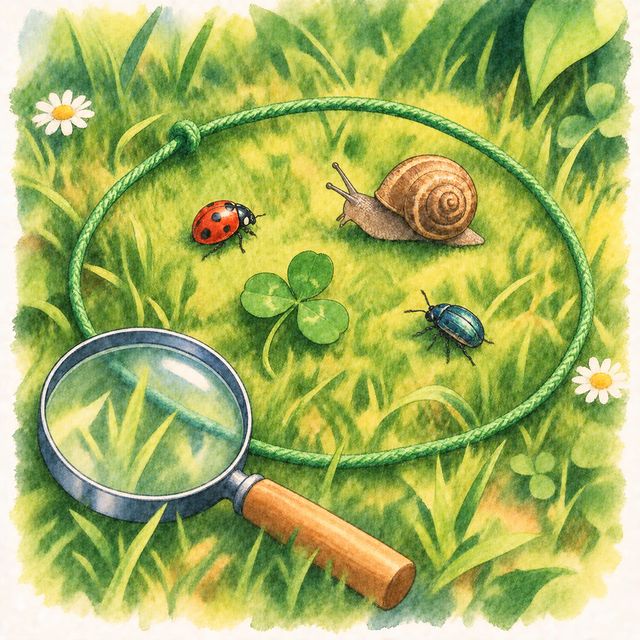
A loop of string on the ground becomes a small world.
A painted square of ground shows a snail, a worm, a beetle, a dandelion and a few things that aren't alive. Your child finds who lives there and what each one needs, then drops a loop of string in the garden or park to look for real.
- Pre-K to Grade 5–6
- 20 min
- A printout
- On the screen
Free to sign up.
Is it a good fit?
- Ready if Your child can tap things in a picture and is curious about snails and worms.
- Too much today? Start with What lives in the pond?: tap the painted pond and hear each thing named.
- Too easy? The Grade 3–4 level: count your square, compare it with the Pet's shady one, and say why.
What your child practises
- Alive or not
- What living things need
- Counting and comparing
- Who eats whom
“The worm eats the leaf, and the beetle eats the worm.”
If your child says something like this, in their own words, the idea has landed. Finishing the rounds means they took part; this is the learning.
Your part
- A loop of string or a hula hoop, and a magnifier if you have one
- Each question has a Read it to me button
- Outside with your child up to Grade 1–2, alone from Grade 3–4
Take it off the screen (optional)
Drop the loop in your garden, balcony box or nearest park, and from Grade 1–2 draw what lives there.
More like this
The full design
What it is
Drop a loop of string on the ground, and everything inside it is a small world. Who lives there, what is alive and what is not, what each one needs, and who eats whom. The screen shows a painted square with a snail, a worm, a beetle, a dandelion, a stone, a fallen leaf and a bottle cap; the real square in your garden or the park is the point, and the screen is the rehearsal for it.
How it goes
The Pet says "drop the loop, I wonder who is home", and the question sits above the painting. Your child taps a thing in the square; the Pet names it and says whether it fits, and a tap on anything else is answered too. What was found, named or chained goes into the notebook under the square, and if the game is left in the middle, it offers to carry on from that round with the notebook as it was. At the end, a card says what was done and what to do outside.
The Pet
Asks: "the worm, what do you think it eats?" Notices what the tap showed: "Dandelion. Alive. It grows toward the sun." A miss is answered with the true thing: "A dandelion eats nothing. It makes its food from light." Dares: at K, the beetle's need; at 1–2, the last name; at 3–4, the worm's dinner; at 5–6, the snail in a chain. From 3–4 the shady square is the Pet's own, said as the Pet's.
By band
Pre-K: tap something alive, then something not, twice each; any that fits is right, and the fallen leaf gets its own honest answer (part of a plant once, not alive now). K: tap each living thing to count it, then say what three of them need: water, sun or a hiding place. 1–2: tap a living thing and name it from its clue (the shell, the six legs), three times, then what the worm eats. 3–4: count your square, then the Pet says its shady square had seven, yours has four, how many more, and why. 5–6: a food chain from the square, leaf to worm to beetle, then the two squares and a reason with a because.
What it grows
Living or not, what living things need, and who eats whom are the first three ideas of ecology in the early grades, and the practice that carries them is looking at one small place again and again. Nature journaling is that practice, and a loop of string is the oldest tool ecologists have for it.
Done, and what counts as evidence
Done = one square on the screen, then one outside. The drawing of the real square with its labels is the work sample from 1–2; the 3–4 count of two squares and the 5–6 chain and reason are observations. One line worth keeping: what your child thinks lives under the leaf.
What's personal
The square is your garden, balcony box or nearest park, and the grown-up who comes is whoever comes. The real square will have different things in it from the painted one; that is the conversation, not a problem. No place is stored: "the park" is a word your family says.