Science · Grade 1–2 to Grade 5–6
Moon diary
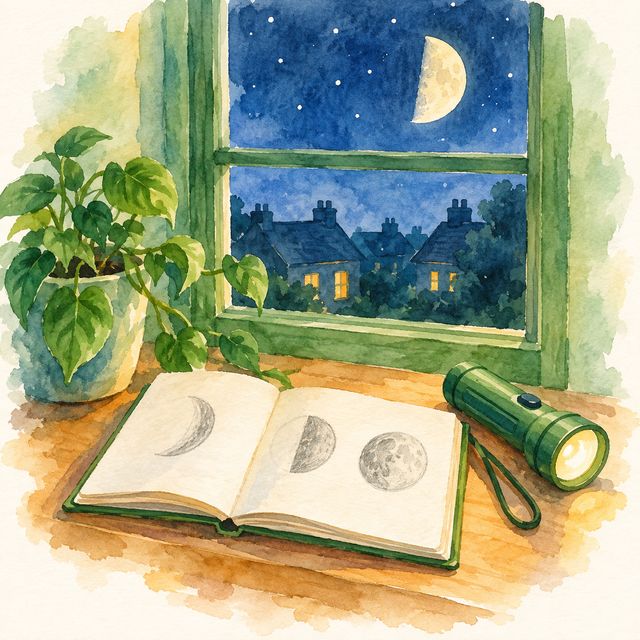
Two minutes at bedtime, and the moon's pattern appears.
Each night at bedtime, your child looks at the moon and taps the shape it is, which takes about two minutes. After two weeks the strip of shapes shows a pattern, and your child predicts what comes next.
- Grade 1–2 to Grade 5–6
- 2 min
- Nothing to prepare
- On the screen
Free to sign up.
Is it a good fit?
- Ready if Your child can look at the moon and point to the picture that matches its shape.
- Too much today? Start with Weather window: a daily look out of the window and one tap.
- Too easy? The Grade 3–4 level: where the moon sat and when, and a guess at its shape a week on.
What your child practises
- Matching shapes
- Bigger or smaller
- What comes next
- A prediction, then a check
“It has been getting fatter every night, so soon it will be full.”
If your child says something like this, in their own words, the idea has landed. Finishing the rounds means they took part; this is the learning.
Your part
- Nothing to prepare
- Two minutes at a window at bedtime, alone or with you
- A lamp and a ball at Grade 5–6
Take it off the screen (optional)
At Grade 5–6, a lamp for the Sun, a ball for the Moon and your child's own head for the Earth show why the shape changes.
More like this
The full design
What it is
Look at the moon at bedtime and tap the shape it is tonight. After two weeks the strip of shapes tells a story on its own: a fingernail, a half, a plate. The moon grows and shrinks on a cycle of about twenty-nine and a half days, and a child who has drawn a fortnight of it can say what comes next before it happens. That is the first prediction in science they will make from their own record.
How it goes
The Pet reminds once, quietly, at bedtime: "moon check?" Your child looks out of the window, taps the shape that matches (or "hidden, clouds"), and the Pet says one thing: "fatter than last night, growing". The shape goes onto the strip and the round is over, in two minutes. Night 14 is the long one: the strip, bigger or smaller, and "it cannot get fuller than full, so what is next?"
The Pet
Notices: "thinner than last night, shrinking." Asks (night 14): "it has been growing for five nights, what is next?" Remembers (3–4): "a week ago you guessed tonight's moon. Look first!" Admits on a cloudy night: "I cannot see it either, we mark hidden." Dares (3–4 and 5–6): "bet you can say the date of the next full moon."
By band
1–2: eight moon shapes as pictures, tap the one that matches, "hidden" when it is cloudy; on night 14 the strip and the question, bigger or smaller, and what comes next. 3–4: also where in the sky it sat and when; from night 5 a guess at the shape a week on, checked when that night comes; at full, "when will it be full again? how many nights?" 5–6: the model, a lamp for the Sun, a ball for the Moon, your own head for the Earth, and why the shape changes (not the Earth's shadow: we see more or less of the half that is always lit); then, counting from tonight's shape, the date of the next full moon, which the Pet keeps and asks about on that night.
What it grows
The moon's pattern is the first sky cycle in the early-years science standards and the model with a lamp is the one for the middle years; the two-minute round at bedtime is what actually gets done every night, and a fortnight of two minutes is where the pattern shows.
Done, and what counts as evidence
Done = a night. Nothing nightly is written to the records; the fortnight strip is a work sample once, and at 3–4 and 5–6 the prediction and whether it held is an observation a parent may keep.
What's personal
The family's bedtime and the family's window. If the family keeps a lunar calendar, its months are a memory a parent can share, and the Pet then names them.