Science · Kindergarten to Grade 7–8
Our solar system
The sun and its planets, in order, at their true sizes.
Your child compares the sun and the planets two at a time, drawn at their true sizes, and guesses which is nearer the sun. Older children pace out the distances on a walk.
- Kindergarten to Grade 7–8
- 10 min
- Nothing to prepare
- On the screen
Free to sign up.
Is it a good fit?
- Ready if Your child can tell you which of two balls is bigger and knows the sun is hot.
- Too much today? The Kindergarten level: three balls, which one is home, which is nearer and which is bigger.
- Too easy? The Grade 1–2 level: the eight planets tapped into order from the sun, rocky or giant.
What your child practises
- Nearer or further
- Bigger or smaller
- Planets in order
- Scale
“Mars is fourth from the sun, next door to us.”
If your child says something like this, in their own words, the idea has landed. Finishing the rounds means they took part; this is the learning.
Your part
- Nothing to prepare
- Each question has a Read it to me button
- Plays alone; you go with your child on the walk at Grade 3–4
Take it off the screen (optional)
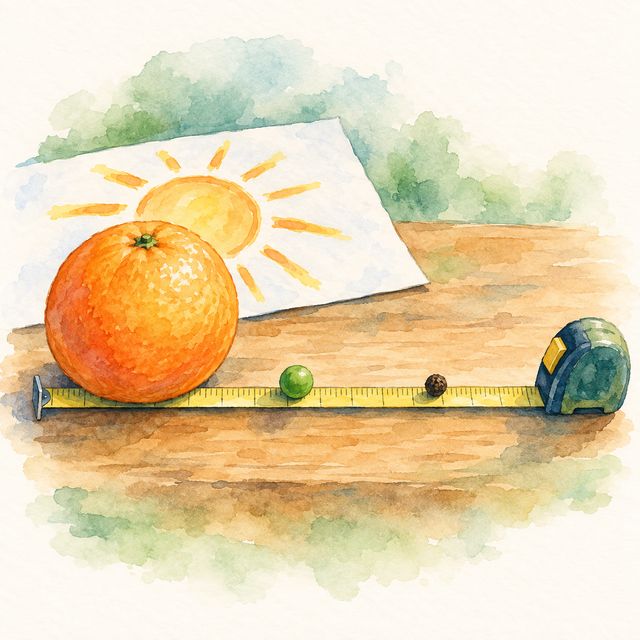
At Grade 3–4, walk the model on your street together: the sun as big as your head, Earth a peppercorn 26 paces away.
More like this
The full design
What it is
The sun and its eight planets as a family of things with an order, sizes, and distances a child can walk. Skill: order and compare; scale; then a model with gravity in it.
How it goes
The Pet: "which is nearer? guess before you look" → two bodies side by side at sizes true to each other → a miss is answered with the line from the sun, never "wrong" → one true thing about the winner → at 3–4 the walk, reported by a tap, then Neptune's paces guessed.
The Pet
Notices: "Mars, fourth. Its neighbour." Asks: "bigger, or smaller? guess before you look." Dares (3–4 up): "bet you can spot a planet tonight: the brightest thing that does not twinkle."
By band
K: three balls and which is home; the sun is hot; which is nearer, which is bigger. 1–2: the eight tapped into order from the sun (a rhyme the family makes up); rocky or giant. 3–4: how many Earths across; the peppercorn walk for real (the sun a ball as big as your head, Earth a peppercorn 26 paces off, Neptune 777). 5–6: a day is a spin and a year a trip round (Venus, where the day is longer); why the seasons (the lean, not the distance: the usual guess named and answered). 7–8: a child's weight on the Moon and two worlds; the scale from the numbers.
What it grows
NGSS 5-ESS1, MS-ESS1-3; NASA Science for every number; Ottewell's thousand-yard model for the walk.
Done, and what counts as evidence
Done = the rung's rounds. The walk (3–4) and the seasons answer (5–6) are the observations.
What's personal
The family's own paces and street for the walk; the rhyme in the family's language.