Science · Kindergarten to Grade 5–6
Light around corners
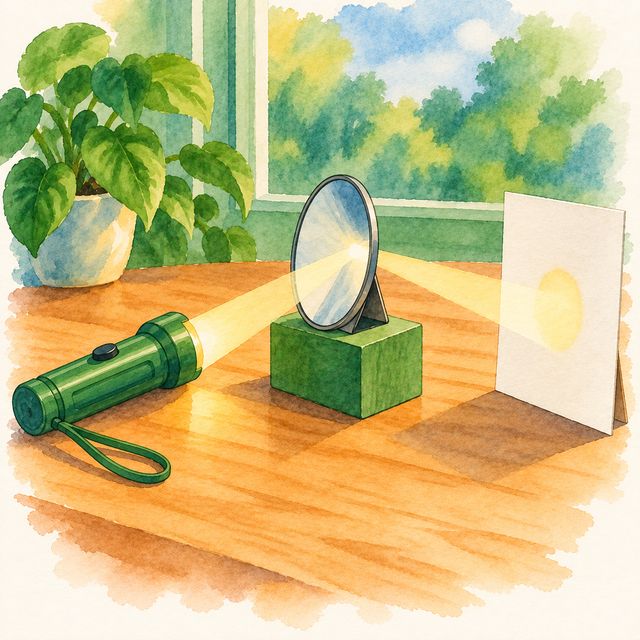
Aim a torch beam round a corner with a mirror.
A paper star hides behind a cardboard wall, and a torch points at a mirror. Your child turns the mirror a little at a time until the beam lands on the star, then draws the light's path.
- Kindergarten to Grade 5–6
- 15 min
- A printout
- On the screen
Free to sign up.
Is it a good fit?
- Ready if Your child can turn a mirror slowly and watch where the bright patch goes.
- Too much today? The Kindergarten level: turn the mirror and watch the patch move until the star lights.
- Too easy? The Grade 3–4 level: look at the way in and the way out at the mirror, and find they match.
What your child practises
- Light goes straight
- A mirror turns it
- Drawing the path
- Guessing before turning
“Light goes straight until the mirror turns it.”
If your child says something like this, in their own words, the idea has landed. Finishing the rounds means they took part; this is the learning.
Your part
- A small torch, an unbreakable mirror, a piece of cardboard and a paper star
- You set the torch and keep the one rule: never a beam at eyes, no lasers, no sunlight
- Your child then plays alone in a dim room
More like this
The full design
What it is
Light goes in a straight line until something turns it, and a mirror turns it exactly, so you can aim a beam round a corner. A paper star hides behind a cardboard wall; the torch may not move; only the mirror turns. Your child turns it and watches the bright patch swing until it lands on the star. The rule they take away is that light bounces, it never bends round on its own.
How it goes
A grown-up sets the torch on a book pointing at the mirror, with the wall between the torch and the star, and your child taps "set". The screen shows the room from above. Two buttons turn the mirror a little left or a little right, and the beam on the drawing swings with it; the Pet says where the patch went ("into the wall, turn a bit more"). When the beam reaches the star, it lights. At 1–2 your child then taps the torch, the mirror and the star in order to draw the path; at 3–4 answers the question about the two angles; at 5–6 the guess comes first, and then the second mirror. A star lit and a path drawn is a round.
The Pet
Notices: "you turned the mirror and kept the torch still, one thing at a time." Asks: "where does the light touch the mirror?" Remembers: "the hidden target, can light reach it from here?" Dares: two mirrors, played now at 3–4.
By band
K: turn the mirror and watch the patch move; light the star. 1–2: then draw the path, torch to mirror to star, two straight lines and one bend. 3–4: look at the way in and the way out at the mirror: the same angle. 5–6: say where the patch will land before turning, turn and see; then two mirrors, round two corners.
What it grows
Light in straight lines, and a mirror turning it, is the early-years light standard and the middle-years one, and a periscope is where children meet it; the guess before the turn is what makes the second mirror a test instead of a fiddle. The grown-up keeps the one rule: never a beam at eyes, no lasers, no sunlight.
Done, and what counts as evidence
Done = a target lit and a path drawn. At 5–6 the guess beside what actually happened is the work sample; the 3–4 answer about the angles is an observation a parent may keep.
What's personal
The star can be your child's own drawing, and the room is theirs.