Science · Grade 1–2 to Grade 5–6
Circuit rescue
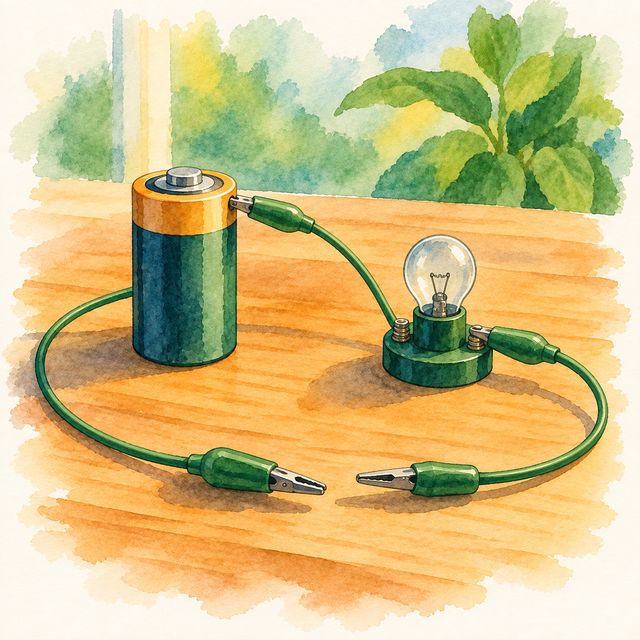
Your child finds the break and lights the bulb again.
The Pet's light has gone out. Your child follows the loop from the battery through the bulb and back, finds the break, and reconnects a real circuit kit until the real bulb lights.
- Grade 1–2 to Grade 5–6
- 20 min
- A printout
- On the screen
Free to sign up.
Is it a good fit?
- Ready if Your child can follow a line with a finger, part by part, and push a lead into a clip.
- Too much today? Start with Magnet hunt: guess, test and sort, with no wires at all.
- Too easy? The Grade 3–4 level: draw the loop, then test which of a paper clip, a rubber band and a coin closes a gap.
What your child practises
- Following a loop
- Finding a fault
- Saying first, then testing
“The bulb only lights when the loop goes all the way round.”
If your child says something like this, in their own words, the idea has landed. Finishing the rounds means they took part; this is the learning.
Your part
- A bought low-voltage circuit kit, never anything home-made
- You check the kit before and after: no mains, no button cells, no shorting the battery
- Your child then works alone at the table
More like this
The full design
What it is
A bulb lights only when there is a complete loop from one end of the battery, through the bulb, back to the other end. The Pet's light has gone dark, and the job is to find the break by following the loop with a finger, not by pulling everything apart. That habit, trace the path and change one thing, is the whole of fault-finding, and it starts here.
How it goes
A grown-up checks the kit and your child taps "kit checked". The loop is drawn on the screen with the battery's end marked; your child taps each part in the order the loop goes, and the Pet asks "and next?" At the break, "reconnect it", then the real lead into its real clip, and "the real bulb lit". The Pet walks the recorded loop once. At 3–4 the three things in the gap, each predicted then tried; at 5–6 the tests, each predicted then tried, with a log of what each showed. A restored loop is a round.
The Pet
Notices: "you followed the path instead of pulling everything out." Asks: "where does this lead go next?" and, before every test, "say first". Remembers: "the loose lead, where will you start today?" Dares: the break with a second bulb in the way.
By band
1–2: one loose connection in the real loop; follow the loop part by part on the screen, find the break, push the real lead back into its clip and see the bulb light. 3–4: draw the loop by tapping its parts in order (the drawing is kept), then a gap in one lead and three things to put in it, a paper clip, a rubber band, a coin: say first, then try, which ones close the loop? 5–6: two bulbs side by side on one battery, one dark; pick one test at a time (swap the bulb, swap the lead, swap the battery), say what will happen first, and find the fault.
What it grows
Circuit simulations teach the loop; a real kit teaches the hands, and the two together are what the middle-years energy standard asks for. Safety is the grown-up's: no mains, no button cells, no shorting the battery, and the kit is checked before and after.
Done, and what counts as evidence
Done = a restored loop. The 3–4 drawing is the work sample; the 5–6 sequence of tests, with a prediction before each, is an observation a parent may keep. No count of faults is kept anywhere.
What's personal
The kit is the family's; the "dark thing" can be your child's own lamp in the drawing once the games take the family's memories.