Math · Kindergarten to Grade 5–6
Secret rule machine
Your child finds a machine's secret rule, then tests it on a number it has not seen.
The Pet becomes a machine with a secret rule. Your child feeds it apples or numbers, watches what comes out, picks the rule, then tests it on a new number to see if it holds.
- Kindergarten to Grade 5–6
- 15 min
- Nothing to prepare
- On the screen
Free to sign up.
Is it a good fit?
- Ready if Your child knows what "one more" means with a few apples.
- Too much today? Start with Pattern parade: hearing a rule and keeping it going before finding one.
- Too easy? The Grade 5–6 level: a two-step rule written as 3n − 1, used to predict a new number, and told apart from another rule that also fits.
What your child practises
- Spotting a rule
- Testing a guess
- Telling two rules apart
- A rule written with n
“It works for the ones I fed, not sure for big ones.”
If your child says something like this, in their own words, the idea has landed. Finishing the rounds means they took part; this is the learning.
Your part
- Nothing for the screen game
- Each question has a Read it to me button, and a long press on an answer reads it aloud
- Sit beside a Kindergarten child; from Grade 1–2 your child plays alone
Take it off the screen (optional)
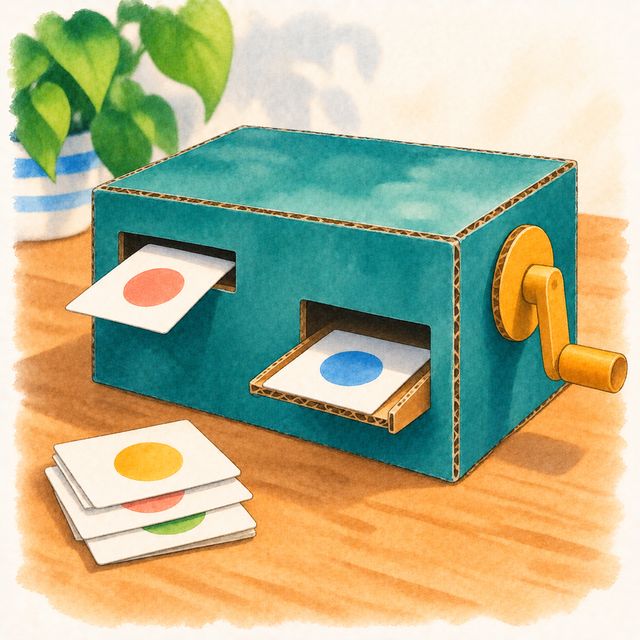
Make the machine from a cardboard box and let a grown-up be the machine, with a rule of their own.
More like this
The full design
What it is
A machine with a secret rule: something goes in, something else comes out. Your child feeds it, watches, feeds it again, and says the rule. Then the real move: feed it a new number the rule has not seen, and see whether the rule holds. Guessing is easy; choosing the test that could catch a guess out is the science, and the maths, in this game.
How it goes
The Pet is the machine on the screen. Your child feeds it (apples from a basket at K, a number from 1–2), the machine whirrs and shows what came out, and each case goes in a table. After a few, "what is the rule?" with three to choose from, or at the top the rule built as maths writes it. The screen checks the chosen rule against every case in the table: a rule that fits them all is accepted, even one that is not the machine's, and the next new number decides. A number fed twice is answered and never counted as a case. Last, the rule is written down with one honest limit: "works for the ones I fed, not sure for big ones". Three or four steps, then the next machine.
The Pet
Notices: "a new one, and the rule held. Tested!" Asks: "4 gave 2, 7 gave 5. What changed?" Admits: "two rules fit both, I cannot tell either", and on a number that tells nothing, "both rules say 15 for 5, that one does not tell them apart". Remembers: "last time you caught my secret rule, catch me again?" Dares: numbers after apples, two rules that fit, a rule written with n, and at the top, being the machine for someone at home tonight.
By band
K: apples in, apples out; one machine gives one more, another one fewer; say what the machine does, then test it on a new number of apples. 1–2: the machine takes two away, then a second machine (adds three, adds ten or doubles); the rule in words, tested on a number not fed, and written down with how far it was tested. 3–4: two rules fit the two cases shown (0 gives 0 and 2 gives 4: "doubles it" and "times itself" both work), so which number would tell them apart? Feed it, then say which rule it is. 5–6: a rule with two steps, written the way maths writes it ("3n − 1"), used to predict a new number before the machine runs; then a two-step rule that another rule also fits, told apart by a number the child chooses.
What it grows
Children learn more from choosing the case that could settle a question than from being handed the answer, and several rules can fit a little evidence: the Pet says so out loud instead of pretending the first fit is the truth.
Done, and what counts as evidence
Done = a rule tested on a new case. What is kept is the written rule and its limit, in the child's words; a guess that did not hold is never written down, because a wrong guess tested is exactly what the game asks for. Nothing counts errors.
What's personal
On the screen the machine is the Pet, by the name your child gave it. Away from the screen the machine can be a person your child loves, a sibling or a grandparent, with a real box and the family's own things to feed it.