Math · Grade 3–4 to Grade 7–8
Balance the beast
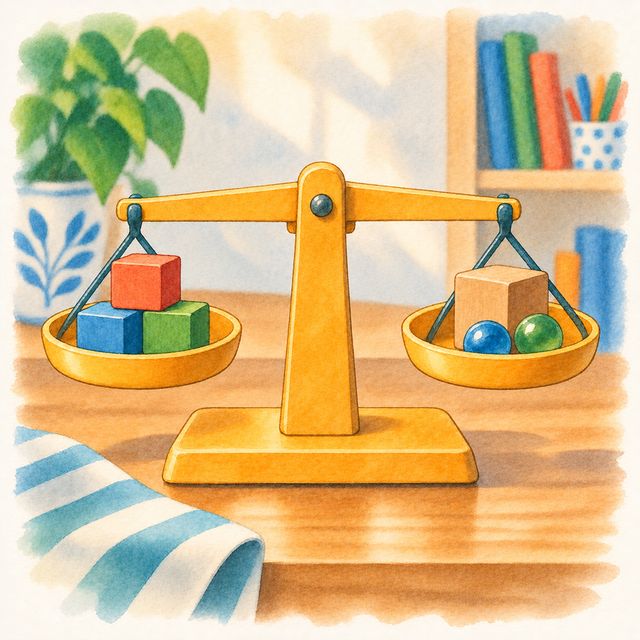
Keep the scale level and find what is in the box.
A balance scale holds a mystery box on one side. Your child takes the same weight off both sides to keep it level until the box sits across from one number, and each move is written as a line of maths beside the scale.
- Grade 3–4 to Grade 7–8
- 10 min
- Nothing to prepare
- On the screen
Free to sign up.
Is it a good fit?
- Ready if Your child can add and take away small numbers, like 6 and something making 10.
- Too much today? The Grade 3–4 level: one box and one weight, the box wearing the Pet's face.
- Too easy? The Grade 7–8 level: boxes on both sides, numbers below zero as balloons, then the equation alone.
What your child practises
- The same to both sides
- Finding the unknown
- From a scale to an equation
“Six off both sides, and it's still level.”
If your child says something like this, in their own words, the idea has landed. Finishing the rounds means they took part; this is the learning.
Your part
- Nothing to prepare; a real balance scale and some blocks if you have them
- Each question has a Read it to me button
- Plays alone: a wrong number goes into the boxes and the scale tips to show why
Take it off the screen (optional)
Put a block, an apple or a toy on a real balance scale and keep it level together.
More like this
The full design
What it is
A toy balance scale with a mystery box on one pan. It is level, so both sides weigh the same. Your child takes a weight off the box's side, sees the scale tip, and takes the same off the other side to make it level again, until the box sits alone across from one number. That number is what is in the box. Every move is also written as a line of maths beside the scale, so "keep it level" and "do the same to both sides of the equals sign" are learned as one thing, which they are.
How it goes
The scale is level. Your child taps the weight sitting with the box: it lifts off, the scale tips, and at the same moment the line beside it grows the move, with a dashed box where the same is still owed on the other side. A tap on the number on the other pan takes the same off there, the scale levels and the line settles. That pair of taps is the lesson, written and weighed together. When the box is alone across from one number, your child opens the box and sees what was in it: nothing asks them to guess a number the scale is already showing. On the last round of the older rungs there is no scale at all, only the lines, and there your child picks from three numbers; a wrong one goes into the boxes and the scale appears, tipped, so they can see why. Five boxes, then a card that says what was done.
The Pet
Notices: "6 off both sides, and that kept it level." Asks when the scale tips: "the line shows the same still owed on the other." Remembers: the box comes back later in the session with something else in it, and the Pet says what it held last time. Dares: the next kind of box, one rung up, played there and then; at the top, where there is no rung above, it bets your child can write one of these for a grown-up tonight and check their moves.
By band
3–4: one box and one weight, "6 and the box make 10", the box a picture with the Pet's face on it; five rounds. 5–6: the box is called x; two boxes and a weight, then three boxes alone that must be shared out; the last round has the scale hidden and the lines alone, with a button to show the scale if it is wanted. 7–8: boxes on both sides, and numbers below zero drawn as balloons that lift the pan; then the equation alone.
What it grows
Children learn the moves of algebra fast when the moves are on a scale, and lose them when the symbols come later on their own. Writing the line at the moment of each move is the bridge, and it is why the symbols never leave the screen here.
Done, and what counts as evidence
Done = five level rounds. Nothing here is scored. From 5–6 the written lines beside the scale are a piece of work worth keeping: the same problem as a scale and as an equation, in your child's own moves.
What's personal
The box wears the Pet's face. The weights are plain numbers on the screen; at the table they can be anything, a block, an apple, the Pet's toy, on a real scale.