History · Grade 1–2 to Grade 5–6
Older or newer?
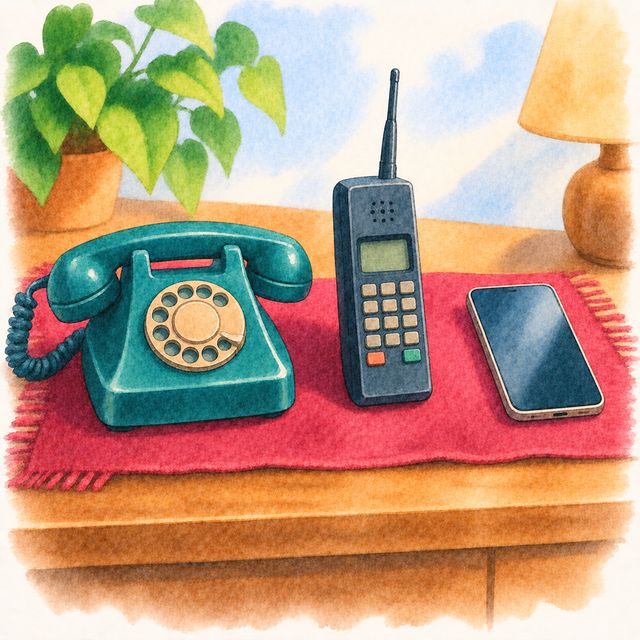
Tell older from newer by the clues, not a guess.
Two painted things appear side by side, each with a clue like worn edges or a plug. Your child taps the older one and says how they know, then checks the Pet's guesses, which are sometimes wrong on purpose.
- Grade 1–2 to Grade 5–6
- 15 min
- Nothing to prepare
- On the screen
Free to sign up.
Is it a good fit?
- Ready if Your child can look at two things side by side and say which looks more used or old.
- Too much today? Start with Then and now: the same kitchen long ago and today, side by side.
- Too easy? The Grade 3–4 level: five things put in order, then a building's clues and a guess at its decade.
What your child practises
- Clues to age
- Oldest to newest
- BCE and CE
“It has a plug, so it's newer.”
If your child says something like this, in their own words, the idea has landed. Finishing the rounds means they took part; this is the learning.
Your part
- Nothing to prepare or print
- Each question has a Read it to me button
- Alone at the table; at Grade 3–4 a grown-up for a short walk to look at one real building
Take it off the screen (optional)
Put two real things from home in order, a spoon, a toy or a photo, and say how you know.
More like this
The full design
What it is
Everything around you was made at some time. Which of two things is older, and how can you tell? Not by guessing: by clues. Worn edges, a wind-up key, a plug, a date on a coin, wooden windows on a house. Your child learns to look at a thing and say what it says about when it was made, which is the first habit of history.
How it goes
Two painted things side by side, each with its clue written under it. Your child taps the older one; a newer one tapped is asked "is that older, or newer?" with its clue, never marked. Then "how do you know?" and a reason. Then the Pet has its turn: it says which it thinks is older and why, and your child judges it. Twice in three pairs the Pet is wrong on purpose, always the same way (a scratch means used, not old), and catching it earns "you caught me". Every picture opens big with a hold, and "Read it to me" reads its clue. Left mid-game, the game offers to carry on where it was.
The Pet
Asks: "a plug and a shiny lid. Is that older, or newer?" Notices: "you looked at the plug, a clue for newer. So the other is older." Claims, and is checked: "I say the kettle is older, because it has got a scratch. Am I right?" Dares: "bet you can put five things in order, oldest first", and the round runs right then.
By band
1–2: two things at a time, tap the older one, then say how you know from five reasons (every reason is a clue; none is wrong). 3–4: five things put in order from their clues, then a real building on a walk and a drawn house to practise on: pick its clues, guess the decade, check the date stone. 5–6: a coin, a photo, a house and a fossil placed on one timeline with BCE and CE, and the fossil worked out as thousands of strips of twelve thousand years.
What it grows
Chronology from evidence is the core of history in the first years of school: not dates first, but "older, newer, how do I know". The scale of time (centuries, BCE and CE, deep time) comes later and is hardest to picture, which is why the fossil is counted in strips rather than said as a number.
Done, and what counts as evidence
Done = the pairs (1–2), the five in order and the house (3–4), the timeline (5–6). Evidence is what your child says at the table: which is older, and how they know. At 5–6 the timeline drawn on a strip of paper, with the fossil off the end, is the work sample.
What's personal
The things on the screen are painted stand-ins, and nobody is named: the old clock is "the old clock", not anyone's grandmother's. The walk is yours: the game sends your child to look at one real building, then comes back to a drawn house to practise on. Nothing about your street is stored. The two real things from home at the end are the best part, and the game never sees them.