History · Grade 3–4
Timeline of everything
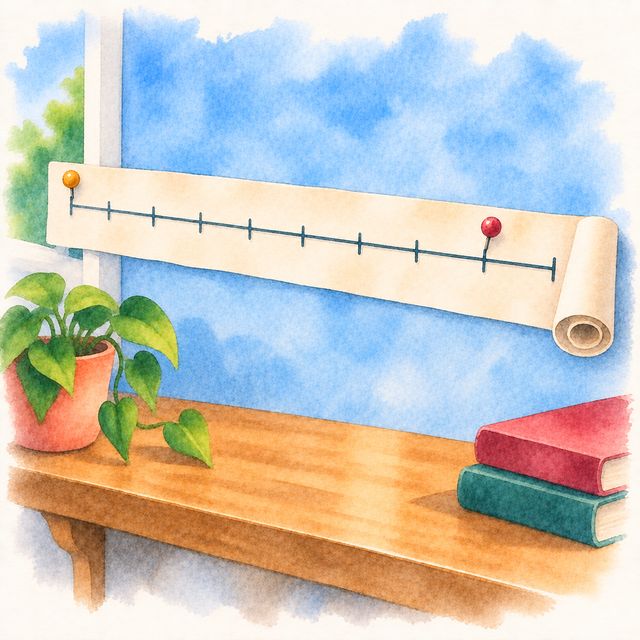
A line of time with your child in the middle of it.
Your child places cards on a line of time with their own birthday on it: a grandparent's birth, the first phone call, the pyramids, the dinosaurs. The screen shows each gap in years, so your child sees how long ago each one was.
- Grade 3–4
- 10 min
- Nothing to prepare
- On the screen
Free to sign up.
Is it a good fit?
- Ready if Your child knows their grandparents were born long before them and has seen a year written, like 1998.
- Too much today? Start with Older or newer?: putting things in order by their clues, before by years.
- Too easy? The Grade 5–6 and 7–8 levels, with BCE and CE and three places at once, are written and still to come.
What your child practises
- Before I was born
- Gaps in years
- How long ago is long ago
“The pyramids were already very old when Grandma was born.”
If your child says something like this, in their own words, the idea has landed. Finishing the rounds means they took part; this is the learning.
Your part
- Optional: a birth year or two on your family tree puts your own grown-ups on the line, kept private to your family; without them it plays four fixed cards
- Each question has a Read it to me button
- A grown-up nearby for the first go
Take it off the screen (optional)
At the table, ask which two things were nearly at the same time, and why the pyramids are "about".
More like this
The full design
What it is
One line of time with your child's birthday on it, and everything else placed next to it: a grandparent's birth year, the first phone call, a coin from 1998, the Great Pyramid, the dinosaurs. Nothing is memorised. The child taps each card into "in my life", "before I was born, long ago" or "very long ago", and the screen writes the gap in years. The lesson is the stretch: Grandma is 60 years before you, the pyramids 4,600, the dinosaurs so far that the line would have to be a thousand times longer. History starts to have a shape, with your child in the middle of it.
How it goes
The Pet asks "what was happening when Grandma was born?" and any true answer will do: no phones in anyone's pocket, the pyramids already very old, the dinosaurs long gone. Then one card at a time: the child taps the part of the line it belongs to, the card lands as a pin with its year under it, and the gap is written ("62 years before you were born"). A tap in the wrong part is answered with the years, never with "wrong". Then the Pet puts the first aeroplane flight in the child's life on purpose and the child sends it where it belongs. Last, three pairs from the line: which two are nearly neighbours? The line reads old to new, and the "very long ago" end is drawn wider because it holds almost everything.
The Pet
Asks "closer to you, or to the pyramids?" and "1903: before the phone call, or after?" Notices every landing with the number: "1876. Before everyone in your family. Long ago, not very long." When the child catches its aeroplane: "You checked me." It says "about" whenever the number is one: the pyramids' year is a range, and so is the child's own if you have not entered it.
By band
3–4 today: an opening question about the year the oldest grown-up on your tree was born, six cards placed one at a time, the Pet's own card checked, then "which two were nearly at the same time?". 5–6 (zooming from my life to the world, BCE and CE, "how do you know?") and 7–8 (what was happening in three places at once) come later.
What it grows
Relative time comes before dates: a child places "before I was born" long before they can hold "1876", and a family timeline is the entry point the classroom research names. Saying "about" out loud, and showing that the far end of the line is enormous, is how the scale of time first lands.
Done, and what counts as evidence
Done = the cards placed and the aeroplane put right; if you left the game part way, it carries on from the same card with the line as it was. Evidence is a sentence at the table: ask which two things were nearly at the same time and why the pyramids are "about".
What's personal
The grown-ups on the line are your own, by the names and birth years you put on the family tree (two at most, the oldest first; a person without a year is not a card, and nobody is invented). Your child's own year is used only if you entered it; otherwise the game says "about" and shows no year on their pin. A family with no tree yet plays the four fixed cards, and the opening question is about the phone call instead.