Geography · Grade 1–2 to Grade 7–8
Where in the world is Pip?
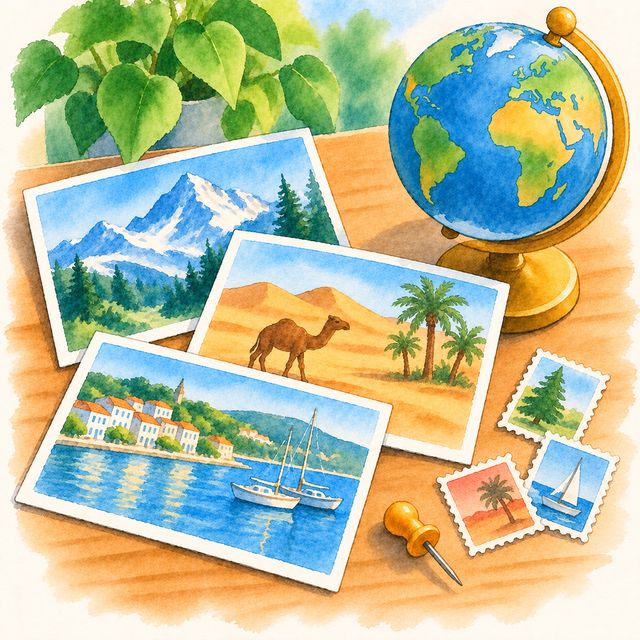
Read the clues on a postcard and find where the Pet went.
The Pet is travelling and sends postcards with clues: an animal, the weather, a food, a word. Your child reads the clues and taps the map to find where it went.
- Grade 1–2 to Grade 7–8
- 10 min
- Nothing to prepare
- On the screen
Free to sign up.
Is it a good fit?
- Ready if Your child knows a kangaroo or a penguin and enjoys a guessing game read aloud.
- Too much today? Start with Animal atlas: one animal, one continent, no clues to weigh.
- Too easy? The Grade 5–6 level: capitals and climate, with clues about rain and the seasons; Grade 7–8 adds time zones and the lines on the globe.
What your child practises
- Continents and countries
- Clues from animals, weather and food
- Ruling places out
- Seasons and time zones
“The llama told me it was the mountains.”
If your child says something like this, in their own words, the idea has landed. Finishing the rounds means they took part; this is the learning.
Your part
- Nothing to prepare or print
- Each question has a Read it to me button
- At Grade 1–2, sit with your child to read the clues; from Grade 3–4 it plays alone
Take it off the screen (optional)
If there is a globe or an atlas at home, find the postcard's place on it together.
More like this
The full design
What it is
Your child's Pet has gone travelling and sends postcards home. Each postcard carries clues: an animal, the weather, a food, a word people say there, a famous place. Your child reads the clues, works out where the Pet is, and taps the map. It is the old detective game of guessing a country from what life is like there, with a traveller your child already loves. What it teaches is that a place is a bundle of things: what lives there, what the weather does, what people eat and say.
How it goes
A painted postcard slides in with the Pet in the scene. The first clue appears and is read aloud. Your child taps a continent. A wrong tap greys that continent out, the Pet asks a question that rules something out ("is it hot there? what does that tell you?"), and the next clue arrives. When the continent is right, at 3–4 and up the map gives way to three countries and the last clue. When the place is right, the postcard turns over: "you found me in Peru", one true fact, and something the Pet wonders about. Three postcards make a session.
The Pet
It notices how your child got there ("you knew it from the animal"). It asks rather than tells: a question about hot or cold, about where the animal in the clue lives, and, if your child is stuck, it lights the continent it means. It remembers the places found before ("you found me in Peru in March; this one is next door"). Its dare is to get the next postcard from a single clue.
By band
1–2: the seven continents on a simple map and one big clue that points at one of them (an animal that hops and keeps its baby in a pocket; a penguin). 3–4: once the continent is found, three countries to choose from and three clues to weigh, one of which fits only one country. 5–6: capitals and climate, with clues about rain and season ("it is summer here and winter at home"). 7–8: time zones and lines on the globe ("the sun rose here two hours before it rose for you").
What it grows
Children learn places best as bundles of features, not as names on a blank map, and the clue-by-clue detective game has lasted forty years in classrooms because it makes a child reason about a place rather than recall it. Guessing wrong, then ruling something out with a question, is the reasoning the game practises.
Done, and what counts as evidence
Done means one postcard solved. Nothing is scored. From 5–6, a line in your child's words about why they thought so ("the llama told me it was the mountains") is the kind of thing worth keeping.
What's personal
The Pet's first trips are to places your family has a link to, if you have shared one: where Grandma lives, where you went camping. The postcard is addressed to your child by name. A memory a grown-up shared is marked on the screen and that grown-up can erase it. Every fact on a postcard is checked and carries its source for you, and nothing about your child leaves your family.