Geography · Kindergarten to Grade 7–8
Wonders of the world
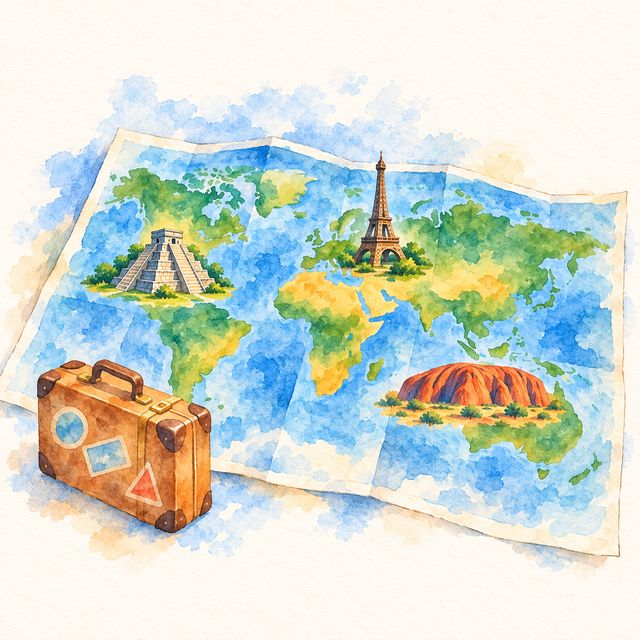
Famous places of the world, one true thing each.
The Pet holds up a famous place, like a pyramid or a waterfall, and your child taps its continent on the world map. It lands there with one true fact, and a new set comes every few days.
- Kindergarten to Grade 7–8
- 10 min
- Nothing to prepare
- On the screen
Free to sign up.
Is it a good fit?
- Ready if Your child can tap a place on a map; a wrong tap names the continent, so every try teaches one.
- Too much today? Start with Animal atlas: the same map with animals, a gentle first meeting with the continents.
- Too easy? The Grade 5–6 level: landmarks placed from the name alone, then what each was built for; Grade 7–8 adds a gate that stands far from where it was built, and whether it should go home.
What your child practises
- Continents
- Made by people or by nature
- Which came first
- What buildings were for
“People didn't make that. It was there before people.”
If your child says something like this, in their own words, the idea has landed. Finishing the rounds means they took part; this is the learning.
Your part
- Nothing to prepare or print
- Each question has a Read it to me button
- Plays alone; at Kindergarten a grown-up nearby helps
Take it off the screen (optional)
Ask your child at dinner for the true thing the Pet said about one landmark.
More like this
The full design
What it is
Fifty painted landmarks, one world map, and one question: where in the world is it? Your child taps the continent, the landmark lands there, and the Pet says one true thing about it in a sentence a five-year-old can repeat at dinner. A wrong tap greys the continent and names it ("that is Africa, try another"), so every miss teaches a continent too. Every picture opens big with a tap. The set changes every few days, so the map fills with new wonders on the next visit.
How it goes
The Pet holds up a landmark on a card. Your child taps a continent on the map. Right: the landmark lands on that continent, the Pet hops clear of the map and says its one true thing. Miss: the continent greys and the Pet names it, then the child tries again. When the set is placed, the rung's own question follows (the sort, the pairs, the uses, the gate). From 1–2 up, when the day's set has a mountain, a waterfall or a rock in it, the Pet dares: find the oldest thing on the whole map, which is never something people built.
The Pet
Notices: "you knew it from the shape"; "that one is in your own country". Asks: "did people make it, or was it there before people?" Admits: "I have not been there either. Let us look." Dares (1–2 up, when the set has one): "bet you can find the oldest thing on the whole map."
By band
K: six landmarks, tap the continent, one true thing each; your own country's comes first when the set has one, and the Pet says so. 1–2: eight; before each is placed, "did people make it, or was it there before people?" 3–4: six placed, then three pairs: which was there first, and how many years apart. 5–6: eight placed from the name alone, then what each built one was for (a tomb, a gate or a wall, a temple, a church or a mosque, a tower to look out from, a place to watch shows, a place to live). 7–8: the same, and the Ishtar Gate, built in Babylon and standing in a Berlin museum: your child places it in both, then says whether it should go home, stay, or whether both places have a claim, and hears what people say for each view. No answer is marked wrong.
What it grows
Naming the continents, then telling what people made from what the Earth made, is the first year of geography at school; placing landmarks on a world map and asking what they were for is the upper-primary version of the same lesson. The Ishtar Gate is a real argument museums and countries are having now, and a twelve-year-old can hold both sides of it.
Done, and what counts as evidence
Done = the set placed. Nothing is written for the record. If you want to keep something, the 1–2 sort, the 3–4 order or the 7–8 view on the gate is worth a line as an observation, in your child's words. The years and the sources are in the grown-ups' note.
What's personal
Your family's country decides which landmark comes first and gets "in your country" from the Pet, and a home dot marks your continent on the map. When the set has none from your country, the day's order stands. Nothing about your child is stored: what was placed is kept only so the game can carry on where it left off.