Geography · Kindergarten to Grade 3–4
Hot or cold?
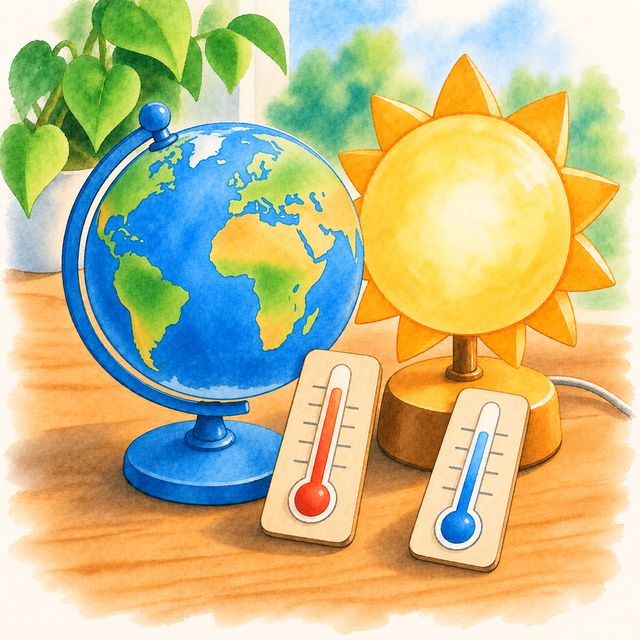
Why some places are hot and others are cold.
Your child packs a suitcase for the Pet's trip from a weather forecast, then finds hot and cold places on a painted globe. Older children compare today's temperature at home with a faraway city.
- Kindergarten to Grade 3–4
- 10 min
- Kitchen things
- On the screen
Free to sign up.
Is it a good fit?
- Ready if Your child knows a woolly hat is for the cold and sandals are for the sun.
- Too much today? The Kindergarten level: pack three things for the Pet from a forecast.
- Too easy? The Grade 3–4 level: two real temperatures placed on the globe's bands, and why a far place can have summer during your winter.
What your child practises
- Reading a forecast
- Hot near the middle, cold at the ends
- Temperatures
- Why the seasons swap
“It's minus four there, so the Pet needs the woolly hat.”
If your child says something like this, in their own words, the idea has landed. Finishing the rounds means they took part; this is the learning.
Your part
- Nothing to prepare at Kindergarten and Grade 1–2
- At Grade 3–4, find two temperatures with your child: today's here, and today's in a far city
- Each question has a Read it to me button
Take it off the screen (optional)
Hold a globe or a ball under a lamp and see which part the light reaches most.
More like this
The full design
What it is
Some places are hot and some are cold, and a globe can explain why. Your child starts by packing a suitcase for the Pet from a forecast, then finds out on a painted globe that the red belt round the middle is where the hot places are and the white caps at the ends are where the cold ones are. By 3–4 they are placing two real temperatures, one from home and one from a far city, on the three bands of the world, and asking why a place on the other half of the globe has its summer during our winter.
How it goes
At K the Pet reads the forecast card out loud and your child taps three things into the case; a fourth is refused. Then the Pet lands and says thank you for the warm things and "brr" for the sandals, and asks why the woolly hat: the forecast decides, not the place. At 1–2 a city's dot glows on the globe, your child taps Hot or Cold, and a miss gets the question again with a clue ("Moscow is near the pole"). A tap on any dot says where that city stands. At the end the Pet bets your child cannot name a cold place on the belt, and Quito, high in the mountains, is the surprise. At 3–4 your child enters today's temperature at home and in the far city on a stepper, places each dot in its band, and picks a reason for the difference; every reason is answered, and "not sure yet" is honest and gets a globe and a lamp to try.
The Pet
It notices when the forecast was read before the packing ("you read the forecast first, that is the trick"). It asks about the belt ("near the belt is...?"). It dares, at 1–2, the cold place on the belt. It never marks the packing wrong: the wrong thing gets a "brr" or a "phew", and the next trip is the try again.
By band
K: the Pet is off to Tromsø on Thursday at minus four, and to Cairo on Saturday at thirty-four (in your family's unit); your child packs three things from eight and hears what the Pet thought of each one when it landed. 1–2: five cities on the globe, Singapore, Cairo, Kinshasa, Moscow and Reykjavík, each one hot or cold by where its dot sits from the belt. 3–4: the globe with its three bands, two temperatures your child enters from the real world today, and one question about the seasons.
What it grows
Hot and cold places are the first geography most curricula ask for (the belt and the poles in the early years, the climate zones a couple of years later), and the surprise that a place on the equator can be cold is where the idea of a globe, not a flat map, starts to matter. The habit this grows is reading a number before deciding.
Done, and what counts as evidence
Done = two trips packed at K, five cities sorted at 1–2, two temperatures placed at 3–4. What counts as evidence is the reason your child gave for the seasons, kept as an observation, never marked.
What's personal
Home on the globe is your family's home place and country, as set in the family settings; the far city is where a relative in your family tree was born, when the tree names a city the globe knows (twenty-four so far), and the card says whose it is. With no such relative the Pet picks Melbourne and says it is its own pick. Temperatures show in your family's unit. Your child's own location is never used.