Science · Grades 3–4 and 5–6
A soil sponge
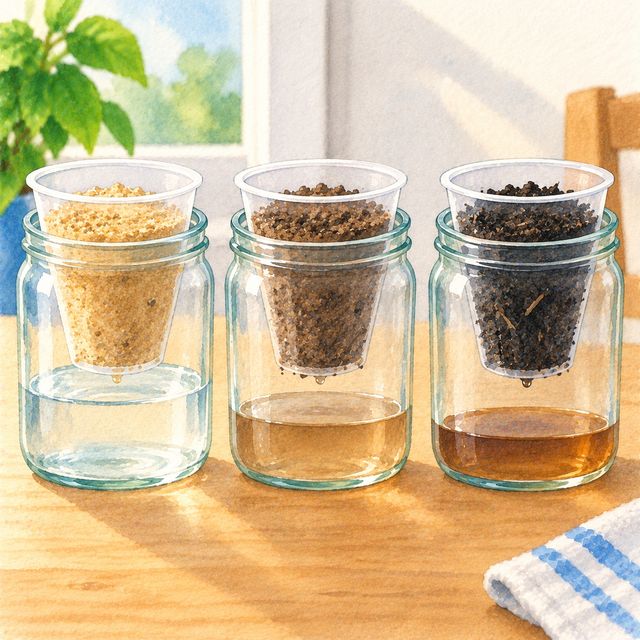
Three soils tested side by side by your child, and an answer to which holds the most water.
Your child fills three cups with sand, garden soil and compost, pours the same water through each, and compares what drips into the jars below. At 5–6 they guess first, measure it and draw a bar chart.
- Grades 3–4 and 5–6
- 30 min
- A printout
- On the screen
Free to sign up.
Is it a good fit?
- Ready if Your child can count eight level spoonfuls and read 100 ml on a jug.
- Too much today? The 3–4 level: the jars compared by eye.
- Too easy? The 5–6 level: a guess, three measurements and a chart.
What your child practises
- A fair test
- Measuring
- Reading the result
“The sand let it all through, so the compost is the sponge.”
If your child says something like this, in their own words, the idea has landed. Finishing the rounds means they took part; this is the learning.
Your part
- Poke the holes with the skewer
- Open the compost bag outside
- Thirty minutes at the table, near the sink
What you need
From home
- Three same-size clear plastic cups, each about as big as a mug, and three quarter-sheets of kitchen paper or three coffee filters
- A skewer, for poking the holes (a grown-up's)
- Three same-size jam jars or glasses, their mouths narrower than the cups, so each cup sits with its bottom well above the jar's floor
- A measuring jug, a tablespoon and a timer
- A pencil, a ruler whose 0 is at its very end, and paper
From a local store
- Play sand and potting compost from a garden or toy shop, and garden soil, crumbled, with stones and roots picked out: a mugful of each
The steps
Grade 3–4
 A grown-up turns the three cups upside down and pokes five holes in each bottom with the skewer: one in the middle, four around it. (A grown-up does this step)
 A grown-up turns the three cups upside down and pokes five holes in each bottom with the skewer: one in the middle, four around it. (A grown-up does this step)
The other 4 steps, each with its painting, are in the Family portal.
It must pass: A fair test: the same cups, the same amount of soil, the same water and the same wait, and you can say which soil held the most water.
Grade 5–6
- A grown-up turns the three cups upside down and pokes five holes in each bottom with the skewer: one in the middle, four around it. (A grown-up does this step)
The other 5 steps, each with its painting, are in the Family portal.
It must pass: You wrote your guess first, measured the water each soil let through in millimetres, charted it, and can say which soil held the most.
Safety
The skewer is yours: poke the holes with each cup upside down on the table, never held in a hand. Potting compost can carry germs in its dust, so open the bag outside, away from faces, and keep it damp. Bagged compost can have fertiliser beads in it: no soil or compost goes near a mouth. Everyone washes their hands after. Tip the soil onto a garden bed or into the bin afterwards, never down the sink.
Where the facts come from
More like this
The full design
What it is
Three clear cups with holes in their bottoms, each lined with kitchen paper and sitting in the mouth of a jam jar, filled with the same amount of three soils: play sand, garden soil and potting compost. The same water goes into each, and five minutes later the jars show how much each soil let through. Sand's big grains leave big gaps, so much of the water runs through; compost is rotted plant matter that soaks water up, so its jar has the least; garden soil usually sits between, and one with a lot of clay drains slowly. The screen shows one step at a time as a painting of that step and asks at the end.
How it goes
One step fills the screen: the painted plate of that step, the words under it, and two buttons. Done this step moves on. Too hard, skip it also moves on, and the finish says how many were skipped without dressing it up. At the end, Show asks what is true (I kept it fair, the sand let the most through), and What I learned asks the band's question.
The Pet
Asks at each step: "Eight level spoonfuls in each. Do not press it down." Notices: "The same amount of each soil. That keeps it fair." Remembers across a pause. A result that surprises, sand holding more than compost, is a reason to test again, and the Pet says why: very dry compost sheds water at first.
By band
3 to 4: the cups, the soils and the water kept the same, and the jars compared by eye at the five minutes. 5 to 6: a written guess first, the water in each jar measured in millimetres with a ruler, and a bar for each soil; the shortest bar is the soil that held the most, because the jars are the same size.
What it grows
The engineering standards for grades 3 to 5 ask for fair tests in which one thing changes at a time; fifth-grade earth science asks how the land and water interact. The Soil Science Society of America describes sand as the coarsest part of soil and clay the finest, and the spaces between them as what moves air and water. Here only the soil changes, so the jars answer the question.
Done, and what counts as evidence
Done = the steps done or honestly skipped, and one line chosen at the end. The evidence is the three jars side by side, and at 5 to 6 the guess, the three measurements and the chart.
What's personal
Your child's answers are stored as their answer, not as a mark. Nothing about your garden is stored. A material you do not have is named once, a substitute is offered, and the project carries on.