Science · Grades 3–4 and 5–6
A rain gauge and a week of weather
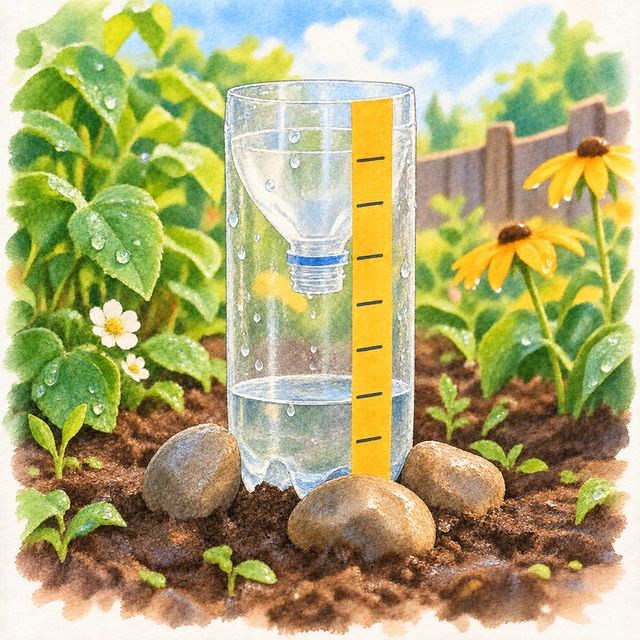
A rain gauge your child made, and a week of rain measured.
Your child turns a plastic bottle into a rain gauge, stands it outside, and reads it at the same time every day for a week. At 5–6 they draw the week as a bar chart.
- Grades 3–4 and 5–6
- 30 min
- Kitchen things
- On the screen
Free to sign up.
Is it a good fit?
- Ready if Your child can read a ruler to the nearest millimetre.
- Too much today? The 3–4 level: build it and read it each day.
- Too easy? The 5–6 level: a bar chart of the week.
What your child practises
- Measuring the same way each time
- Recording data
- Reading a bar chart
“Tuesday was the wettest day.”
If your child says something like this, in their own words, the idea has landed. Finishing the rounds means they took part; this is the learning.
Your part
- Save a clear bottle with straight sides
- Cut it at 3–4
- Remind them of the reading at the same time each day for a week
What you need
From home
- A clear plastic bottle with straight sides
- Scissors, and a knife for the grown-up to start the cut (a grown-up's)
- Tape
- A ruler
- A pen that writes on tape, and squared paper
- Three or four stones
The steps
Grade 3–4
 Take the cap off. A grown-up starts a cut with a knife where the curved top meets the straight sides. Cut all the way round there with scissors. (A grown-up does this step)
 Take the cap off. A grown-up starts a cut with a knife where the curved top meets the straight sides. Cut all the way round there with scissors. (A grown-up does this step)
The other 4 steps, each with its painting, are in the Family portal.
It must pass: It stays standing all week, and you read it at the same time every day.
Grade 5–6
- Take the cap off. A grown-up starts a cut with a knife where the curved top meets the straight sides. Cut all the way round there with scissors.
The other 5 steps, each with its painting, are in the Family portal.
It must pass: It stays standing, you read it at the same time each day, and a bar chart of the week shows the wettest day.
Safety
At 3–4 you cut the bottle; the cut edge is sharp, so tape over it at every grade. Put the gauge where nobody will trip on it, away from a road. Empty it at the end of the week, so it does not stand full of water.
Where the facts come from
More like this
The full design
What it is
A clear plastic bottle with its top cut off and turned upside down into it as a funnel, a scale of centimetre lines on tape up its side, stood in an open spot outside and read at the same time every day for a week. The screen shows one step at a time as a painting of that step, comes back each day for the reading, and asks at the end. The gauge and the week of readings are the make.
How it goes
One step fills the screen: the painted plate of that step, the words under it, and two buttons. The steps fall into a building sitting and a week of short readings. Done this step moves on; skip it also moves on, and the finish says how many were skipped. At the end, Show asks what is true (it caught rain, I read it every day), and What I learned asks the band's question.
The Pet
Asks at each step: "Same time every day. How many millimetres?" Notices: "Read and written. Back to zero for tomorrow." Remembers across the week: the make comes back at the reading it stopped on. A dry week is not a failure; it is the week's result.
By band
3 to 4: you cut the bottle; your child makes the funnel and the scale, places it so it stands in the wind, and reads it every day for a week. 5 to 6: your child cuts it too, and at the end draws the week as a bar chart, one bar a day, to find the wettest day.
What it grows
Third-grade science asks children to record weather data and show it in a table or a bar graph. Reading one gauge at the same time each day is a fair measurement, because only the day changes.
Done, and what counts as evidence
Done = the steps done or honestly skipped, and one line chosen at the end. The evidence is the week of readings taken the same way each day, and at 5 to 6 the bar chart: data recorded and shown, which is what the third-grade weather standard asks for.
What's personal
The readings and your child's answers are stored as their answer, not as a mark. Nothing about where you live is stored. A material you do not have is named once, a substitute is offered, and the project carries on.