Science · Pre-K to Grade 5–6
Grow it
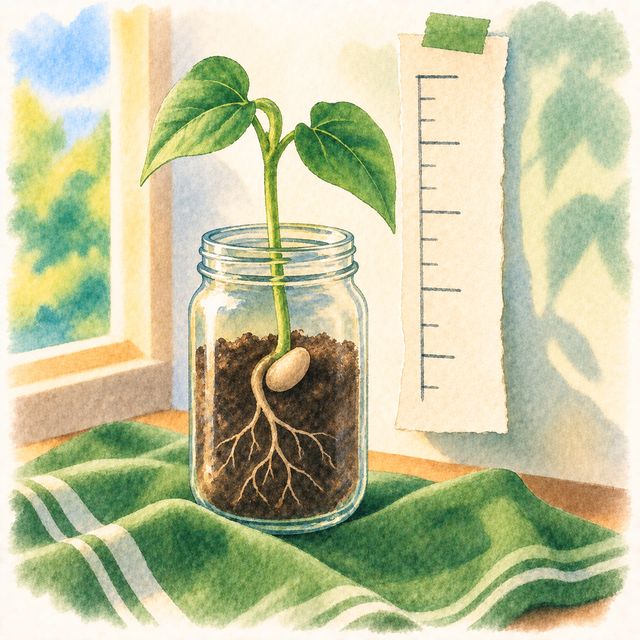
A real bean on the sill, and a daily look at what changed.
Your child starts a real bean in a jar on the windowsill, while the Pet grows its own bean on the screen, stage by stage. Short questions show what a bean does next, so your child knows what to look for on the real one tomorrow.
- Pre-K to Grade 5–6
- 5 min
- A printout
- On the screen
Free to sign up.
Is it a good fit?
- Ready if Your child can look at two pictures and say which is bigger, or that they are the same.
- Too much today? Start with Seed to plate: what a seed needs, before the real bean.
- Too easy? The Grade 3–4 level: the root, the stem, a leaf and the flower, and what each one does.
What your child practises
- What changed since yesterday
- Parts of a plant
- Measuring growth
- One fair change
“The root goes down first, before anything goes up.”
If your child says something like this, in their own words, the idea has landed. Finishing the rounds means they took part; this is the learning.
Your part
- A dried bean, a jar, a wet paper towel and a sunny sill
- Each question has a Read it to me button
- Set the bean up together on day one, then five minutes a day
Take it off the screen (optional)
Look at the real bean every day, and at Grade 1–2 keep its chart on the fridge.
More like this
The full design
What it is
Your child starts a real bean in a jar on the windowsill and looks at it every day. On the screen the Pet grows a bean of its own, drawn stage by stage, and the game says so out loud: "yours is on the sill, mine grows here". The screen never pretends to be your bean. It shows what a bean does next, so your child knows what to look for, and it writes down what they noticed. This is the first shape of a science diary: look, say what changed, keep it.
How it goes
The Pet asks in one line and the read-aloud button reads the question. Your child taps the part, the number or the choice. A right tap makes the bean grow a stage, with a little sprout and a sound; a tap anywhere on the bean gets an answer, never silence. The Bean diary under the picture keeps each answer. Three to four rounds, then a finish that says what they did and what to look for on the real bean tomorrow.
The Pet
Notices: "a root! It goes down first, before anything goes up." Asks: "look at the top. Is it higher than yesterday?" When your child is stuck it looks with them and says what it thinks before it taps. Dares (3–4): "window tall, cupboard short. Bet you can say why."
By band
Pre-K: two pictures, yesterday and today, "bigger, or the same?", and the same is a right answer, because some days a bean rests. K: something new grew, tap it: the root about day three, the shoot about day five, the leaves about day nine, and weeks later a flower. 1–2: how many blocks tall, four looks, and a chart that climbs (with one resting day in it). 3–4: tap the root, the stem, a leaf, the flower, and hear what each one does. 5–6: two beans, one goes in a cupboard; the one thing you change, which bean was in the dark, and why it is pale.
What it grows
A companion that grows with the child's effort keeps the effort going, and nothing is ever lost; a daily look at a real living thing is how the habit of observing starts, and "what changed since yesterday" is the question science begins with.
Done, and what counts as evidence
Done = a round of looks. The evidence is off the screen: the real bean's days, a photo each if you like, the chart on the fridge at 1–2, and at 5–6 the sentence "the dark one was pale because…" with the two jars to prove it.
What's personal
The real bean is your child's; the Pet's bean is a mirror that never dies if a day is missed. It just waits. What the diary keeps is your child's own words for what the bean did.