Science · Pre-K to Kindergarten
What the colours do
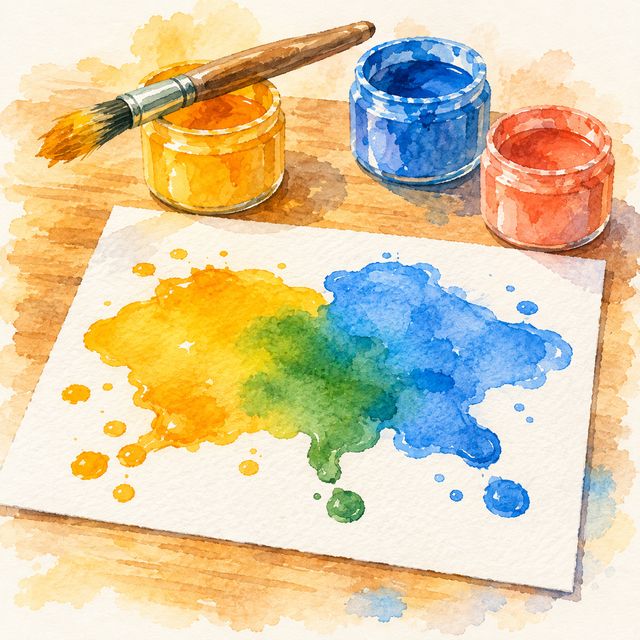
A new colour your child made by mixing two, and can tell you how.
Your child puts two blobs of paint side by side on thick paper and pushes them together to see what colour comes. At K they guess first, then mix.
- Pre-K to Kindergarten
- 15 min
- A printout
- On the screen
Free to sign up.
Is it a good fit?
- Ready if Your child can hold a brush and name a few colours.
- Too much today? The Pre-K level: two colours, one new one, and it dries.
- Too easy? The K level: a third colour, then a guess before each mix.
What your child practises
- Naming colours
- Mixing and looking
- Guessing, then checking
“Yellow and blue made green.”
If your child says something like this, in their own words, the idea has landed. Finishing the rounds means they took part; this is the learning.
Your part
- Buy or find yellow, blue and red washable paint
- Put newspaper down and an old shirt on your child
- At Pre-K stay at the table
What you need
From home
- Thick paper or card
- A fat brush
- A pot of water for the brush
- An old cloth or newspaper under the paper
From a local store
- Paint in yellow, blue and red
The steps
Pre-K
 Put a big blob of yellow paint in the middle of the paper.
 Put a big blob of yellow paint in the middle of the paper.
The other 3 steps, each with its painting, are in the Family portal.
Kindergarten
- Put a big blob of yellow paint in the middle of the paper.
The other 5 steps, each with its painting, are in the Family portal.
Safety
Use washable paint made for children, and put newspaper or an old cloth under the paper and an old shirt on your child. At Pre-K stay at the table while the paint is out: paint goes on paper, not in mouths.
Where the facts come from
More like this
The full design
What it is
Two blobs of paint side by side on thick paper, pushed together with a brush, and a new colour where they meet. Nobody tells your child that yellow and blue make green: they see it. The screen gathers the things, shows one step at a time as a painting of that step, and asks at the end which colour they made. The paper on the table is the make.
How it goes
One step fills the screen: the painted plate of that step, the words under it, and two buttons. Done this step moves on. Too hard, skip it also moves on, and the finish says how many were skipped without dressing it up. At the end, Show asks what is true about the paper (yellow and blue made green, lots of colours made brown), and What I learned asks the band's question.
The Pet
Asks at each step in the fewest words: "Push them together. What do you see?" Notices the step done: "A new colour, where they met." Remembers across a pause: the make comes back at the step it stopped on. At K it asks for the guess before the mixing. It never says a colour is wrong: brown is a real result.
By band
Pre-K: yellow, then blue beside it, then pushed together, then laid flat to dry; four steps, with you at the table. K: the same, then red with yellow, then a guess first: your child picks two colours, says what they will make, and mixes them to see.
What it grows
Early learning frameworks name exploring materials and colour as part of creative expression from age 3, and most children of 4 and 5 can keep at making art for a few minutes at a time. So this is short, open, and about looking: there is no picture to copy and nothing to get right.
Done, and what counts as evidence
Done = the steps done or honestly skipped, and one line chosen at the end. The evidence is the paper, and the colour your child names and says how they made. At K the guess beside the result is the observation: a guess that was wrong is as useful as one that was right.
What's personal
The colours your child mixed and what they answered are stored as their answer, not as a mark. Nothing about your home or your table is stored. A material you do not have is named once, a substitute is offered, and the make carries on.