Science · Grade 3–4 to Grade 7–8
Ripples in a tray
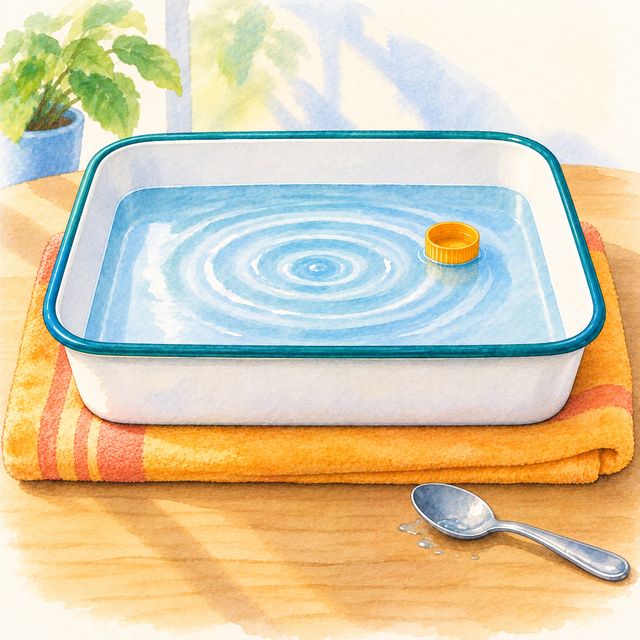
A tray of water, a bottle cap and a measured answer to whether the water travels with a ripple.
Your child tips water into the middle of a still tray and measures where a floating cap ends up as the ripple passes. From 5–6 they repeat it and keep a table; at 7–8 they send waves along a rope and time them in slow motion.
- Grade 3–4 to Grade 7–8
- 40 min
- A printout
- On the screen
Free to sign up.
Is it a good fit?
- Ready if Your child can read centimetres on a ruler and wait for water to go still.
- Too much today? The 3–4 level: two pours, one change.
- Too easy? The 7–8 level: a rope wave, small and big flicks timed in slow motion.
What your child practises
- Changing one thing at a time
- Measuring and recording
- Saying what a model cannot show
“The ripple went right past it, but the cap only bobbed. It is still 8 centimetres from the end.”
If your child says something like this, in their own words, the idea has landed. Finishing the rounds means they took part; this is the learning.
Your part
- A deep tray and a towel on a table or the floor
- Stand the ruler by the tray
- Mop the spills
- At 7–8, hold the far end of the rope, or a heavy chair for it, and film the flicks in slow motion
- Two sittings
What you need
From home
- A roasting tin or a deep baking tray, its sides at least 4 centimetres high, and a bath towel to stand it on
- A jug of tap water and a teaspoon
- A plastic bottle cap, the float (small parts)
- A ruler, 30 centimetres long
- A pencil and paper
- For 7–8: a skipping rope, 2 to 3 metres long, a ribbon, and a grown-up's phone that films in slow motion
The steps
Grade 3–4
 Stand the tray on the folded towel. Lean the ruler in a corner, 0 end down. Pour water to its 2 centimetre mark. Lift it out. Wait for still water.
 Stand the tray on the folded towel. Lean the ruler in a corner, 0 end down. Pour water to its 2 centimetre mark. Lift it out. Wait for still water.
The other 5 steps, each with its painting, are in the Family portal.
It must pass: Only the pour's height changed; you measured the cap's place in centimetres before and after each pour and after a minute with no pour, and you say from your numbers whether the bigger push carried the cap further than its drift, and which pour rocked it more.
Grade 5–6
- Stand the tray on the folded towel. Lean the ruler in a corner, 0 end down. Pour water to its 2 centimetre mark. Lift it out. Wait for still water.
The other 5 steps, each with its painting, are in the Family portal.
It must pass: A still row, three small drops and three spoonfuls from the same height onto the same spot, each a row in your table; from the table you say what the bigger drop changed and what it did not, against the drift in the still row.
Grade 7–8
- Stand the tray on the folded towel. Lean the ruler in a corner, 0 end down. Pour water to its 2 centimetre mark. Lift it out. Wait for still water.
The other 5 steps, each with its painting, are in the Family portal.
It must pass: The ribbon swings and comes back near its place as the pulse passes; you counted the frames for three small and three big flicks with the same pull, say whether the bigger flick arrived sooner and how much your counts differ, and name one thing the rope cannot show.
Safety
Stand the tray on a towel and mop up spills straight away: a wet floor is slippery. Nothing that plugs in goes near the water. Pour the water away at the end; it is not for drinking. A bottle cap is small enough for a toddler to swallow: put it away afterwards. The rope stays on the floor, never round anyone's neck, and nobody walks across it while it moves. Tie it only to a heavy chair, and never yank the chair.
Where the facts come from
More like this
The full design
What it is
A deep tray with 2 centimetres of still water, a teaspoon of water tipped in near the far end, and a bottle cap floating 8 centimetres from the near short end. The ring runs out past the cap; the cap bobs up and down and is still near its place when the water settles, which your child measures with a ruler. The wave moved on and the water mostly did not. On the screen, Sound safari (science-sound-safari) practises the idea that sound is something moving; this is the real thing, in a tray.
How it goes
One step fills the screen: the painted plate of that step, the words under it, and two buttons. Done this step moves on. Too hard, skip it also moves on, and the finish says how many were skipped without dressing it up. At the end, Show asks what is true (the cap bobbed and stayed, the ring went past the cap and kept going), and What I learned asks the band's question.
The Pet
Asks at each step: "Spoon at the 10 mark, over the middle. Tip, watch, measure." Notices: "The ring went past the cap." Remembers across the two sittings. A cap that drifted is a result to measure, not a mistake, and the Pet asks by how many centimetres.
By band
3 to 4: a minute with no pour to measure how far the cap drifts on its own, then the same spoonful from two heights, the 10 and the 30 mark of a ruler a grown-up holds by the tray, and the cap's distance from the end measured after each. 5 to 6: a seven-row table drawn first, a still row, then a fingertip drop and a full spoonful from the same height, three of each, every one a row. Every pour lands near the far end, as far from the cap as the tray allows, and the cap is measured ten counts after the ripples fade, so splash and slosh do not carry it. 7 to 8: one pour, then a skipping rope on the floor with a ribbon at its middle: one flick sends a pulse past the ribbon, then small and big flicks with the same pull are filmed in slow motion and the frames counted from flick to chair, three of each. A rope wave crosses 2.5 metres in under half a second, too fast for a stopwatch, which is why it is filmed.
What it grows
The Grade 4 standard asks children to build a model of waves showing amplitude and wavelength, and its core idea is this make: a wave moves across the water while the water itself stays about where it was. The middle school standard adds that a bigger amplitude carries more energy, which the big drop and the high pour show. Physics education research (Wittmann, Steinberg and Redish, The Physics Teacher, 1999) found that university students often treat a wave like a thrown ball: a harder flick makes it faster, and sound pushes the air along. The cap, the ribbon and the filmed small and big flicks test that picture.
Done, and what counts as evidence
Done = the steps done or honestly skipped, and one line chosen at the end. The evidence is the cap's measured place before and after, against its drift, with only the height changed at 3 to 4; the seven-row table at 5 to 6; and at 7 to 8, the frame counts for small and big flicks, how much they varied, and one thing the rope cannot show. Ripples bounce off the tray's sides and the water creeps forward a little with each wave, so a cap that ends a few millimetres, sometimes a centimetre, away is the expected result, not a failed one.
What's personal
The measurements and your child's answers are stored as their answer, not as a mark. Nothing about your home is stored. A material you do not have is named once, a substitute is offered, and the project carries on.