Science · Grades 3–4 and 5–6
A periscope from two cartons
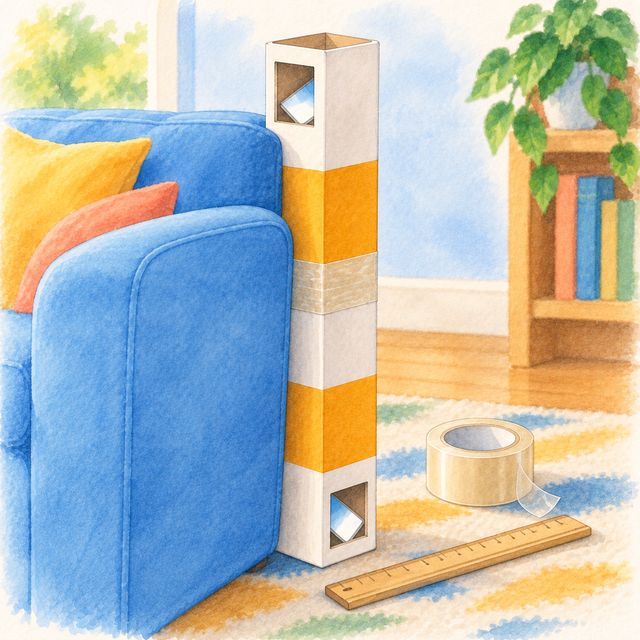
A periscope your child built that sees over the sofa, and the light's path to explain it.
Your child rules a 45 degree line on each carton, you cut the windows and slits, and they set two mirrors face to face, measure how much higher it sees and look over the sofa. At 5–6 they draw the light's path and tilt the top mirror to see what changes.
- Grades 3–4 and 5–6
- 40 min
- A printout
- On the screen
Free to sign up.
Is it a good fit?
- Ready if Your child can measure in centimetres and rule a straight line with a ruler.
- Too much today? The 3–4 level: build it and see over the sofa.
- Too easy? The 5–6 level: draw the light's path, then tilt the top mirror and explain the change.
What your child practises
- Measuring and ruling a line
- How mirrors turn light
- Changing one thing at a time
“The light comes in the top, bounces down off one mirror and off the other into my eye.”
If your child says something like this, in their own words, the idea has landed. Finishing the rounds means they took part; this is the learning.
Your part
- Rinse two cartons the same size
- Buy two small acrylic mirrors at a craft shop
- The knife is always yours: tops, windows, slits
- Two sittings
What you need
From home
- Two empty 1-litre juice or milk cartons, the same size, rinsed and dry; square ones, about 7 centimetres across, work best
- Parcel tape
- A ruler
- A pencil and paper
- A craft knife, and sharp scissors for the tops if you like (a grown-up's)
From a local store
- Two flat acrylic craft mirrors, about 8 centimetres square, a little wider than a carton's narrower face, never glass
The steps
Grade 3–4
 Each carton upright: on a wide face, mark a dot up the left edge, as high as the face is wide. Rule to the bottom right corner.
 Each carton upright: on a wide face, mark a dot up the left edge, as high as the face is wide. Rule to the bottom right corner.
The other 5 steps, each with its painting, are in the Family portal.
It must pass: Crouched behind the sofa and looking through your periscope, you name something on the other side that you cannot see without it; you cover the top window and say what happens, and you say the light's way: in at the top, off both mirrors, into your eye.
Grade 5–6
- Each carton upright: on a wide face, mark a dot up the left edge, as high as the face is wide. Rule to the bottom right corner.
The other 5 steps, each with its painting, are in the Family portal.
It must pass: You draw the light's path through your periscope, leaving each mirror at the same slant it hit; then, with only the top mirror moved to the steep slit, you say whether it shows higher or lower things, and why.
Safety
Use acrylic craft mirrors only, never glass. Run a finger along each edge before your child handles one, and tape over an edge that feels rough. The craft knife is yours at every grade: you cut the tops off, the windows and the slits, and your child marks the lines. Never look at the sun through the periscope, and never point it at the sun: the mirrors pass sunlight straight to the eye. Do not flash sunlight off a mirror into anyone's eyes. Your child crouches behind the sofa to use it, and does not climb on it.
Where the facts come from
More like this
The full design
What it is
Two 1-litre cartons taped end to end into one tall tube, a window low on one face and another high on the opposite face, and a small acrylic mirror behind each window, slanting at 45 degrees, the two shiny sides facing each other. Your child looks in the bottom window and sees out of the top one: over the back of the sofa without standing up. Light around corners (science-light-around-corners) is the game twin: the practice on the screen, steering a beam with a mirror. The periscope is the real thing.
How it goes
One step fills the screen: the painted plate of that step, the words under it, and two buttons. Done this step moves on. Too hard, skip it also moves on, and the finish says how many were skipped without dressing it up. At the end, Show asks what is true (I saw over the sofa, the mirrors face each other), and What I learned asks the band's question.
The Pet
Asks at each step: "Shiny side to the window. Down into the corner." Notices: "Look in the window: the mirror shows you straight up to the open end." Reminds whose the knife is before the cut, and that the periscope never points at the sun. Remembers across the two sittings. A view that does not move is a reason to check the mirror, never a failure.
By band
3 to 4: on a wide face of each carton your child marks a dot up one edge as high as the face is wide and rules a line from it to the opposite bottom corner. That line is the diagonal of a square, so it is 45 degrees with no protractor. You cut the tops off, a 4 cm window low in the side face that the line runs down into (not the face the line is drawn on), and a slit along the line. Square cartons about 7 cm across give the best view; a flat juice carton works but tips the view a little. Each mirror slides into its slit, shiny side to the window; the cartons are joined open end to open end, the windows facing opposite ways, and your child measures from window to window how much higher it sees. 5 to 6: the same build, plus a steeper line on the other wide face of the top carton (a dot one and a half widths up, about 56 degrees, 11 more than 45). Your child draws the light's path, then moves the top mirror to the steep slit and says what the view did.
What it grows
The Grade 4 standard asks for a model that light reflecting from objects and entering the eye lets them be seen, and the Grade 1 standard puts a mirror in the path of a beam. Osborne and colleagues (1993) studied how 64 children of 7 to 11 explained seeing, and how teaching changed it. Drawing the arrows through their own periscope, light from the room into the eye, makes that model something they built.
Done, and what counts as evidence
Done = the steps done or honestly skipped, and one line chosen at the end. The evidence at 3 to 4 is the thing they named that they could not see without it, what covering the top window did, and the light's way they say: in at the top, off both mirrors, into the eye. How many centimetres higher it sees is a measurement of the tube, the same for every child, so it is not the evidence. At 5 to 6 it is the two drawn paths and the reason: the steeper mirror sends down the tube light from higher up, so the view swings up, by about 23 degrees, twice the mirror's 11 (things in the picture slide down). What it cannot show: why a mirror reflects at all, and a slightly crooked mirror still gives a picture, so a picture is not proof the angle is exact.
What's personal
What your child saw over the sofa and their drawing are stored as their answer, not as a mark. Nothing about your home is stored. A material you do not have is named once, a substitute is offered where there is one, and the project carries on.