Science · Grade 1–2 to Grade 5–6
A parachute that lands softly
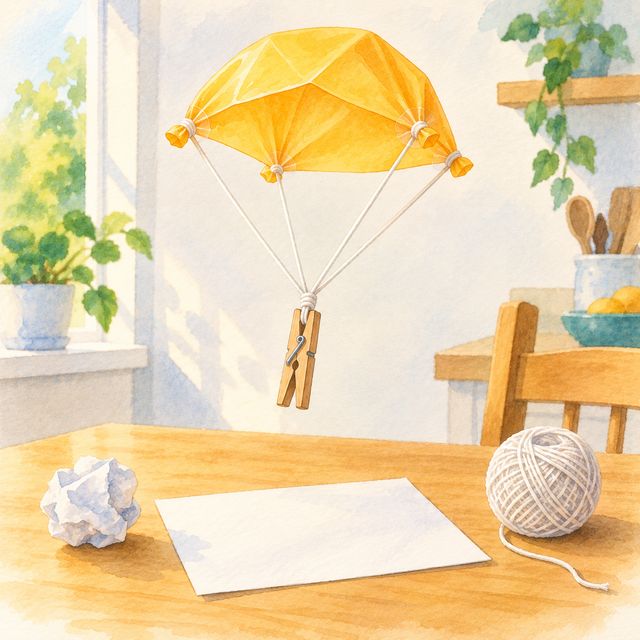
A parachute your child made that lands a peg softly, and the drops that show why.
Your child drops a paper ball and a flat sheet together, then makes a parachute from a square of carrier bag and races it against a peg. From 3–4 only the canopy's size changes, and every drop is timed.
- Grade 1–2 to Grade 5–6
- 20 min
- A printout
- On the screen
Free to sign up.
Is it a good fit?
- Ready if Your child can cut string with scissors and, from 3–4, read seconds on a stopwatch.
- Too much today? The 1–2 level: a ball against a flat sheet, and one parachute against a peg.
- Too easy? The 5–6 level: three canopies, a table of middle times, and twice the load tested.
What your child practises
- Comparing two falls
- Changing one thing at a time
- Timing and a table of results
“They weigh the same. The flat one is slower because the air pushes on it.”
If your child says something like this, in their own words, the idea has landed. Finishing the rounds means they took part; this is the learning.
Your part
- Cut the bag squares and bin the rest at once
- Do the parachute drops from the floor, arms up, each timed canopy held spread by two corners
- Lend a phone stopwatch that shows tenths of a second
- Two sittings from 3–4
What you need
From home
- Printer paper, all the same size, and a pencil
- Thin plastic carrier bags, one or two, at least 40 centimetres from the bottom to the handles (a grown-up's)
- Thin string
- Two clothes pegs, the same kind (small parts)
- Scissors, a ruler 30 centimetres long, and sticky tape
- A stopwatch that shows tenths of a second, on the grown-up's phone or a second phone (a grown-up's)
The steps
Grade 1–2
 Take two sheets of printer paper the same size. Crumple one into a tight ball with both hands. Keep the other one flat.
 Take two sheets of printer paper the same size. Crumple one into a tight ball with both hands. Keep the other one flat.
The other 5 steps, each with its painting, are in the Family portal.
It must pass: The parachute must land after the peg dropped beside it, and you say which sheet landed first and why.
Grade 3–4
- The grown-up cuts open a bag down one side and along the bottom, cuts 20 and 40 centimetre squares, and bins the rest at once. (A grown-up does this step)
 The grown-up cuts open a bag down one side and along the bottom, cuts 20 and 40 centimetre squares, and bins the rest at once. (A grown-up does this step)
The other 5 steps, each with its painting, are in the Family portal.
It must pass: Six drops timed in seconds, three for each canopy, from the same height with the same peg, and you say which fell slower and the one thing you changed.
Grade 5–6
- The grown-up cuts open a bag down one side and along the bottom, cuts 15, 25 and 40 centimetre squares, and bins the rest at once. (A grown-up does this step)
The other 5 steps, each with its painting, are in the Family portal.
It must pass: Three canopies, three timed drops each, a table with each middle time; then the slowest dropped three more times with two pegs, and you say from the table what twice the load changed.
Safety
A plastic bag can stop a child breathing if it covers the face. The grown-up cuts the square and puts the rest of the bag in the bin at once; nobody puts a bag or a canopy over a head; keep the bags, the canopies, the strings and the pegs away from babies and toddlers, and put them away high between sittings. Pegs and small toys can be swallowed by a small child. No climbing. Every drop is from the floor: the child with an arm up, or the grown-up with an arm straight up. Never from a chair, a table, the stairs, a balcony or a window. Let go, never throw, and drop where nobody is walking. The child cuts string with scissors; only the grown-up cuts the bag.
Where the facts come from
- NGSS 3-PS2-1: the effects of balanced and unbalanced forces on motion
- NGSS K-2-ETS1: define a problem, make and compare designs
- NGSS 3-5-ETS1: plan fair tests and improve a design
- NASA Glenn: the drag equation, and why drag grows with area
- RoSPA: accidents to children at home, falls from stairs and windows
- CPSC: small parts for toys and children's products
More like this
The full design
What it is
Two sheets of the same paper, one crumpled into a ball and one flat, dropped together: the ball lands first, though both weigh the same, because air pushes up on the flat sheet's wide side. Then a parachute: a square cut from a carrier bag, four equal strings from its corners to one knot, and a clothes peg clipped on as the load, dropped from a grown-up's raised hand. The screen shows one step at a time as a painting of that step and asks at the end. The canopies and the pegs on the floor are the make.
How it goes
One step fills the screen: the painted plate of that step, the words under it, and two buttons. Done this step moves on. Too hard, skip it also moves on, and the finish says how many were skipped without dressing it up. At the end, Show asks what is true (the ball landed first, the big canopy fell slowest), and What I learned asks the band's question.
The Pet
Asks at each step: "Start at Go. Stop when it lands. Write it." Notices the result: "The peg alone landed first. The parachute came down slower." Remembers across the two sittings. Dares at 3 to 4 and up: change only the size. A canopy that did not open is a drop to do again, and the Pet says so.
By band
1 to 2: the ball against the flat sheet, then a 30 centimetre parachute raced against a peg on its own, and your child says which landed first and why. 3 to 4: a fair test, a 20 and a 40 centimetre canopy with the same peg, the same strings and the same raised hand, three drops each timed in seconds. 5 to 6: three canopies, 15, 25 and 40 centimetres, three timed drops each in a table, the middle time of each, then a second peg added to the slowest and three more drops, to see what twice the load does. The grown-up holds each timed canopy spread by two corners, so it opens at once instead of using half the fall to fill.
What it grows
Third-grade science asks children to investigate balanced and unbalanced forces on a moving object; a parachute is the plainest case, gravity pulling down and air pushing up until the fall is steady. NASA's drag equation says the air's push grows with the area facing the fall, which is what the bigger canopy shows. The engineering standards ask for comparing two designs by a test (K to 2) and for fair tests that improve a design (3 to 5). The game Ramp race (science-ramp-race) practises the same fair test on the screen, with a toy car; this project is the real thing in the air.
Done, and what counts as evidence
Done = the steps done or honestly skipped, and one line chosen at the end. The evidence is the comparison: which landed first at 1 to 2, the six times with one change at 3 to 4, and at 5 to 6 a table of middle times and what twice the load changed, read from the table. A drop timed at a little over a second varies by a tenth or two, which is why the older bands drop each canopy three times. The big canopy is also a little heavier than the small one; it still falls slower, because its area grew far more than its weight.
What's personal
The times and your child's answers are stored as their answer, not as a mark. Nothing about your home is stored. A material you do not have is named once, a substitute is offered, and the project carries on.