Math · Grade 1–2 to Grade 7–8
Origami: a boat, a frog, a crane
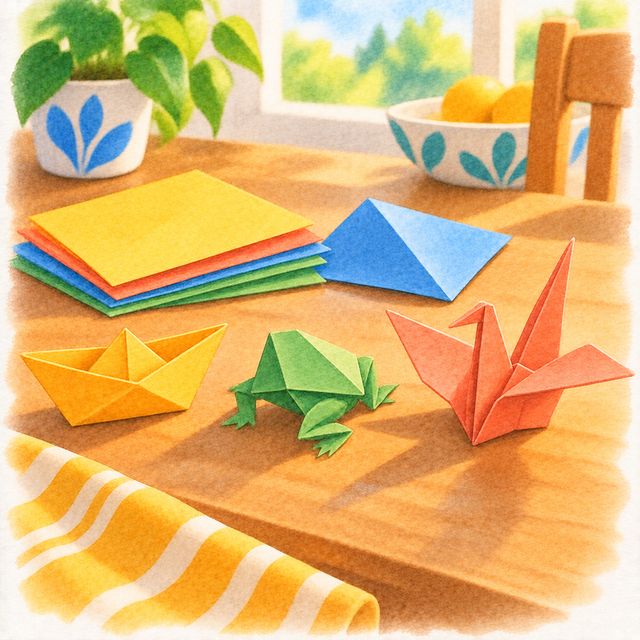
A paper model your child folded that works: a boat that stands, a frog that jumps, a crane that flaps.
Your child folds one model at their level, a step at a time with a painting of each fold: a boat at 1–2, a jumping frog at 3–4, a flapping crane from 5–6.
- Grade 1–2 to Grade 7–8
- 20 min
- A printout
- On the screen
Free to sign up.
Is it a good fit?
- Ready if Your child can fold a sheet in half with the edges lined up.
- Too much today? The 1–2 level: the boat.
- Too easy? The 5–6 level: the crane that flaps.
What your child practises
- Folding precisely
- Halves and quarters
- Following a long sequence
“The zigzag is the spring that makes it jump.”
If your child says something like this, in their own words, the idea has landed. Finishing the rounds means they took part; this is the learning.
Your part
- Find a sheet of printer paper, an index card and a square of paper
- Help cut the square if needed
- Twenty minutes, at the table
What you need
From home
- A sheet of printer paper, for the boat
- An index card, for the frog
- A square of paper, for the crane
- Scissors
The steps
Grade 1–2
 Stand the sheet tall. Fold the top edge down to the bottom edge, so the fold is at the top. Fold it side to side; open it.
 Stand the sheet tall. Fold the top edge down to the bottom edge, so the fold is at the top. Fold it side to side; open it.
The other 5 steps, each with its painting, are in the Family portal.
It must pass: The boat stands up on its own.
Grade 3–4
- Stand the card tall. Fold the top left corner down until the top edge lies along the right edge. Unfold. Repeat with the right corner. An X at the top.
 Stand the card tall. Fold the top left corner down until the top edge lies along the right edge. Unfold. Repeat with the right corner. An X at the top.
The other 5 steps, each with its painting, are in the Family portal.
It must pass: The frog jumps.
Grade 5–6
- If one side is coloured, put it up. Fold corner to corner both ways; unfold. Turn it over. Fold edge to edge both ways; unfold.
 If one side is coloured, put it up. Fold corner to corner both ways; unfold. Turn it over. Fold edge to edge both ways; unfold.
The other 5 steps, each with its painting, are in the Family portal.
It must pass: The crane's wings flap.
Grade 7–8
- If one side is coloured, put it up. Fold corner to corner both ways; unfold. Turn it over. Fold edge to edge both ways; unfold.
The other 5 steps, each with its painting, are in the Family portal.
It must pass: The crane's wings flap, and you can say what a first-time folder needs to know.
Safety
Scissors only to make the square or cut a card from a cereal box, beside you. Paper edges can give a small cut; nothing else here can hurt.
Where the facts come from
More like this
The full design
What it is
Three folded models, each harder than the last: a boat from a sheet of printer paper, a frog that jumps from an index card, and a crane whose wings flap when you pull its tail. No glue, no tape: only folds. The screen shows one fold at a time as a painting of that fold, and asks at the end. The model on the table is the make.
How it goes
One fold fills the screen: the painted plate of that fold, the words under it, and two buttons. Done this step moves on. Too hard, skip it also moves on, and the finish says how many were skipped without dressing it up. At the end, Show asks what is true (it jumps, my folds are crisp), and What I learned asks the band's question.
The Pet
Asks at each fold: "Lift the point. Press the sides in." Notices: "A long diamond. The hardest fold is done." Remembers across a pause, so a half-folded crane comes back where it stopped. A crumpled try is a reason for a second sheet, not a failure.
By band
1 to 2: the boat, by way of a hat and a diamond. 3 to 4: the jumping frog, whose zigzag spring makes it jump. 5 to 6: the flapping crane, from a small square base through a long diamond, the trickiest fold. 7 to 8: the same crane, and what a first-time folder needs to know.
What it grows
Folding in half and in half again is first-grade geometry's equal shares, done with the hands. England's design and technology programme asks children to follow and then plan a sequence of making steps; origami is that sequence with nothing to hide a mistake.
Done, and what counts as evidence
Done = the folds done or honestly skipped, and one line chosen at the end. The evidence is the model that works: a boat that stands, a frog that jumps, a crane that flaps; at 7 to 8, teaching it to someone.
What's personal
Your child's answers are stored as their answer, not as a mark. Nothing about your home is stored. A material you do not have is named once, a substitute is offered, and the make carries on.