Math · Kindergarten to Grade 3–4
Half for you, half for me
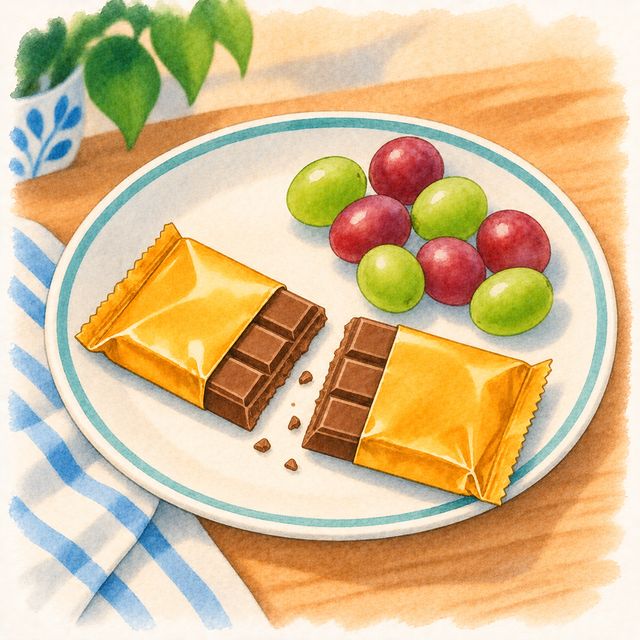
Fair shares at the table, and what to do with one left over.
Your child deals snacks onto a plate for everyone at the table, one at a time, and checks every plate has the same. When some are left over, they decide what is fair: cut them, give them to the Pet or save them.
- Kindergarten to Grade 3–4
- 10 min
- Kitchen things
- On the screen
Free to sign up.
Is it a good fit?
- Ready if Your child can count to seven and give out one each, like dealing cards.
- Too much today? Start with Snack count: counting out one plate before sharing between two.
- Too easy? The Grade 3–4 level: 13 between four, the leftover cut into quarters, and a third of the bowl.
What your child practises
- Sharing fairly
- What is left over
- A share as a number sentence
“Everyone has three, and there's one left over.”
If your child says something like this, in their own words, the idea has landed. Finishing the rounds means they took part; this is the learning.
Your part
- A snack that comes in pieces, a small bowl, and a plate for everyone
- Each question has a Read it to me button
- A grown-up or a sibling nearby
Take it off the screen (optional)
Share a real snack out at the table, one at a time like cards, and decide together what to do with the leftover.
More like this
The full design
What it is
A bowl of snacks and a plate for everyone. Your child deals them out one at a time, checks every plate has the same, and meets the best question in early maths: one is left over, what is fair now? That is division as sharing, remainders as a real decision, and later a fraction of a set, all learned the way children first meet it: at a table with food.
How it goes
The Pet asks who is at the table and sets a small plate for each. Your child taps snacks from the bowl; each goes to the plate with the gold edge, round and round like cards. "Fair?" checks the plates: if one has more, the Pet asks about it by name. If some are left in the bowl, your child decides: cut them into pieces, give them to the Pet, or save them. Then "how many on each plate?", and at K, the same share with the real snack before the next round.
The Pet
Notices: "all the same. You dealt one, one, one, like cards." Asks: "is my plate the same as Mira's? Count both." Remembers: "last time we saved it. Three of us today." Dares: "bet you can share 9 between three." A tap on any plate makes the Pet count it.
By band
K: two plates, the child's and the Pet's, six grapes then seven, then the real snack on real plates. Ages six to eight: three plates and four, with a leftover of one or two, and the share read back as a number sentence (10 = 3 + 3 + 3 + 1). Ages eight to ten: 13 between four with the leftover cut into quarters, 13 = 4 × 3 + 1, and "a third of the bowl on your plate".
What it grows
Sharing is where division and fractions begin for children, and the order matters: the real grapes first, the picture second, the symbol last. The screen here is the middle step, and the real snack on real plates is why the K round ends at the table.
Done, and what counts as evidence
Done = three fair shares. Worth keeping: what your child did with the leftover, and from about age eight the sentence they read back (13 = 4 × 3 + 1), which is an observation of what they can do, not a mark.
What's personal
The people at the table are your child's: a grown-up, a brother or sister, a friend, each with a named plate (the family's own names come when the Pet's memory does). The leftover is your child's call, and the finish says which call they made.