Science · Pre-K to Grade 3–4
Leaf rubbings and pressed flowers
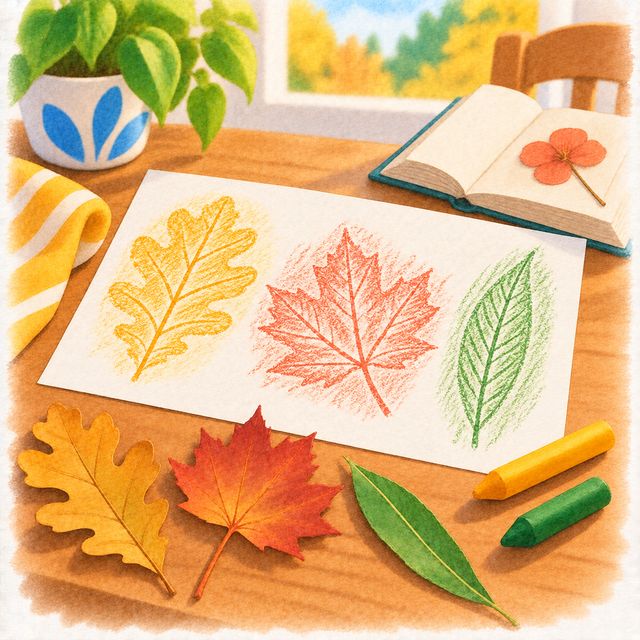
Crayon rubbings of three leaves and two pressed flowers, made by your child.
Your child collects leaves and small flowers with you, rubs the leaves under paper until their veins show, and presses the flowers in a book for a week.
- Pre-K to Grade 3–4
- 30 min
- A printout
- On the screen
Free to sign up.
Is it a good fit?
- Ready if Your child can hold a crayon on its side and rub.
- Too much today? The Pre-K level: one rubbing and one pressed flower.
- Too easy? The 3–4 level: each leaf named by its tree.
What your child practises
- Looking closely
- Comparing
- Naming what grows
“This one is from the oak tree, it has wiggly edges.”
If your child says something like this, in their own words, the idea has landed. Finishing the rounds means they took part; this is the learning.
Your part
- Go out together to collect, from where picking is allowed
- Find a heavy old book and a tree guide
- Come back to it in a week
What you need
From home
- Three soft leaves from three different trees, from outside
- Two small, flat flowers of different colours, like a daisy and a pansy, picked with permission
- Crayons with their paper peeled off
- Thin white paper
- A heavy old book, and kitchen paper or newspaper, for pressing
- A tree guide, a book or an app (a grown-up's)
The steps
Pre-K
 With a grown-up, collect three soft leaves from three different trees, and two small, flat flowers of different colours, like a daisy and a pansy. Ask before you pick.
 With a grown-up, collect three soft leaves from three different trees, and two small, flat flowers of different colours, like a daisy and a pansy. Ask before you pick.
The other 3 steps, each with its painting, are in the Family portal.
Kindergarten
- With a grown-up, collect three soft leaves from three different trees, and two small, flat flowers of different colours, like a daisy and a pansy. Ask before you pick.
The other 5 steps, each with its painting, are in the Family portal.
Grade 1–2
- With a grown-up, collect three soft leaves from three different trees, and two small, flat flowers of different colours, like a daisy and a pansy. Ask before you pick.
The other 4 steps, each with its painting, are in the Family portal.
It must pass: Pressed for a week, and you can say which flower kept its colour best.
Grade 3–4
- With a grown-up, collect three soft leaves from three different trees, and two small, flat flowers of different colours, like a daisy and a pansy. Ask before you pick.
The other 5 steps, each with its painting, are in the Family portal.
It must pass: Pressed for a week, you can say which flower kept its colour, and you named each leaf's tree.
Safety
Collect with your child, from your own garden or where picking is allowed, and leave anything you do not know, any plant that stings, and wild flowers in protected places. Wash hands after collecting.
Where the facts come from
More like this
The full design
What it is
Leaves collected outside, laid under thin paper and rubbed with the side of a peeled crayon until every vein shows, and two small flowers pressed flat in a heavy book for a week. The screen gathers the things, shows one step at a time as a painting of that step, comes back after the week, and asks at the end. The rubbings and the pressed flowers are the make.
How it goes
One step fills the screen: the painted plate of that step, the words under it, and two buttons. The steps fall into two sittings a week apart. Done this step moves on; skip it also moves on, and the finish says how many were skipped. At the end, Show asks what is true (the veins came through, one kept its colour), and What I learned asks the band's question.
The Pet
Asks at each step: "Leaf under the paper. Rub with the side of the crayon." Notices: "The veins came through." Remembers across the week: the paused card says to keep the book closed.
By band
Pre-K: collect with you, rub one leaf, press a flower, open it a week later. K: three leaves in three colours, then a matching game, each leaf to its rubbing. 1 to 2: after the week, which flower kept its colour best. 3 to 4: each leaf named by its tree, with you and a tree guide.
What it grows
Early learning frameworks name observing and comparing living things as science from age 3. A garden-learning synthesis found science gains in most studies that measured them, with weak methods in many, so the claim here is only that your child looks closely at real plants.
Done, and what counts as evidence
Done = the steps done or honestly skipped, and one line chosen at the end. The evidence is the rubbings and the pressed flowers, and from K a comparison: leaves matched by their veins, flowers compared after a week, trees named by their leaves.
What's personal
Your child's answers are stored as their answer, not as a mark. Nothing about your home or where you walked is stored. A material you do not have is named once, a substitute is offered, and the make carries on.