Math · Pre-K to Grade 1–2
Potato and leaf prints
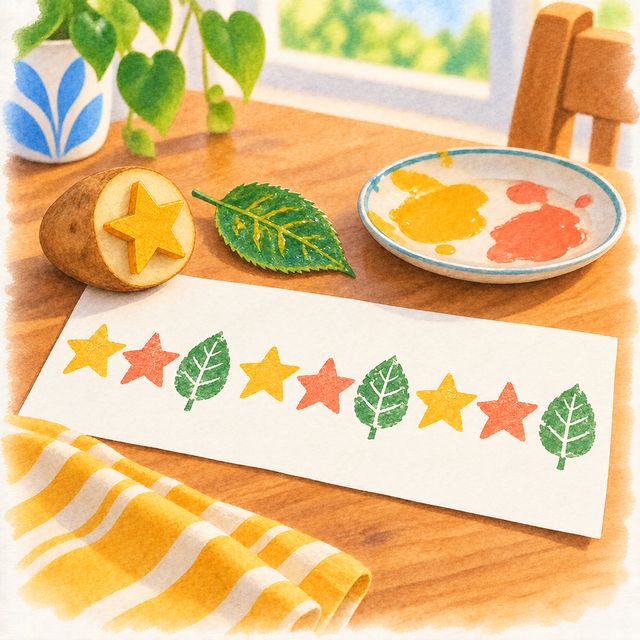
A row of potato and leaf prints that repeats, made by your child.
You cut a shape on half a potato; your child prints it and a painted leaf onto paper, and from K makes a row that repeats.
- Pre-K to Grade 1–2
- 15 min
- A printout
- On the screen
Free to sign up.
Is it a good fit?
- Ready if Your child can press something flat and lift it off.
- Too much today? The Pre-K level: a star and a leaf.
- Too easy? The 1–2 level: a pattern of three, planned and repeated.
What your child practises
- Pressing and printing
- A repeating pattern
- Noticing a leaf's veins
“Star, star, leaf. Star, star, leaf.”
If your child says something like this, in their own words, the idea has landed. Finishing the rounds means they took part; this is the learning.
Your part
- Cut the potato and its shape
- Put out two or three paints and some leaves
- Newspaper down
What you need
From home
- A potato
- A knife and a board (a grown-up's)
- A flat saucer for the paint, and a cloth
- Paper
- Two or three leaves from outside
From a local store
- Paint in two or three colours
The steps
Pre-K
 Cut the potato in half. On the cut face, cut away the edges so a simple shape stands up: a star or a square. (A grown-up does this step)
 Cut the potato in half. On the cut face, cut away the edges so a simple shape stands up: a star or a square. (A grown-up does this step)
The other 3 steps, each with its painting, are in the Family portal.
Kindergarten
- Cut the potato in half. On the cut face, cut away the edges so a simple shape stands up: a star or a square. (A grown-up does this step)
The other 4 steps, each with its painting, are in the Family portal.
It must pass: A row of prints that repeats.
Grade 1–2
- Cut the potato in half. On the cut face, cut away the edges so a simple shape stands up: a star or a square. (A grown-up does this step)
The other 5 steps, each with its painting, are in the Family portal.
It must pass: Your pattern of three, printed three times over, in rows on the paper.
Safety
The knife is yours at every grade: you cut the potato and the shape. Use washable paint, with newspaper under the paper and an old shirt on your child. Wash hands after picking leaves, and leave out any plant you do not know.
Where the facts come from
More like this
The full design
What it is
Half a potato with a simple shape cut standing up on its face, pressed into paint and onto paper, and a leaf painted on its bumpy side and pressed so its veins print. At K and up the prints make a row that repeats. The screen gathers the things, shows one step at a time as a painting of that step, and asks at the end. The printed paper is the make.
How it goes
One step fills the screen: the painted plate of that step, the words under it, and two buttons. Done this step moves on. Too hard, skip it also moves on, and the finish says how many were skipped without dressing it up. At the end, Show asks what is true (you can see the leaf's veins, my row repeats), and What I learned asks the band's question.
The Pet
Asks at each step: "Press hard. Lift straight up." Notices: "A leaf print. You can see its veins." Remembers across a pause. A smudged print is a print.
By band
Pre-K: you cut the stamp; your child paints it, prints it and prints a leaf. K: the same, then a row that repeats, star, star, leaf. 1 to 2: your child plans a pattern of three first, says it aloud, and prints it three times along the paper.
What it grows
Early learning frameworks name making repeating patterns as early maths and exploring materials as creative expression from age 3; by 4, most children can press, lift and place with some care. Printing joins the two, and the repeat is something the child sees at a glance.
Done, and what counts as evidence
Done = the steps done or honestly skipped, and one line chosen at the end. The evidence is the paper, and from K the row that repeats: a pattern your child kept going, and at 1 to 2 one they planned and can check.
What's personal
Your child's shapes, colours and answers are stored as their answer, not as a mark. Nothing about your home is stored. A material you do not have is named once, a substitute is offered, and the make carries on.