Science · Kindergarten to Grade 3–4
Two windows
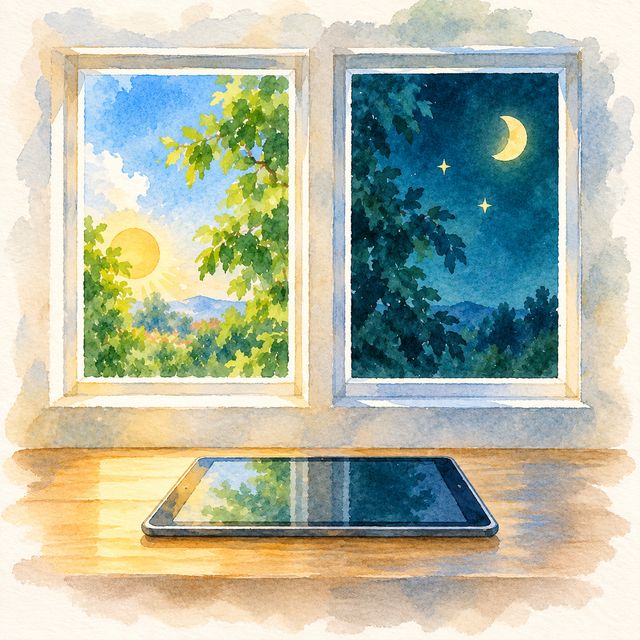
A call to someone far away becomes a look at the world.
Your child calls someone far away, and each of them looks out of their own window at the same time. They mark both skies on the screen, talk about why they differ, and pick something to do outside tomorrow.
- Kindergarten to Grade 3–4
- 15 min
- Kitchen things
- On the screen
Free to sign up.
Is it a good fit?
- Ready if Your child can tell you whether the sky is sunny or cloudy, and light or dark.
- Too much today? Start with Weather window: one window, one sky, one tap.
- Too easy? The Grade 3–4 level: guess the far sky before asking, check it, and write one line with because.
What your child practises
- Describing the sky
- Comparing two places
- Asking why
- Deciding together
“It is night there because the sun has gone round.”
If your child says something like this, in their own words, the idea has landed. Finishing the rounds means they took part; this is the learning.
Your part
- A window at each end and a phone or tablet for the call
- Each question has a Read it to me button
- The person on the call needs only their window and their words
Take it off the screen (optional)
Do the plan you both chose for tomorrow: a walk, puddles, or wrapping up warm.
More like this
The full design
What it is
Two people on a call, each looking out of their own window at the same minute, and the two views drawn side by side on your child's screen. Your child marks what they see, then asks the other person and marks what they say. Then the question that makes it science: why are the two windows different? Night at Grandma's while it is afternoon here is the world being round, seen from a kitchen. The last step is a small decision together about tomorrow.
How it goes
Who is on the call, by the names your family uses. My window: tap the sky (sunny, cloudy, rainy, windy) and light or dark. Then "ask Teta: what is the sky like there?" and tap what she says; her window appears beside yours, with a night veil and a moon if it is dark there, and the time of day under each. The why step by band. Then: what should you both do outside tomorrow, a walk, puddles or wrap up warm; each picks, and if the picks differ each says why before they choose one together, or your child hands the choice over.
The Pet
Asks "look out of your own window first", then "ask Teta", and says plainly that it cannot see her window. It goes quiet while the two of them talk. Notices what the windows show: "night there, day here, the sun is somewhere else"; "same light, different sky, weather is not everywhere the same". It never says who is right, never picks a window or a plan for your child, and never guesses who is on the call.
By band
K: the sky and light or dark for each window, then "which window is darker?" (or, when both are the same, "is the sky the same?"). 1–2: the time of day there as well (the time here comes from the phone), and an idea about why they differ: later there, night there, more clouds, far away, or not sure yet. 3–4: a guess of the far sky before asking, checked against what the person says, and one written line with because.
What it grows
Two real observations beat one: a child who compares their own window with someone else's is doing what weather science does, at the size of a family. Looking at the same thing at the same time is also what holds a young child on a call, and the decision at the end gives the call somewhere to go.
Done, and what counts as evidence
Done = both windows marked and a plan decided together. The evidence at K is the darker window found, or the skies compared; at 1–2 the idea about why; at 3–4 the guess, whether it held, and the because line. A child who says "it is night there because the sun has gone round" has the whole lesson.
What's personal
The person, by your family's word for them. The time here is the phone's; the time there is whatever the person says, and the app never looks a place up. What goes in the notebook is what the two of them saw, the idea or the line your child gave, and the plan.