Geography · Kindergarten to Grade 5–6
Time-zone call
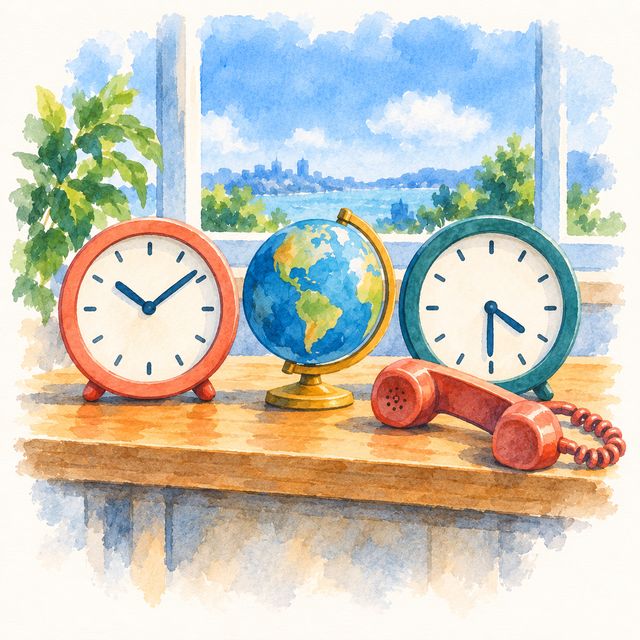
Why it is bedtime somewhere when it is breakfast here.
Your child sees the world with day on one side and night on the other, and finds the people your family has added. They work out what time it is where Grandma lives, and older children call to check.
- Kindergarten to Grade 5–6
- 15 min
- A kit
- On the screen
Free to sign up.
Is it a good fit?
- Ready if Your child knows day from night and can turn a ball in their hands.
- Too much today? The Kindergarten level: a torch on a ball, then a light place and a dark place on the screen.
- Too easy? The Grade 5–6 level: working out the time somewhere else, east and west, and a call planned at a time that is polite at both ends.
What your child practises
- Day and night
- A turning Earth
- Time differences
- Planning a call
“When we have breakfast, Uncle Sami has dinner.”
If your child says something like this, in their own words, the idea has landed. Finishing the rounds means they took part; this is the learning.
Your part
- A torch and a ball (an orange will do)
- A grown-up plays alongside; at Grade 3–4 you make a real call to a relative or friend abroad
- The call happens outside the app and nothing said on it is recorded
Take it off the screen (optional)
Shine a torch on a ball in a dark room and turn it slowly: one side lit, one side dark.
More like this
The full design
What it is
When it is breakfast here it is bedtime somewhere else, and a real person there can tell you so. A torch and a ball show why: one sun, a turning Earth, half lit and half dark at every moment. Over four rungs the idea grows from "light here, dark there" to the sum that says what time it is at Grandma's, and why.
How it goes
The screen shows the world unrolled with the sun fixed in the middle and the night at the edges, and a pin for home and for each person your family has shared. Your child taps a pin, picks a meal, or presses "turn the world on" and watches every clock move together. A wrong pin gets a pointer, not a mark ("Grandma is in the light too; find the shadow"). At 3–4 the Pet goes quiet for the call and asks afterwards what was said; either answer is a fact, because they were there. Then the model shows why.
The Pet
It notices the turn ("the sun came up on us; you turned it the right way: the Earth turns east"). It asks: if the sun is on us, who is on the other side? It remembers what the relative said last time ("Uncle Sami said dark and dinner; is it still?"). Its dare at 5–6 is to plan a polite time to call someone five hours behind us.
By band
K: shine the torch on the ball and turn it, then on the screen find a place where it is dark right now and a place where it is light. 1–2: what is Uncle Sami doing at this moment (dinner, while we have breakfast), then turn the world an hour at a time until Auntie Rana wakes up. 3–4: a real call to someone abroad, the grown-up's call, with two questions to ask (is it light there? what are you doing?); then turn the world from the middle of our night until the sun comes up on us and see their side go dark, as they said. 5–6: the 24 zones, the sum ("it is 9 here; what time is it in Beirut?"), east and west, why a place further east meets the morning first, and a call planned at a time that is polite at both ends.
What it grows
Day and night as a turning Earth is a model children can hold from five if they turn the ball themselves, and time zones make sense at ten and eleven only once the turning is felt, not told. A real voice on the phone saying "it is dark here" does what no diagram can: it makes the far side of the world a place where someone is.
Done, and what counts as evidence
Done means one turn of the world, and at 3–4 one call. The 5–6 sums are observations worth a line; the call is never one.
What's personal
The people on the map are your relatives and friends abroad, by the names your child uses for them, shared by a grown-up as memories and erasable; home is your family's town. The call itself is outside the app and nothing said on it is recorded. The hour difference for each person comes from where they live, summer time included, so the clock on the screen is the clock on their wall.