Reading · Pre-K to Grade 7–8
Memory pairs
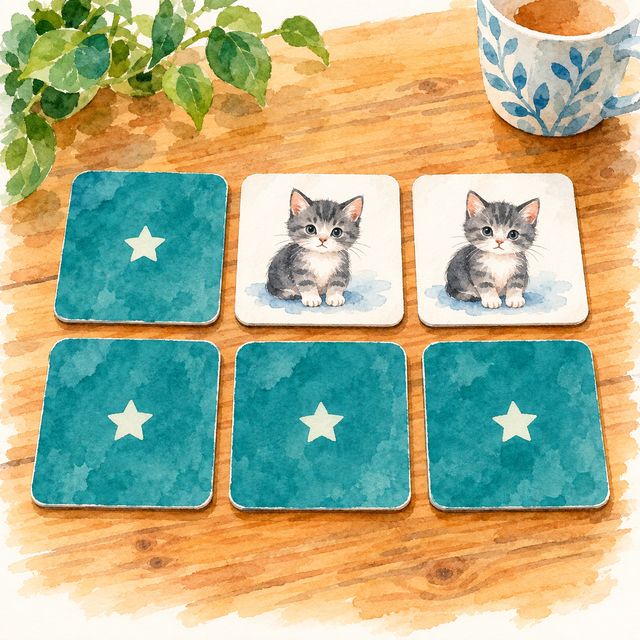
Your child finds the pairs among pictures from their own storybooks, and, from Grade 1, matches each picture to its word.
Cards lie face down. Your child turns two at a time; a pair that matches stays up and its name is read aloud. Three rounds, new cards each time.
- Pre-K to Grade 7–8
- 5 min
- Nothing to prepare
- On the screen
Free to sign up.
Is it a good fit?
- Ready if Your child can name most of the pictures in a book they have read.
- Too much today? The Pre-K level: six cards, the same picture twice, and a first look before they turn over.
- Too easy? The Grade 5–6 and 7–8 levels: each picture with its word in your family's language, read with a helper who knows it.
What your child practises
- Remembering where things are
- Naming pictures
- Reading short words
“The kitten is next to the bed!”
If your child says something like this, in their own words, the idea has landed. Finishing the rounds means they took part; this is the learning.
Your part
- Nothing to prepare
- Every word has a Read it to me button
- From Grade 5, a helper who speaks the family's language makes it a language game
Take it off the screen (optional)
Lay out real things from the story (a sock, a cup, a spoon) and their names on paper, and play the same game on the table.
More like this
The full design
What it is
Cards lie face down. Your child turns two at a time, looking for the two that match, and a pair that matches stays face up while its name is said aloud. The cards are the pictures from the storybooks your family reads: the kitten from Where Is My Other Sock?, the bee from The Tallest Sunflower. What it grows is holding a picture in mind, and, from Grade 1, tying a picture to its written word.
How it goes
Your child taps a card; it turns and its name is said. A second tap turns another. A match stays up, with the picture's name said again and a small celebration. Two that do not match stay up until your child taps once more, so there is never a clock turning them back. The round ends when every pair is found. Three rounds, each with new cards drawn from the library, and never the same card twice in a day.
The Pet
Notices a good memory: "you remembered where the kitten was!" Asks when your child turns the same two wrong cards again: it glows the half of the board where the other one is, then the row, then turns one card with your child. Remembers a book: when a pair comes from a story your child has finished, "the bee from the sunflower book!" Dares the next rung up, once.
By band
Pre-K: six cards, three pairs of the same picture, and the cards start face up for a first look until your child taps "Ready". K: eight cards, four pairs of the same picture. 1–2: eight cards, each pair a picture and its word (three to five letters), the word read aloud when it turns. 3–4: twelve cards, a picture and its word, words up to eight letters. 5–6: twelve cards, a picture and its word in a language your child has finished a story in (the most recent one), played with a helper who reads it; 7–8: sixteen cards. The device never says a word in that language: the helper does. A child who has finished a story only in the app's language plays the 3–4 rung.
What it grows
Matching games hold a picture in working memory between turns; pairing a picture with its printed word is how early readers tie a spoken word to the letters that spell it. The words here are the nouns of the books themselves, so a word met in the game is met again in the next reading.
Done, and what counts as evidence
Done = three rounds, every pair found. Nothing about how many turns it took is kept or shown; finding the pairs is the whole of it. The words your child matched are listed at the end, to read together.
What's personal
The pictures are the stories your child has met, and as your family reads more books, the cards grow with them. With a helper (5–6 up), the words are in the language your family is passing on.