Math · Grades 1–2 and 3–4
What time is it?
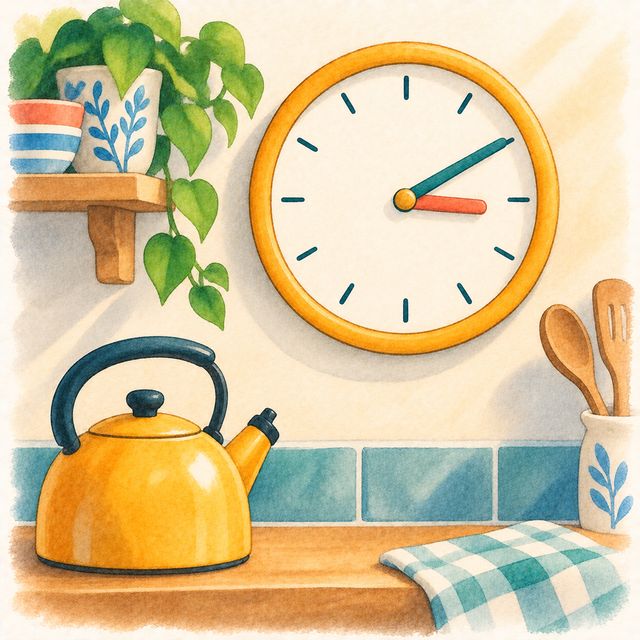
Reading a clock with hands, and the minutes until dinner.
The Pet's big clock shows a time and your child reads it, then sets times with two buttons for the hands. Older children work out how long it is until dinner at your house.
- Grades 1–2 and 3–4
- 10 min
- A printout
- On the screen
Free to sign up.
Is it a good fit?
- Ready if Your child knows the numbers 1 to 12 on a clock face.
- Too much today? The Grade 1–2 level: o'clock, half past and quarter to, read by tapping the time in words.
- Too easy? The Grade 3–4 level: clocks to five minutes, and how long until dinner, counted by fives.
What your child practises
- O'clock, half past, quarter to
- Setting a clock
- How long until
“The short hand is past the 5, so it's 5.”
If your child says something like this, in their own words, the idea has landed. Finishing the rounds means they took part; this is the learning.
Your part
- A clock with hands, or paper and a pencil to draw one
- Each question has a Read it to me button
- Plays alone with you within earshot: a wrong tap gets the hand explained and another go
Take it off the screen (optional)
Find the kitchen clock at half past something tonight, or work out how long until bed from a real clock.
More like this
The full design
What it is
Reading a clock with hands, then time as how long until. The Pet has a clock on the screen, drawn big, with a short hand that creeps between the numbers the way a real one does. Your child reads it, sets it with two buttons, and tells the Pet when dinner is at your house. Nothing is timed about your child; the game reads the clock, never a stopwatch.
How it goes
The Pet's clock shows a time and asks "what does my clock say?" Three or four times are offered on chips, in a different order each day. A wrong tap gets the hand that was wrong explained ("long hand up is o'clock, down is half past"; "short hand is past the 5, so it is 5") and another go. When your child sets a time, the Short hand button moves an hour and the Long hand button a quarter hour (five minutes at 3–4), forward only, as on a real clock; going past the time means going round again, and the Pet says so. Six clocks at 1–2, five at 3–4, then a card that says what was done.
The Pet
Asks "when is dinner at your house? Set my clock", and keeps that time for the rest of the play. Notices "short hand first, the hour hand rules" when the hour is set before the minutes. Answers a tap on the clock with a small fact about the hands. Dares (1–2): "bet you can find the kitchen clock at half past something tonight"; (3–4): "how long until bed, from a real clock, right now".
By band
1–2: find a real clock and set it to match the Pet's; set dinner time; read three clocks (o'clock, half past, quarter to) by tapping the time in words; set one. 3–4: set dinner time to the minute; read two clocks to five minutes; set one; then "it is 5:10, dinner is at 5:45, how long until dinner?", counted by fives.
What it grows
Telling time is the one early-years standard families say is hardest to make concrete, because a clock is an abstraction of a day. The concrete here is the real kitchen clock and the house's own dinner time, and the moving short hand shows why half past 3 has the hour hand between the 3 and the 4.
Done, and what counts as evidence
Done = the clocks of the rung, read and set. At 3–4 the minutes-until-dinner count is the observation worth a line: "counted 35 minutes by fives". The dinner time is not a record.
What's personal
Dinner time is your child's answer, on the Pet's clock. It stays in this play only (if the game is left and picked up again it is still there) and is never stored or remembered another day. The real clock at 1–2 is your own; nothing on the screen checks it.