Math · Kindergarten to Grade 1–2
Number hunt
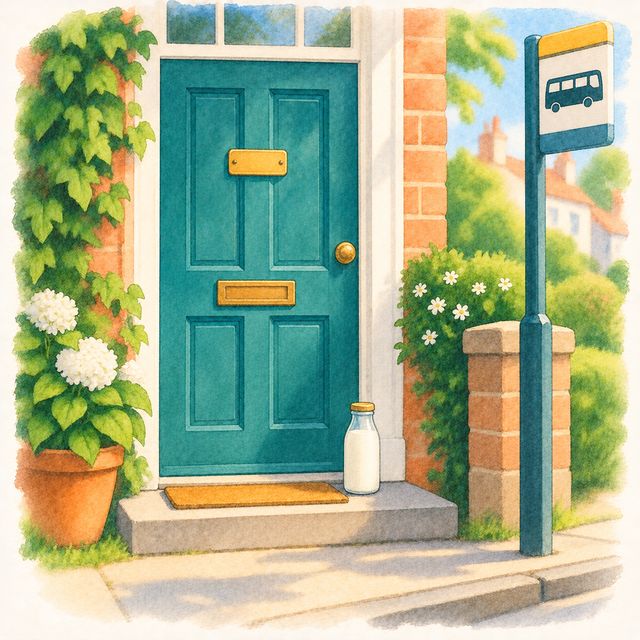
Real numbers from your street, put in order.
Your child goes out and finds five real numbers: a front door, a bus, a price tag. Back home they type them in and put them in order on a number line, and older children sort odd and even doors.
- Kindergarten to Grade 1–2
- 20 min
- Nothing to prepare
- On the screen
Free to sign up.
Is it a good fit?
- Ready if Your child can read and say numbers up to twenty.
- Too much today? The Kindergarten level: five numbers under twenty, put on the Pet's line smallest first.
- Too easy? The Grade 1–2 level: doors sorted onto the two sides of the Pet's street, the odd and even rule, and the number next door to 14.
What your child practises
- Reading numbers
- Putting them in order
- Odd and even
“Odd on this side, even across the road.”
If your child says something like this, in their own words, the idea has landed. Finishing the rounds means they took part; this is the learning.
Your part
- Nothing to prepare: the numbers are already out there
- Each question has a Read it to me button
- A grown-up on the walk: the screen stays in a pocket until you are home
Take it off the screen (optional)
Look for a number bigger than a hundred on your next walk, and tell a grown-up.
More like this
The full design
What it is
Numbers are everywhere once a child starts looking: on the front door, the bus, the price tag, the kitchen clock. Your child goes out and finds five, says each one out loud, and comes back to put them in order. That is reading numbers, comparing them and lining them up, learned on a real street instead of a worksheet, and later the same street becomes a number line with odd doors on one side and even on the other.
How it goes
The Pet says "I'm collecting numbers today, find me five", and out you go; the screen stays in a pocket and nothing on it moves until your child taps "I did it" back home. Then the Pet shows the five numbers from its own walk, as tiles with what each was on, and your child adds their real ones with a number pad: "17, on a bus". At K the tiles go onto the line smallest first; a bigger one tapped too early gets "is 17 before or after 12?", and when the line is full the Pet hops along it. At six to eight each door is tapped and then its side of the Pet's street; a wrong side is answered from the doors already there ("that side has 12, would 7 fit?"), and the street ends sorted, with the Pet naming the rule.
The Pet
Asks: "is 8 before or after 3? Where does it sit?" Notices: "3 on a gate, 17 on a bus. Numbers everywhere." Says its own: the five numbers are the Pet's finds from its own walk, and the street with door 9 is the Pet's street; your child's real street is never guessed at. Dares: "bet you can find a number bigger than a hundred." A dare your child takes is a promise to tell a grown-up, not something the app keeps.
By band
At K: find five numbers under twenty, then put them on the Pet's line, smallest first, and watch the Pet hop along it. At six to eight: house numbers. The Pet has a street of its own, its door is 9, and your child sorts five doors onto the two sides of the road and finds the rule for themselves, odd here and even across, then works out what number would be next door to 14. From eight the plan is prices with a dot, the street as a number line ("we are at 42, how many doors to 60?") and a nearest-hundred guess for a big number seen; that step is designed and waits on a way to type a price.
What it grows
Children learn numerals fastest from the ones that matter to them, and a house number or a bus route matters in a way a flashcard does not. Ordering comes before place value; odd and even on a street is a pattern a seven-year-old can see and say, which is how a rule is meant to arrive.
Done, and what counts as evidence
Done = one hunt put in order. Worth keeping: the numbers your child found and what they were on, and from six the rule they said out loud about the street. A count of hints is not kept.
What's personal
The numbers your child brings back are theirs, on the line next to the Pet's, and they can be the same number twice (a 3 on a bus beside the Pet's 3 on a gate). The app keeps the number and what it was on, never where it was: no address, no street, no map. The Pet's five at K change from day to day; a hunt left half-done carries on where it stopped.